

Thousands of Tunisians have marched through the capital to protest against President Kais Saied, worsening living conditions and restrictions on political freedoms.
The latest demonstration in Tunis on Saturday was led by the Tunisian General Labour Union (UGTT), an influential trade union federation, alongside opposition parties and civil society organisations.
- list 1 of 2Tunisia: What has Kais Saied achieved economically in seven years?
- list 2 of 2Tunisia softens its ‘false news’ penalty. What really changed, and why now?
end of list
It was the largest protest against Saied in years, bringing together political opponents whose longstanding divisions have weakened their ability to challenge his rule.
The AFP news agency reported that more than 3,000 people were on the march, but the total could not be independently confirmed.
Protesters gathered along Habib Bourguiba Avenue, a major street in central Tunis, as hundreds of police deployed across the capital. Several surrounding roads were closed.
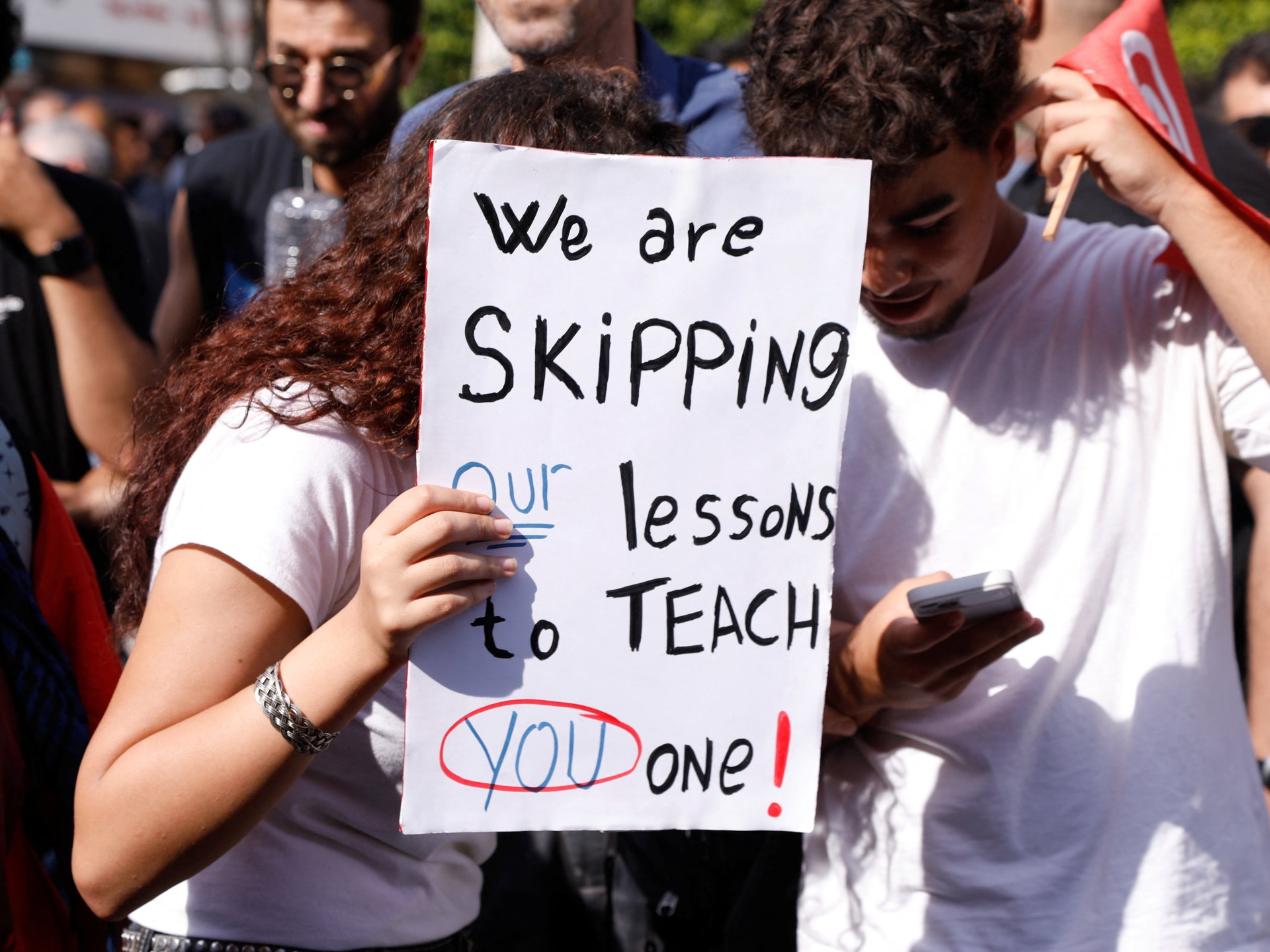
The crowd included lawyers, doctors, journalists and the unemployed, as well as activists and members of parties from across the political spectrum. They demanded the release of detained government critics and an end to restrictions on trade union rights.
Placards reading “No democracy without freedoms” and “No dignity with poverty” reflected the political and economic grievances driving the demonstration.

Protesters also revived a slogan demanding the government’s removal, widely heard during Tunisia’s 2011 uprising.
Advertisement
Addressing the rally on Saturday, UGTT leader Salah Eddine Salmi criticised the concentration of political power in the presidency and said “silence will no longer be acceptable”.
The political demands came alongside mounting frustration over the cost of basic goods and declining purchasing power.
Tunisia has struggled with prolonged economic difficulties, deteriorating public services, recurring water and electricity cuts, as well as shortages of medicines and other essentials.
Demonstrator Yassine Gharseli, who travelled from Sfax, about 250km south of Tunis, said repeated disruptions to basic services had deepened his frustration with the authorities.
“I came from Sfax to stand up for my freedom,” he told the Reuters news agency at the demo, expressing his determination to continue speaking out.
Saturday’s march followed other demonstrations over similar grievances.
On August 20 , protesters in Tunis rallied against rising prices and shortages of basic goods.
Last month, fuel transport workers went on a two-day strike over wages and working conditions, led by a union federation affiliated with the UGTT.

The demands recall the uprising that ousted longtime President Zine El Abidine Ben Ali in 2011, which helped ignite protests across the Arab world.
Tunisia subsequently held competitive elections and expanded political freedoms, but unemployment and struggling public services remain persistent sources of anger.
Saied came to power promising an alternative to that political system; however, in 2021, he suspended parliament and dismissed the government, saying he was confronting corruption and political deadlock.
He later dissolved parliament and a new constitution increased presidential powers in 2022.
Related News
Modi’s India takes on Trump more openly, from ‘terrorism’ to tariffs
SpaceX’s showpiece Starship rocket reaches orbit for first time
Israel kills or wounds Palestinian every 90 minutes in Gaza since ceasefire