

Iranian authorities have repeatedly publicised arrests and clashes with small armed cells inside the country, or skirmishes with armed groups along land borders, particularly in the lead-up to and during the war with Israel and the United States.
They have endeavoured to frame the war as a national security struggle while sending a message of control and deterrence to audiences inside the country and abroad.
- list 1 of 3Claimed Israeli capture of Lebanese ridge reshapes negotiation dynamics
- list 2 of 3Israel deports British activist who protected Palestinian children
- list 3 of 3Why do the Falkland Islands matter to the UK and Argentina so much?
end of list
In one of the latest instances, state media said on Sunday that members of an eight-member network allegedly affiliated with “anti-revolutionary” and “pro-monarchy” groups were arrested.
The Islamic Revolutionary Guard Corps (IRGC) in the southern province of Fars accused those arrested of using Molotov cocktails and burning tyres during nationwide protests in January.
The leaders of Iran’s Islamic Republic have in recent weeks also expressed concern about more potential protests as public discontent rises amid deteriorating economic conditions.
Why the focus on ‘monarchists’?
During Iran’s January protests and on social media, a number of Iranians have expressed support for the return of the country’s monarchy, which was overthrown in the 1979 Islamic revolution.
Reza Pahlavi, the foreign-based son of Iran’s last shah, Mohammad Reza Pahlavi, has been a leading opponent of the country’s government, and in January called on Iranians to join nationwide strikes and protests. Thousands are believed to have been killed during the unrest.
But even though there are instances of chanting in support of Pahlavi in Iran, there are currently no major organised pro-monarchy armed groups operating inside the country.
Advertisement
And while multiple nationwide demonstrations have swept Iran in recent years, they have largely been rooted in protesting economic grievances and repression in the country, rather than support for the monarchy.
US President Donald Trump, as well as Israeli Prime Minister Benjamin Netanyahu, did openly discuss the goal of overthrowing the Iranian state during the opening months of the war, which began in late February. Calls for the monarchy to replace the Islamic Republic have been particularly prominent in demonstrations outside of Iran.
The Iranian government has since then announced a large number of arrests of people it says are supporters of the monarchy.
That has included 111 so-called “monarchist cells” arrested across 26 provinces, as announced on March 18 by the Intelligence Ministry.
Iranian authorities consider the January protests a “coup” orchestrated by armed agents of the US and Israel, including pro-monarchists.
The United Nations and international rights groups have condemned state forces for the “brutality” shown during the crackdown on protesters.
The judiciary has executed dozens of prisoners since the start of the war, including some of those who protested in January. Numerous students, artists, businesspeople, journalists, healthcare workers and others have also been arrested over recent months for acts perceived by the authorities to be against national security.
What are the main armed groups in Iran?
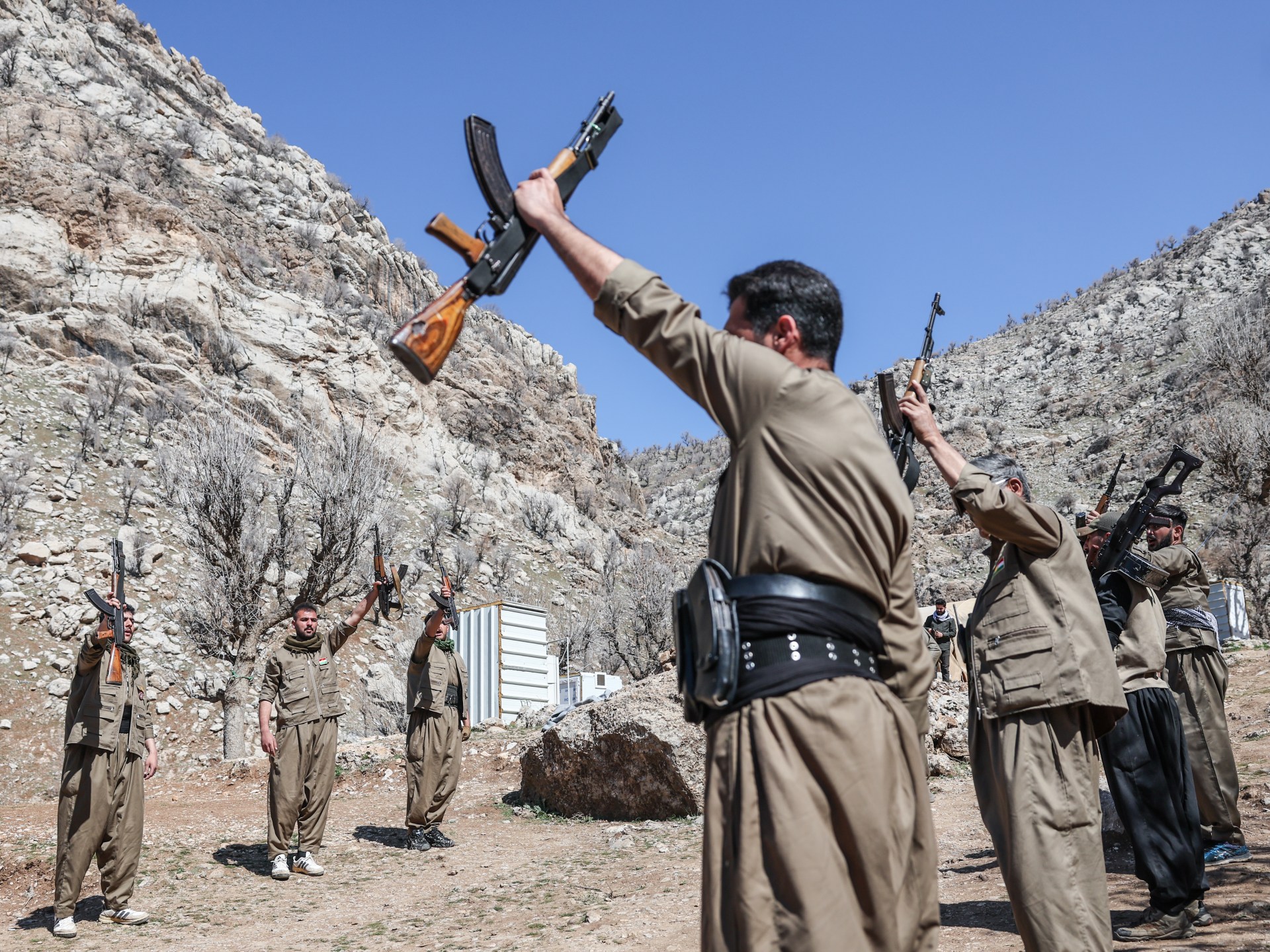
Kurdish fighters active close to Iran’s western borders with Iraq are the country’s largest non-state armed threat.
Multiple groups, designated as “terrorist” outfits by Iranian authorities, have been based in the semiautonomous Kurdish region of northern Iraq for years.
Iran’s military forces have attacked bases operated by these groups in Iraq in recent years, while also pursuing security deals with the Iraqi government to contain them.
At the start of this year’s war, the Kurdish armed groups were considered by the Trump administration to lead a limited ground operation in western Iran to complement extensive air strikes by US and Israeli fighter jets and warships.
The Reuters news agency reported in early March that roughly 5,000-8,000 Iranian Kurdish fighters from groups including the Kurdistan Free Life Party (PJAK), Democratic Party of Iranian Kurdistan (PDKI), and Kurdistan Freedom Party (PAK) were preparing for a potential cross-border operation and had held discussions with US and Israeli representatives.
But the groups said they lacked sufficient weaponry and did not receive a clear signal from Washington to initiate the operation. The plan was not set into motion, and by April the IRGC had sent more troops to the border provinces.
Advertisement
Trump later repeatedly claimed that he had supplied arms to Kurdish forces, but that they had kept the weapons for themselves.
Aside from the Kurdish forces, Iran’s disenfranchised and restive southeastern border areas are also home to separatist Baloch fighters.
In late August, security forces said they had broken up a cell belonging to Jaish al-Adl, the most prominent of the Baloch armed groups. One rebel fighter was reported to have been killed, six arrested, and rifles, grenade launchers and explosives seized. But sporadic attacks from the group have been ongoing, at times killing police officers and IRGC figures.
Iranian authorities have said they will continue to bolster border control in order to limit exposure to armed groups amid the war.
Alex Vatanka, a senior fellow at the Washington-based Middle East Institute, said that external support for the Kurdish and Baloch rebel groups could increase the security challenge facing the authorities.
“The Iranian state might see any signs of increased external support for ethnic militants to be of an existential kind this time around due to the war situation,” he told Al Jazeera.
“I only see ethnic militant groups as possibly decisive [in the war] if they are part of a broader externally-funded push to pressure the regime in Tehran, which the Islamic Republic is already anticipating and calls a foreign-led hybrid-war campaign,” Vatanka added.
For his part, Trita Parsi, the Quincy Institute’s co-founder, said that while separatist militias don’t pose an existential threat to the government, they “may prove tremendously problematic for Tehran if the war with the US escalates after the mid-terms and the US decides, for instance, to deploy ground troops”
“If Trump decides to accept military risks after the midterms that he earlier eschewed, such as deploying ground troops, then it is highly conceivable that the US will seek to use armed militias inside the country,” Parsi added.
Washington encourages internal pressure
During the January protests, Trump and other US officials backed Iranian protesters and said they should continue to act with the goal of overthrowing the Islamic Republic.
Similar rhetoric from Washington has been heard since the start of the war.
Last week, Trump discussed the possibility that the pressure from war, sanctions and a naval blockade of Iran’s southern ports could ultimately lead to an internal uprising, or even the fall of the establishment.
US Treasury Secretary Scott Bessent said the pressure could prompt Iranians to take to the streets again, or even create divisions within the IRGC.
“Maybe the people will rise up,” he said. “There is 100 percent inflation, queues, the military isn’t getting paid, [and] the central bank governor was in a panic last week.”
Related News
Trump says a unified Ireland would be ‘fantastic’ during Irish visit
Finland shelters under French nuclear umbrella amid Russian, US uncertainty
Trump-GCC Summit in New York: What does each side want?