
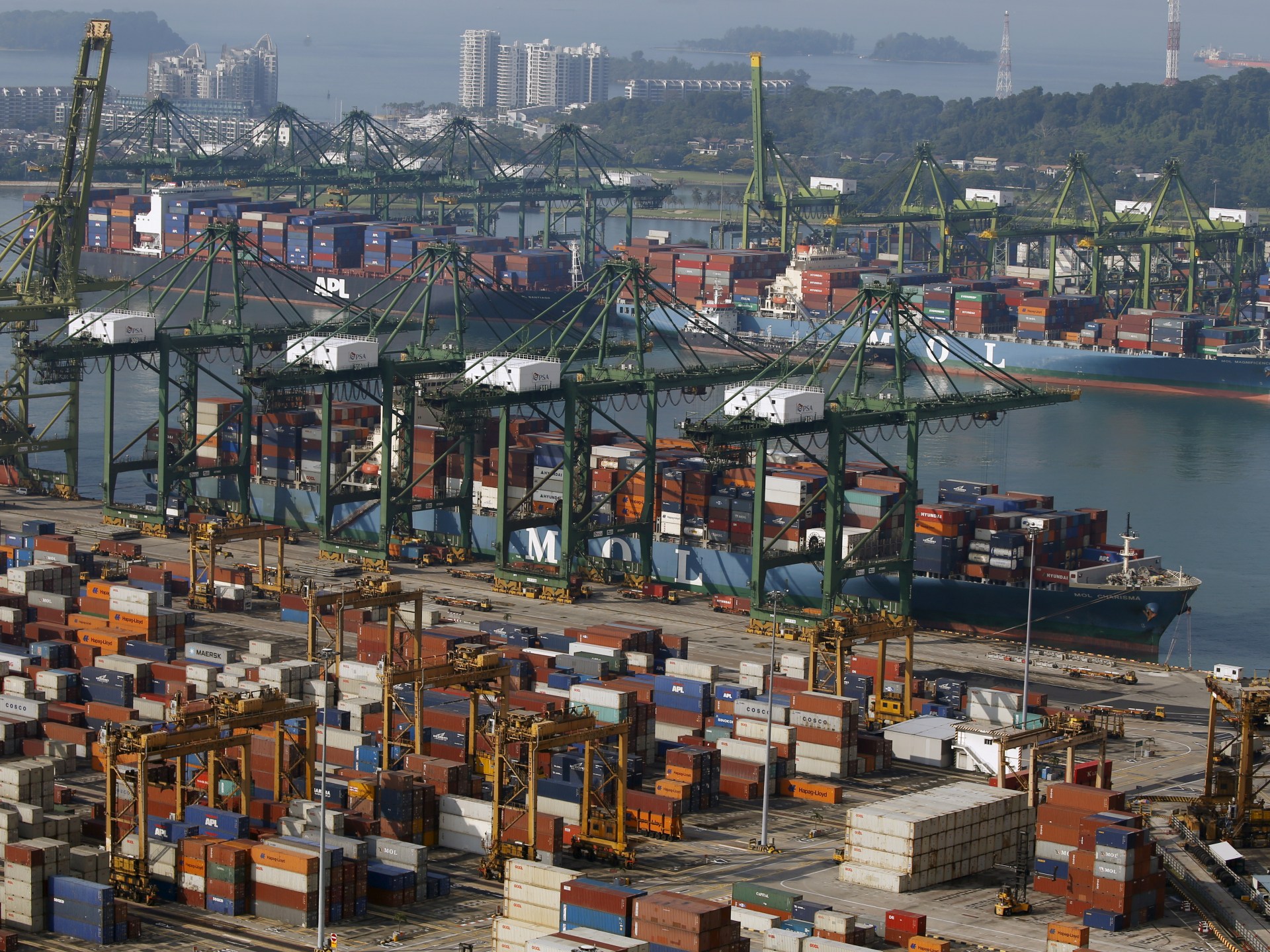

Singapore has reported a growing number of “rogue” or “shadow fleet” tankers operating off its shores in and around one of the world’s busiest maritime corridors.
According to Lloyd’s List Intelligence data cited by international maritime authorities, at least 27 such ships transited the Singapore Strait in early December, with another 130 clustered nearby around Indonesia’s Riau Archipelago.
- list 1 of 4Russia damages Turkish-owned vessels in attacks on two Ukrainian ports
- list 2 of 4How India plans to continue buying Russian oil despite sanctions
- list 3 of 4Ukraine hits two oil tankers in Black Sea targeting Russian ‘shadow fleet’
- list 4 of 4Russia-Ukraine war: List of key events, day 1,387
end of list
While traffic through the strait remains dense and appears outwardly routine – more than 80,000 vessels pass through it each year – ship-spotters and analysts say the profile of some of the ships using these waters has recently changed.
Why are so many ‘rogue’ tankers appearing near Singapore?
Conflict in Ukraine and the Middle East has sparked a surge in Western sanctions on oil exports from countries such as Russia and Iran. The European Commission and the United States Trump administration have both recently renewed or extended sanctions against Venezuelan oil, as well.
As a result, a parallel, unofficial maritime network has emerged to keep sanctioned oil moving.
The Singapore Strait is a vital artery for global maritime trade, carrying about one-third of the world’s traded goods at some point along their journeys. For tankers at sea, it is almost unavoidable – the strait is a natural gateway between the Indian Ocean and the South China Sea, also a busy trade artery.
The Maritime and Port Authority monitors vessel movements within Singaporean waters. But international law limits what action it can take once ships move into the high seas – in effect, international waters – allowing shadow fleets to thrive in regulatory grey zones.
Advertisement
In recent weeks, suspect shipping activity has been noted just beyond Singapore’s territorial waters – roughly 22.2 kilometres from its coast – in international waters, just outside of the city state’s law enforcement reach.
What are ‘shadow fleets’ and how do they avoid sanctions?
As a result of record sanctions by Western governments in recent years over Russia’s war in Ukraine, Iran’s nuclear programme and, most recently, United States President Donald Trump’s campaign against Venezuela, the number of falsely flagged ships globally has more than doubled this year to more than 450, most of them tankers, according to the International Maritime Organization database.
All vessels at sea are required to fly a flag showing the legal jurisdiction governing their operations in international waters. The body which grants ship nationalities is the UN Convention on the Law of the Sea (UNCLOS).
A shadow ship, or “ghost” ship, is typically an ageing vessel with obscure ownership. These vessels frequently change flags – for instance, when the US seized the tanker, Skipper, off the coast of Venezuela earlier this month, the government of Guyana, Venezuela’s neighbour, said it was “falsely flying the Guyana flag”, and clarified that it was not registered in the country.
Operators of shadow ships also falsify registration details, broadcast false geo-location codes, or even switch off tracking systems altogether to evade detection and skirt UNCLOS laws.
These vessels typically carry sanctioned oil and other restricted goods such as military equipment. They often conduct risky ship-to-ship transfers of cargo under the cover of night to avoid detection. This can create serious safety and environmental risks.
Additionally, most of the tankers are owned by shell companies in jurisdictions such as Dubai, where rapid buying and selling by anonymous or newly formed firms can take place, making it even harder to trace their origins.
Jennifer Parker, a specialist in maritime law at Australia’s University of New South Wales, said the increasing number of shadow fleets presents a “real challenge”.
Parker told Al Jazeera that “finding out who owns them and who insures them has been incredibly difficult because of the [murky] paper trail around them”.
She added that “often they would do what is called bunkering, which is the process of transferring fuel at sea between ships. So that makes it hard to track where that ship has actually come from and where that oil has come from.”
Advertisement
She added: “Sometimes, what they do is actually mix oil, so you will have a legitimate ship that will do a ship-to-ship transfer at sea with a shadow fleet and they will mix the oil so it becomes hard to really trace where that oil has come from … to avoid sanctions.”
What sort of problems do these tankers cause?
When ageing, uninsured vessels are involved in accidents, it can lead to environmental disasters like oil spills.
According to Bunkerspot, a specialist maritime publication, a shadow tanker spill, which can cause enormous damage to water, wildlife and local coastlines, can cost up to $1.6bn in response and cleanup alone.
Last December, Russian authorities scrambled to contain an oil spill in the Kerch Strait caused by two 50-year-old tankers which had been damaged during a heavy weekend storm. The scale of the environmental damage and the associated cleanup costs remain unclear.
In addition to vessel collisions, they can cause environmental damage through chemical leaks and illegal waste dumping.

Who uses shadow fleets the most?
Russia is the primary beneficiary of ghost fleet trading. Moscow has largely maintained its oil exports despite Western sanctions, ensuring steady revenue for its war in Ukraine. Though not to the same extent, Iran and Venezuela also sell fossil fuels using ghost fleets.
China and India, currently the largest buyers of Russian crude, benefit from steep discounts, often purchasing oil well below the Western-imposed $60 per barrel price cap, which was imposed in December 2022 following Russia’s invasion of Ukraine.
Tracking by S&P Global and Ukrainian intelligence shows that Russia relied heavily on its shadow tanker fleet in 2025. India has been the main destination, importing about 5.4 million tonnes (or 55 percent of Russian crude oil sales via shadow tankers) between January and September.
China has taken a smaller but still significant share of about 15 percent. Overall, most Russian seaborne crude now moves outside Group of Seven (G7)-compliant shipping, underscoring the shadow fleet’s central role in this trade.
What actions have governments taken against shadow fleets?
To avoid enforcement of sanctions, many shadow tankers have moved out of major shipping lanes. In part, this is down to European authorities now requiring physical inspections during ship-to-ship transfers, making it riskier for these vessels to operate on conventional routes.
For instance, Denmark, Sweden, Poland, Finland and Estonia recently began carrying out insurance checks on tankers transiting the Gulf of Finland and the waters between Sweden and Denmark. This is aimed at ensuring compliance with 2022 sanctions on Russian oil.
Meanwhile, in July 2025, the United Kingdom imposed measures – such as restrictions on access to UK ports, insurance and financial services – on 135 shadow fleet vessels and two linked firms, aiming to reduce Russia’s shipping capacity and cut its energy earnings.
Advertisement
In the US, President Donald Trump has warned that comparable measures will follow if Russia refuses to agree to a ceasefire in Ukraine, raising the prospect of closer transatlantic coordination with the UK and Europe against shadow fleets.
Related News
Does latest US military spending bill place any constraints on Trump?
Condemnation as Israel raids UNRWA HQ in East Jerusalem, removes UN flag
Israel launches new wave of air attacks on Lebanon, straining fragile truce