
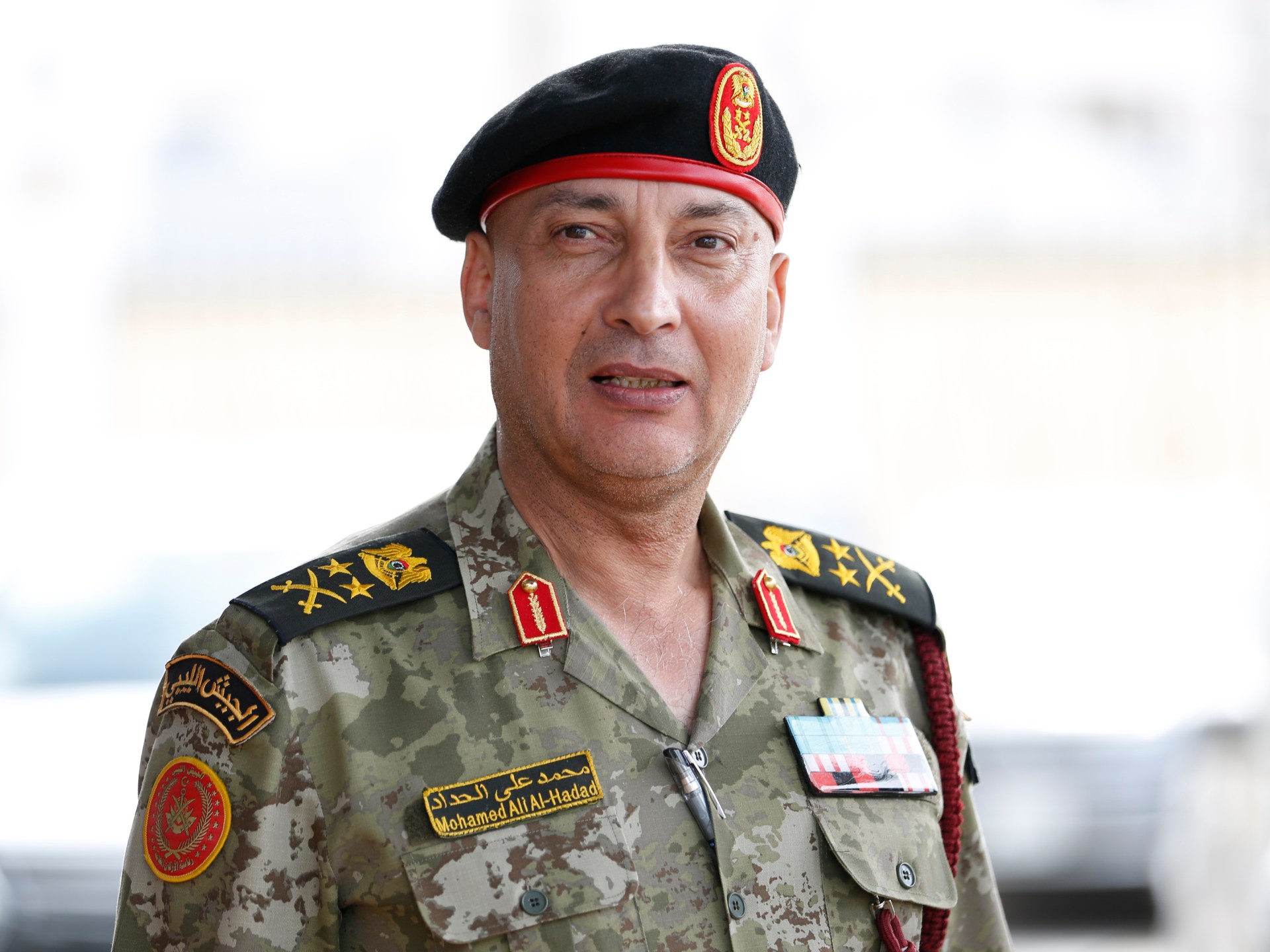

Libya’s top military commander, Lieutenant General Mohammed Ali Ahmed al-Haddad, has been killed in a plane crash in Turkiye while returning from an official visit to Ankara.
Turkish officials said the private aircraft, which was heading back to Tripoli on Tuesday, requested an emergency landing due to an electrical failure just minutes after takeoff, but then lost contact.
- list 1 of 3Libya: A Voice for Reconciliation
- list 2 of 3Donga’s Diary: Libya’s Decade of War
- list 3 of 3Presidents the Arab Spring toppled, where are they now?
end of list
The crash, which also killed four senior Libyan military officials and three crew members, has sent shockwaves across Libya, where General al-Haddad was seen as a unifying figure amid deep political divisions. Calling it a “tragic incident”, Libyan Prime Minister Abdul Hamid Dbeibah, based in Tripoli, announced three days of national mourning.
Here is what we know so far:
Who was Mohammed Ali Ahmed al-Haddad?
General al-Haddad was Libya’s chief of the General Staff, the highest-ranking military officer in the country’s armed forces.
General al-Haddad worked within the United Nations-recognised Government of National Unity (GNU) in Tripoli to bring together competing armed factions.
Al Jazeera’s Malik Traina said people in Libya were mourning al-Haddad, whom he said was a key figure in efforts to unify the country’s fractured military. “He really was someone who tried to build up the military institutions, especially in western Libya, a place that is divided with powerful armed groups and militias controlling vast areas of land,” Traina, reporting from Tripoli, said.
“You have powerful armed groups, militias controlling different parts of land. They hold a huge influence on the government. He refused to let these militias hold sway on the government,” Traina added, and was seen as “someone that people could rally behind and support to try to bring some kind of unity to Libya.”
Advertisement
General al-Haddad had served in that post since 2020 and was seen as a key figure in efforts to unify Libya’s divided military structures, a crucial element of broader attempts to stabilise the country, which descended into chaos following the toppling of its long-term leader Muammar Gaddafi in 2011.
Al Jazeera’s Traina said General al-Haddad was one of the first military officials who joined the rebel forces in the revolution that toppled Gaddafi.
Libya is currently divided between the internationally recognised government based in Tripoli and the rival administration in the east led by military commander Khalifa Haftar.
“He was a very charismatic and strong leader. General Mohammed was someone who was respected by all sides,” Al Jazeera’s Traina said. “He was someone who believed in the rule of law, always talked about values of democracy, and wanted to transition Libya into civilian rule.”
Al-Haddad’s death is being mourned in the eastern part of Libya governed by a rival administration, including Haftar, who expressed sorrow and offered his condolences.
During his Turkiye trip, al-Haddad held talks in Ankara with Turkish Defence Minister Yasar Guler, and his Turkish military counterpart, Selcuk Bayraktaroglu. Ankara has cultivated close military and economic ties with the Tripoli-based administration, but recently, Ankara has moved to strengthen relations with the eastern administration led by Haftar.

Burhanettin Duran, Turkiye’s head of communications, said the Dassault Falcon 50 jet departed Ankara Esenboga Airport at 17:17 GMT on Tuesday, bound for Tripoli.
At 17:33 GMT, it notified air traffic control of an electrical malfunction and declared an emergency, according to his statement. The jet was 37 years old, according to flight tracking site Flightradar24.
Controllers directed the aircraft back towards Esenboga and initiated emergency protocols, but it vanished from radar at 17:36 GMT while descending to land, and communication was lost, Duran said.
Interior Minister Ali Yerlikaya had earlier reported that the plane requested an emergency landing while flying over Ankara’s Haymana district.
He added that the wreckage was later located near Kesikkavak village in the area. Search and rescue teams reached the crash site after operations were launched by the Interior Ministry.
Advertisement
Investigations into the cause are continuing with the participation of all relevant agencies, Duran said. Turkiye has appointed four prosecutors to lead the probe, and Yerlikaya noted that 408 personnel were deployed for the search and recovery effort.
A group of military officials from Libya is carrying out inspections at the crash site, according to Turkish state news agency Anadolu.

Were other people killed in the crash?
Yes. All people on board died in the crash. In addition to al-Haddad, seven others died in the crash, including four senior Libyan military officials and three crew members.
Among the Libyan officials killed were:
- General al-Fitouri Ghraibil, head of Libya’s ground forces.
- Brigadier General Mahmoud al-Qatawi, director of the Military Manufacturing Authority.
- Muhammad al-Asawi Diab, senior military adviser.
- Muhammad Omar Ahmed Mahjoub, a military photographer.
Libyan Prime Minister Dbeibah described the incident as a “tragic loss”.
“This great tragedy is a great loss for the nation, the military establishment, and all the people,” he said. “We have lost men who served their country with sincerity and dedication and were an example of discipline, responsibility, and national commitment.”
In a statement from the eastern Libyan armed forces, commander Haftar expressed “deep sorrow over this tragic loss” and offered condolences to General al-Haddad’s family, tribe, and city, as well as “to all the Libyan people”.
What’s next?
In a statement, Libya’s Government of National Unity announced a three-day mourning period, during which flags will be flown at half-staff across all state institutions, and all official ceremonies and celebrations will be suspended.
Austria’s former defence attache to Libya, Wolfgang Pusztai, said the death of al-Haddad was “very significant” and a major blow for Dbeibah.
“Al-Haddad hails from Misrata, an important merchant city about three hours east of Tripoli, just like Dbeibah, and the key role of al-Haddad was to ensure the loyalty of the mighty militias of the city of Misrata to the government,” Pusztai told Al Jazeera.
“Misrata is the most important military power in western Libya, and this might really trigger some problems for Dbeibah, if this loyalty is broken in the future.”
Libya’s Presidential Council has appointed General Salah Eddine al-Namrush as the acting chief of staff for the Libyan army until General al-Haddad’s replacement is announced.
“It’s extremely big shoes to fill. It is really going be very difficult for authorities to find somebody as charismatic and strong who can unify the country like Mohammed al-Haddad,” Al Jazeera’s Traina said.
Related News
Nigeria says 130 kidnapped Catholic schoolchildren freed
Palestine Action hunger strikers could die in prison: Families, lawyers

Person of interest held in hunt for gunman who killed 2 at Brown University