
‘Energiser’ or ‘circus’: US voters weigh in on Trump’s midterm convention
 08 September 2026
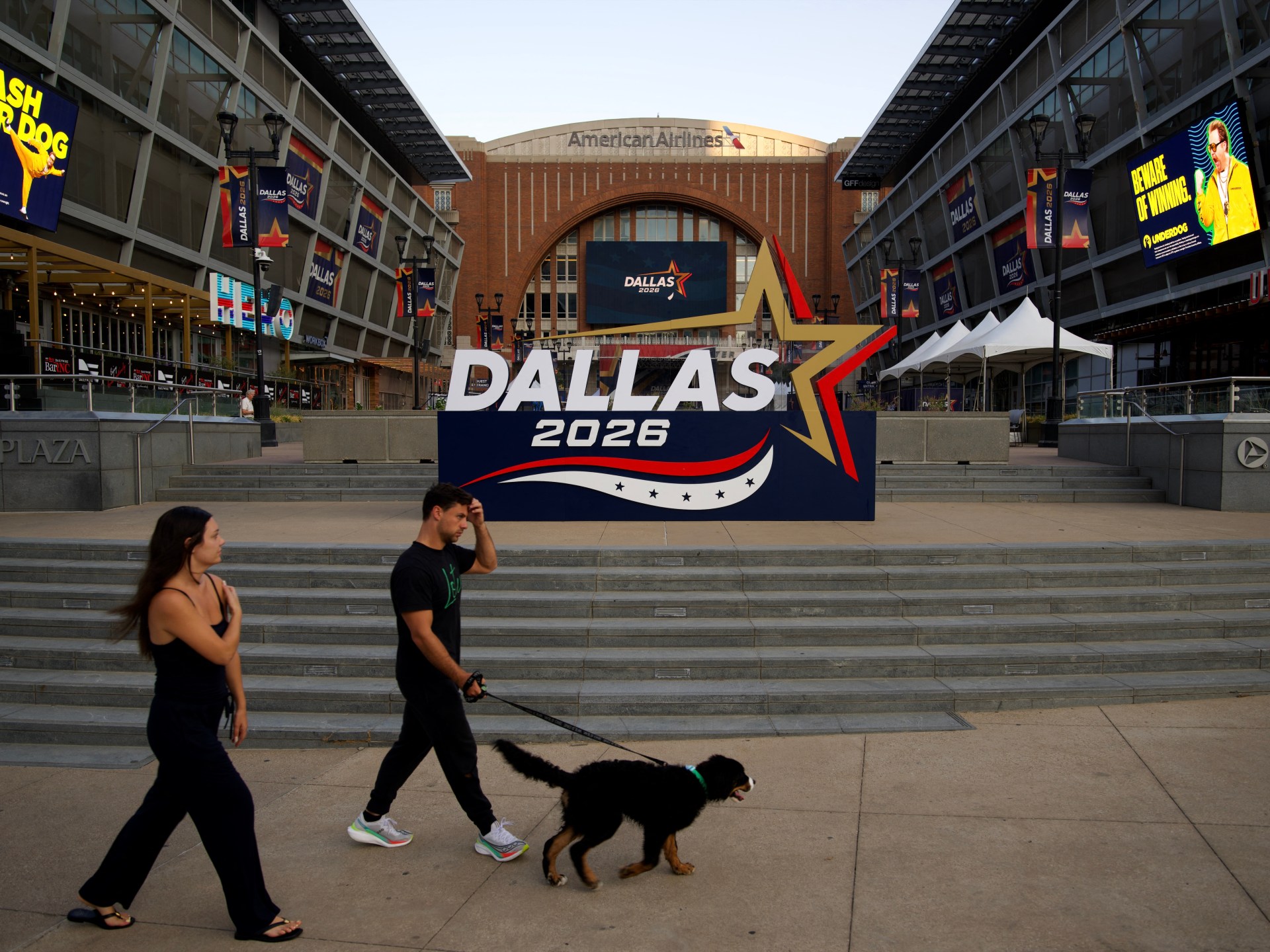

Dallas, Texas – At a farmers market, 58-year-old Cody Johnson said he still believed in United States President Donald Trump’s ability to energise voters.
That belief serves as a cornerstone of the Republican National Committee’s midterm convention, a first-of-its-kind event intended to mobilise voters ahead of the legislative elections in November, albeit in a particularly Trump-dominated fashion.
- list 1 of 3Ken Paxton wins Texas primary election: Results and key takeaways
- list 2 of 3Trump-backed group announces $10m ad spend for midterm Senate race in Texas
- list 3 of 3Democrats gain momentum in pivotal US Senate and governor’s races in Texas
end of list
Although the president, whose approval rating has dipped in recent months, will not be on the ballot, he has loomed large over the race.
“People will come from miles around [to see Trump],” said Johnson, a Republican voter and rock quarry owner.
He argued that the convention, hastily announced by Trump in June, could provide the bump needed to ward off a liberal surge in Texas, led by Democratic Senate candidate James Talarico, and maintain the decades-long conservative hold on statewide office.
“Texas is leaning purple,” he said. “This will definitely help… Trump can energise a voter”.

Walking her dog in a park in downtown Dallas, Shania Spears, who described herself as a policy-over-party voter, took a different view.
The 29-year-old marketing specialist for a tech company wondered how the convention would effectively address state voters’ growing discontent with Republican Governor Greg Abbott’s leadership and Trump’s second term.
Advertisement
How could the event help alleviate the array of issues Texas residents continue to grapple with, she asked, most notably the stubbornly high cost of groceries and gas?
“It’s just entertainment,” Spears concluded. “It’s like a circus”.
The midterm front line?
Texas has emerged as a front line in the November 3 midterm vote, with the convention only solidifying its outsized significance.
The Lone Star State has long been held up as an emblem of the “red state model”, defined by a low-tax, low-regulation economic model and socially conservative policies, according to J Matthew Wilson, a political science professor at Southern Methodist University in the suburbs of Dallas.
The state’s three branches of government, the Senate, House of Representatives, and Governor’s office, have been controlled by Republicans for three decades. A Democrat has not won statewide office since 1994.
“Texas looms very large in the Republican imagination as a kind of exemplar state for Republican policies,” said Wilson, adding that it is home to an outsized number of major Republican donors and was also the “epicentre” of a shift in Latino support for Trump in 2024.

To be sure, he said, Trump will find a warm reception from his base in Texas, but the location also underscores the state’s increasingly precarious position for Republicans.
Polls have consistently suggested that Democrat Talarico is leading or tied in the race for the US Senate with Republican Ken Paxton, the state’s attorney general. Trump’s decision to endorse the scandal-ridden Paxton in the state’s Republican primary over incumbent Senator John Cornyn has added a distinctly personal element to the race.
Meanwhile, Governor Abbott, a close Trump ally, faces an upstart challenge from Democratic state Representative Gina Hinojosa, while three US House districts along the US border, including two currently held by Republicans, are considered toss-ups in November.
Speaking to Al Jazeera, Griffin Blackburn, a 41-year-old bartender from Dallas and a Democratic voter, saw the decision to hold the convention in Dallas as a sign of growing concern over liberal backlash.
“Honestly, I think this thing just kind of shows how scared and intimidated they are,” he told Al Jazeera. “And how people are feeling towards the GOP”.
A referendum?
On the policy front, Texas has adopted many of Trump’s most aggressive agenda items, in what some advocates say offers a preview of the president’s vision for the country.
Advertisement
“Something that you’ll hear… is that Texas is kind of a testing ground, or pilot space for these policies,” Javier Hidalgo, the public affairs director at RAICES Texas, an immigration advocacy group, told Al Jazeera.
He pointed to the Abbott government’s pressure on local jurisdictions to deputise local police to conduct federal immigration enforcement actions, under so-called 287(g) agreements. The campaign predated Trump’s efforts to leverage federal funding to states to gain immigration and voting concessions.
Texas has also passed laws in recent years requiring jurisdictions to coordinate with federal immigration agents and allowing local police to stop individuals on suspicion of entering the country without documents, a policy that rights groups charge codifies racial profiling.

On voting rights, Texas has long imposed heightened restrictions on voter identification and mail-in voting. The Brennan Center for Justice has linked a 2021 law that added further restrictions to mail-in voting to disproportionate ballot rejections for Latino, Asian and Black voters.
Texas was also the first state to heed Trump’s call to conduct rare, mid-decade redistricting, redrawing the state congressional map to potentially create five more Republican-held seats.
The National Association for the Advancement of Colored People (NAACP) has decried the move, which has been upheld by the US Supreme Court, as “unconstitutional racial gerrymandering”.
While Hidalgo cautioned against viewing the popularity of a candidate like Talarico as a referendum on any single issue, he said it may reflect broader pushback in the state.
“Voters are going to look at the candidates and see who’s less likely to cause more harm,” he said.
A Trump-first affair
How much harm Trump may cause the Republican Party in the final stretch of the midterms remains a subject of debate.
With his approval rating dropping as much as 20 points since January last year, according to some polls, and his unpopular war on Iran dragging on with no end in sight, the president threatens to be an albatross for some Republican candidates in competitive districts.
But the Texas convention underscores that distance is not an option, according to Mark Jones, a political science fellow at the Baker Institute for Public Policy in Houston.
“Normally in a midterm with an unpopular president, candidates from the party in power who are in competitive districts tend to try to distance themselves from the president,” Jones said.
“But with Donald Trump, that’s not possible. Especially in his second term, he’s become inextricably linked to the Republican Party and the Republican brand.”
“I think Republicans nationwide, and especially here in Texas, have decided that their best strategy is to embrace the president and hope that he can mobilise his voters from 2024 to turn out and vote in a midterm election where he’s not on the ballot and in which they normally do not turn out to vote,” he said.
Tucking into a Vietnamese rice dish in a food court in central Dallas, 54-year-old Pat Ferguson had little faith that an unorthodox midterm convention, particularly one focused on the administration’s claimed victories, would inspire voters.
Advertisement
“The convention isn’t impacting the things that are going to sway them,” said Ferguson, a Navy and Army veteran who said he has voted both Republican and Democrat throughout his life.
“People vote with their wallets. They’re feeling the impact of the high oil prices,” he added. “They’re feeling the impact of the tariffs, tangentially or directly.”
“That’s how Democrats gave it away [in the 2024 election],” Ferguson said. “It’s just hard for Republicans to say, ‘Everything’s great. This is exactly how it should be’.”
Related News

Ecuador defends US sinking of vessels as joint anti-drug operation

Amazon cargo plane crashes in US while landing at Miami airport

Anthropic discloses 4th AI hacking incident as researcher quits over safety