
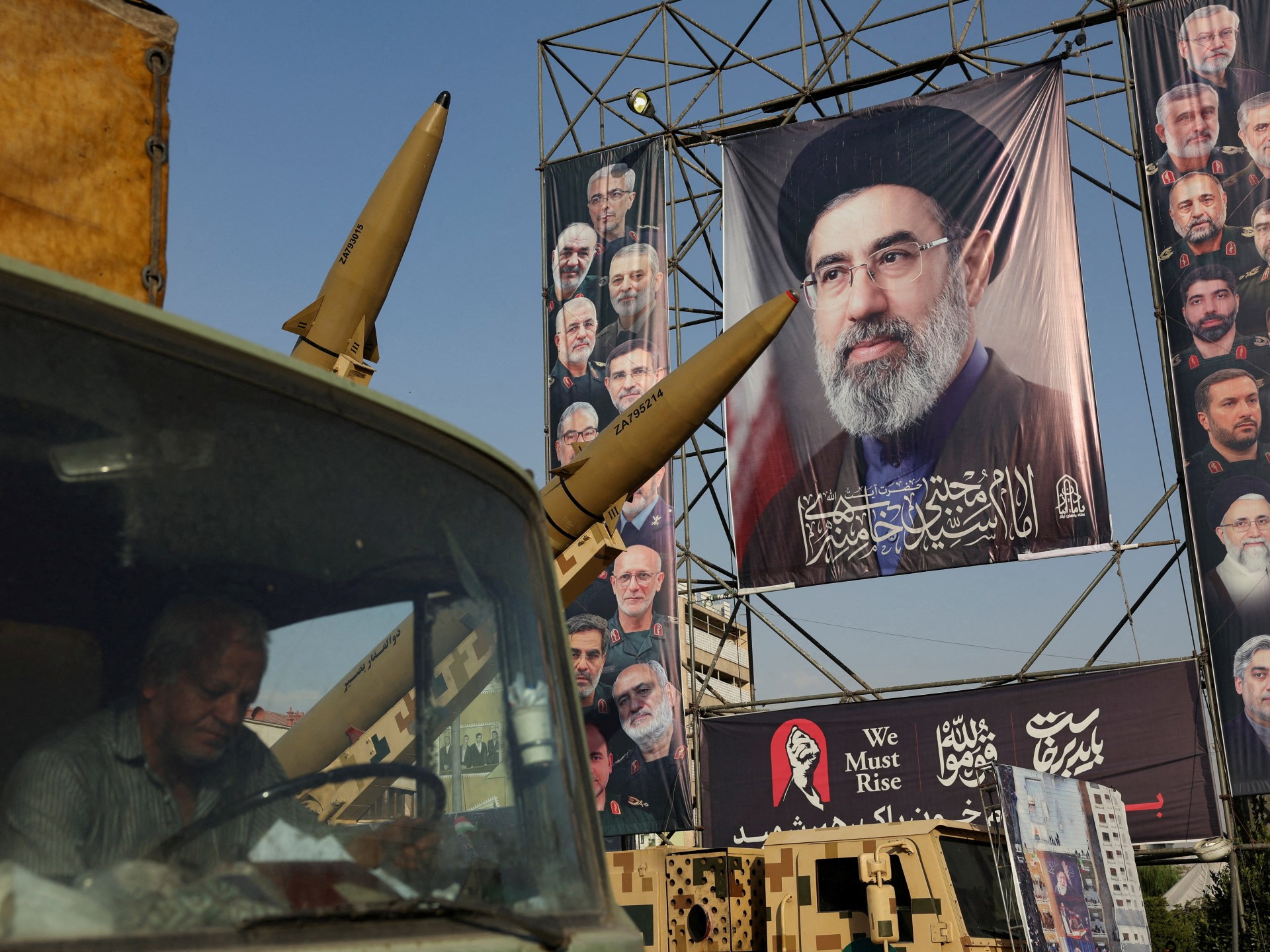

Iran’s Islamic Revolutionary Guard Corps (IRGC) says it has lifted its self-imposed 2,000km (1,250-mile) limit on the range of its ballistic missiles, raising questions over whether Tehran now considers hitting targets beyond the Middle East.
“This limitation has been lifted for us,” IRGC spokesman Brigadier-General Hossein Mohebbi announced at a news conference in Tehran on Saturday.
- list 1 of 3Qatar PM meets with Trump for talks on ending war on Iran
- list 2 of 3Trump signals ‘positive momentum’ with Iran after meeting Qatari PM
- list 3 of 3France blames Iran for October supermarket cyberattack
end of list
Mohebbi did not say whether Iran already had missiles that exceed the cap, but added that Iran would show its capabilities through action rather than statements, as Tehran has hardened its position and shifted towards an “offensive” military doctrine.
The announcement came days after Supreme Leader Mojtaba Khamenei warned that “any kind and level of threat” from the United States or Israel would be met with a response unlimited by geography. Mojtaba has said Iran needs to end the “no war, no peace” situation amid the volatile status of the Strait of Hormuz and the US naval blockade on the Iranian ports.
It also comes as the diplomatic push to end the US-Israel war on Iran has intensified, with Trump on Monday saying there is “positive momentum” towards ending the military hostilities after talks with Qatari Prime Minister Sheikh Mohammed bin Abdulrahman bin Jassim Al Thani in Washington, DC.
So what does lifting the limit actually change, and why is Iran doing it now?
Where could Iran’s missiles reach?
Iran already has operational capabilities to launch missiles beyond 2,000km, but it has kept a cap on them amid focus on regional deterrence. Iranian missiles can reach the entire Arabian Peninsula, the Levant and most of Egypt, as well as parts of Southeastern Europe, including Greece, Bulgaria, Romania, Albania, North Macedonia and Serbia.
Advertisement
For Gulf states, the announcement changes little. They already sit well within Iran’s 2,000km range and have come under repeated Iranian missile fire since the US and Israel launched the war on February 28.
The change can help Iran to position some of its rocket launchers in the country’s east, from where it would require a bigger range to reach Israel. The US and its European allies fear Iran can target US bases in the Indian Ocean and Europe.
In March, the United Kingdom accused Iran of firing missiles towards the joint US-UK base at Diego Garcia, some 4,000km (about 2,500 miles) from Iran. Tehran denied targeting the base located in the Indian Ocean, saying it was “an Israeli false flag” operation.
In 2019, the UK, France and Germany said their modelling put a lighter-warhead version of Iran’s Khorramshahr missile at a range of approximately 3,000km (about 1,900 miles). US officials have also said technology from Iran’s space programme could be repurposed to build intercontinental ballistic missiles, The Associated Press news agency reported. Iran currently does not have intercontinental ballistic missiles in its arsenal.
Muhanad Seloom, assistant professor of international politics and security at the Doha Institute for Graduate Studies, told Al Jazeera that the Diego Garcia launch had already made Iran’s point. “Iran denied doing that, but they wanted to signal that they have the capacity. So yes, they do have the capacity,” he said.
Seloom, who is also an honorary research fellow at the University of Exeter, pointed to Iran’s space launches over the past decade, saying the same rockets could in theory reach anywhere in the world. “How effective, that’s a totally different story,” he said, adding that Iran could probably field missiles with a range of about 5,000km (3,100 miles).
Iranian security analyst Mohamed Taheri made a similar case on Iran’s state-run Channel 3, saying range had stopped being a technical obstacle for Iran by the mid-2010s. “Even now we have no technical limitation in reaching ranges above 2,000km,” he said.
“If we were to increase that range to 4,000km, we would certainly have most of Europe within our missile range, and roughly most of North Africa as well,” Taheri said.
How has Europe responded to Iran’s missile threat?
The IRGC announcement about ending its self-imposed limit seems to be a shift from Tehran’s assurances to Europe on missile range. Europe’s relations with Iran have deteriorated over its nuclear programme and regional geopolitical ambitions. The European Union’s designation of the IRGC as a “terrorist” group and its allowing the US to use bases on the continent have attracted Iran’s ire.
Advertisement
Iran warned Bulgaria repeatedly this year over US aircraft on its soil. In April, Tehran sent a diplomatic note cautioning Bulgaria against letting US military aircraft use its airports for operations against Iran.
When Bulgaria’s parliament approved hosting up to eight US KC-135 refuelling tankers at Bezmer airbase in July, Iran’s Ministry of Foreign Affairs spokesperson Esmaeil Baghaei said Bulgarian decision-makers “must bear responsibility” for the move. It was Tehran’s third warning to Sofia.
In August, two Iranian insiders told the Financial Times that the US bases in countries such as Bulgaria had been assessed as possible targets, describing the threat to Europe as real but confined to the continent’s south and southeast. Two US tankers left Bezmer on August 21.
Last month, the UK spy chief said Iran is stepping up targeting of military bases in Europe. It came after UK Prime Minister Andy Burnham said the IRGC was “almost certainly” behind a suspected plot against Royal Air Force (RAF) Fairford, an airbase used by US bombers to carry out strikes on Iran. The incident prompted the US to withdraw its military jets from the facility over security concerns earlier this month. Tehran has denied involvement, saying it was a “false flag” operation.
On Monday, the US military evacuated aircraft from a second British base, RAF Mildenhall, “in the wake of a threat from Iran”, according to The Wall Street Journal. The refuelling tankers were moved to Germany and elsewhere, and US officials were still discussing the precise nature of the threat.
The UK Ministry of Defence did not confirm the reason. “Aircraft and other assets move regularly according to operational requirements,” a spokesperson said.
Bases in the UK, Germany and Romania are among other European locations the US has used during the conflict.
“It’s possible that in this war we may set aside the geographic restraint we’ve observed stemming from our diplomatic relations with certain countries and even be able to strike the bases that exist in Europe,” Iran’s Taheri said.
For European governments, the announcement is “worrying … but not alarming”, Doha Institute’s Seloom said. Missiles would have to travel far to reach mainland Europe or the UK, he explained, giving NATO members with assets in the region early warning and time to intercept them.
He said threatening Europe would not serve Iran’s interests, since European governments did not back Trump’s war and have pushed for a diplomatic solution despite paying a heavy price in energy costs. That could change if Iran comes to be framed as a threat to international security, he warned, pointing to Iraq, where successive UN Security Council resolutions preceded European support for the 2003 invasion.
“No one could defend Iranian policies when it comes to threatening Europe or the UK,” Seloom said. Lifting the limit, he added, suggests Tehran “is reading this conflict as existential now”.
That, he argued, is what should concern the whole region. “When you give them the idea that you have only one option, is to die … they can do anything. There would be no red lines,” he said.

Why is Iran doing this now?
Because the cap was self-imposed, Iran could have dropped it at any time. For years, the IRGC said the limit was meant to reassure European countries that they would not be targeted.
Advertisement
Mohebbi, the IRGC spokesman, went further, saying that if Iran decided to change its nuclear doctrine and build a bomb, the necessary preparations would be made.
One reading is deterrence: a warning to Washington, and to European governments hosting US aircraft, that renewed strikes could bring a wider response. Iran’s earlier threats to Bulgaria were seen in similar terms, as an attempt to discourage European governments from supporting US operations.
Tehran is also eyeing diplomatic leverage amid efforts to end the conflict. It can offer the cap as a concession, suggesting that any restraint on range now has a price at the negotiating table.
“It’s both,” Seloom said. He argued that Tehran sees a narrow window before the new US Congress convenes in January, in which Trump will want a deal he can present as a success.
The decision to lift the limit, he said, “is basically to push the Trump administration to go for a deal, not to launch another campaign of military action”. With Trump threatening to hit bridges and the power grid, Iran is “signalling that they can go even crazier”.

Western concern over Iran’s missiles has run alongside the nuclear file for more than a decade.
The 2015 nuclear deal signed under US President Barack Obama put a limit on Iran’s nuclear programme in exchange for sanctions relief. UN Security Council Resolution 2231, which endorsed the nuclear deal, officially known as the Joint Comprehensive Plan of Action (JCPOA), put a curb on Iran’s ballistic missile programme.
Those curbs expired in October 2023, following which Western countries expressed concerns about Tehran’s missile activities. In September 2025, France, Germany and the UK reimposed sanctions on Iran over its nuclear enrichment. But Tehran defended the enrichment boost after blaming Trump for withdrawing from the 2015 deal.
Trump put the destruction of Iran’s missile and nuclear programme as the main goals of the war launched in February. “We are going to destroy their missiles and raze their missile industry to the ground,” he had said.
US Defense Secretary Pete Hegseth said days later the goal was to destroy Iranian offensive missiles and missile production. Experts and US intelligence assessments, however, indicated Iran’s missile programme was years away from threatening the US homeland.
Before the war, Iran held the largest ballistic missile stockpile in the Middle East, estimated at between 2,500 and 6,000 missiles.
Related News

In Pictures: US midterm elections in 20 photos
Republican senator says Trump diesel agreement with Russia may be illegal

Global stock markets rise as investors continue to bet on AI