

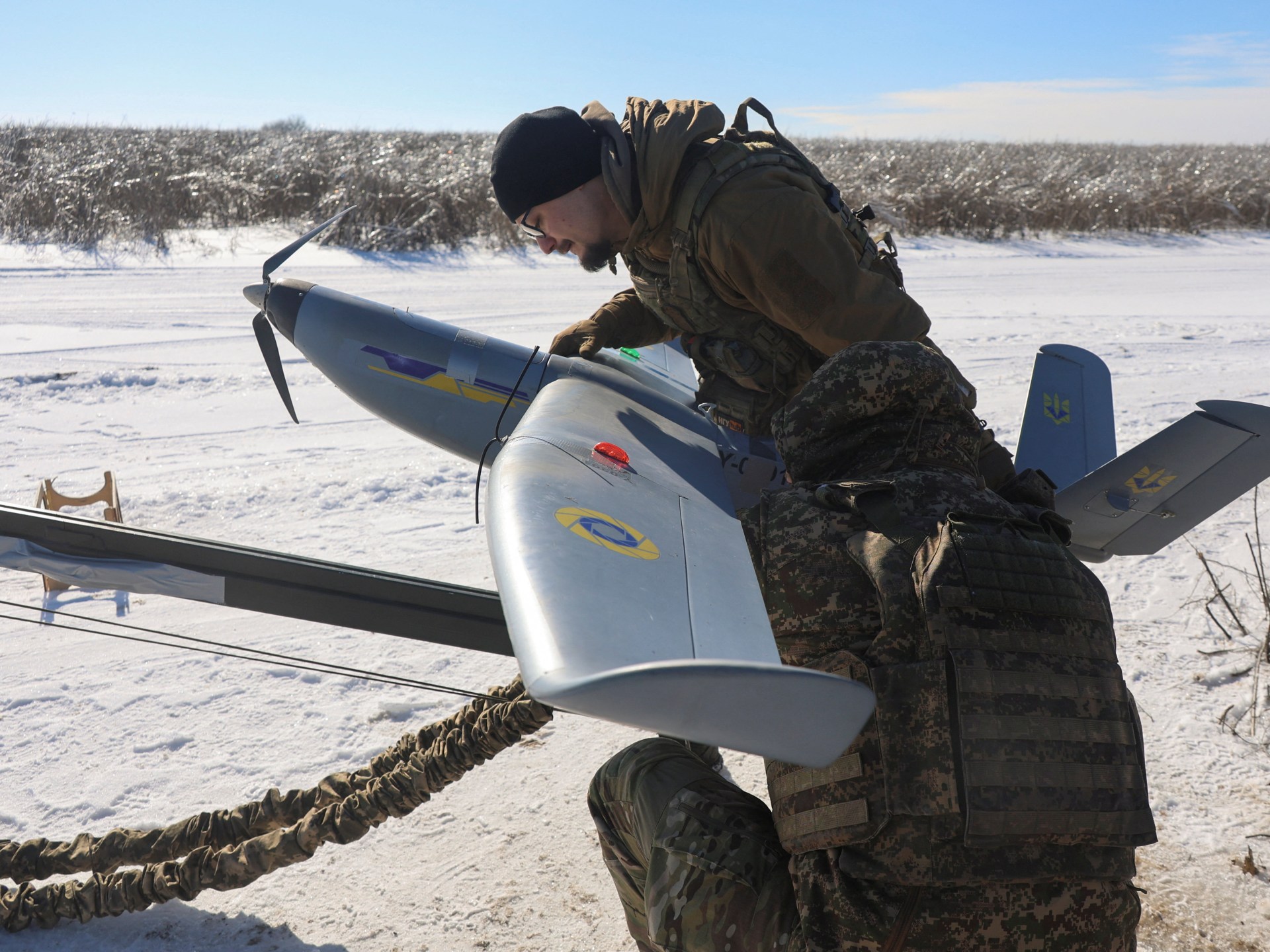

Kyiv, Ukraine – No nation knows more than Ukraine about how to down Iranian-made or designed drones.
Tens of thousands of them have rained death over it since 2022, and now, Ukrainian experts will help shoot them down over Gulf nations, British Prime Minister Keir Starmer announced on Sunday.
- list 1 of 4How Putin stays strong in Russia, four years into war in Ukraine
- list 2 of 4Azov’s hiring spree: How a controversial Ukrainian unit is luring fighters
- list 3 of 4Ukraine claws back southern territory as Russia’s war enters fifth year
- list 4 of 4World reacts to US, Israel attack on Iran, Tehran retaliation
end of list
Just days earlier, Ukrspecsystems, one of Ukraine’s largest drone manufacturers, opened a factory in the eastern English town of Mildenhall to churn out up to 1,000 unmanned aircraft a month.
Ukraine’s former top general and current ambassador to the United Kingdom, Valerii Zaluzhnyi, attended the opening, the BBC reported.
Back in 2022, when Moscow started the full-scale invasion of Ukraine, some Western military analysts believed that two ex-Soviet armies would fight each other using obsolete stratagems and weapons.
Who would have thought that four years later, China, the United States and Europe would scrutinise the war’s technological and tactical breakthroughs, a combination of unorthodox, hi-tech solutions and jury-rigged fixes that make warfare cheaper and arms manufacturing faster and deadlier?
“Undoubtedly, Bundeswehr in particular and NATO in general are closely studying this war’s technological innovations,” Nikolay Mitrokhin of Germany’s Bremen University told Al Jazeera, referring to German armed forces.
“Firstly, there’s a task to modernise [military] equipment and machinery according to [the war’s] outcomes,” he said.
Secondly, the newest Western technologies are being tested during the war, including German air defence systems and certain drones, he said.
Advertisement
And thirdly, Western armies will learn how to wage wars when drones dominate the front line, and traditional weapons and ammunition lose their role, he said.
Ukraine’s military ingenuity
A top US military official compared Ukrainian servicemen with MacGyver, a fictional secret agent from the 1980s’ television series who used his wits, engineering skills and whatever was at hand to get out of death traps.
Outmanned and outgunned, Ukrainians “have MacGyver-ed and come up with whatever they have to do to get to an outcome they need”, US Army Secretary Dan Driscoll said in November. “There are no rules to get to that outcome.”
Army SOS, a Kyiv-based startup, is one example.

It began by raising money to buy flak jackets and deliver them to the front line, but its volunteers kept hearing one persistent request – “Guys, give us maps”.
Instead of printing them out, Army SOS developed software that turns any cheap tablet or smartphone into a precision guidance system that acquires and transmits coordinates for correcting artillery fire.
It calculates the distance to targets, directs shots and even gets meteorological data that can affect each shot.
But Russia follows suit by “mirroring and scaling up” Ukraine’s findings, Andrey Pronin, one of the pioneers of drone warfare in Ukraine, told Al Jazeera.
The mirroring takes weeks.
In early 2023, Ukrainian engineers were the first to attach barely visible optic fibre to drones to make them immune to radio jamming, but their commanders initially rejected the innovation, Pronin said.
But Russians mimicked and scaled up the invention – and these days, forests in front-line areas are covered with countless glistening threads of optic fibre that resemble post-apocalyptic Christmas decorations.
Meanwhile, Russian optic fibre drones began reaching Kharkiv, Ukraine’s second-largest city that sits 40km (25 miles) from the Russian border, and Zaporizhzhia, the administrative capital of the eponymous eastern region.
Drones of all shapes and sizes buzz in the sky over the front line 24/7, risking Russia’s use of large columns of soldiers.
In 2022, these columns failed to enter Kyiv.
“I heard them. And I was killing them,” serviceman Bohdan Yavorsky told Al Jazeera.
On the invasion’s third day, he and 21 other servicemen and barely-armed volunteers ambushed and immobilised a column of three dozen Russian tanks and armoured vehicles in Bucha, north of Kyiv.
Advertisement
Yavorsky and his men fled in getaway civilian cars and sent the column’s coordinates to Ukraine’s air force, which bombed it within 30 minutes.

By 2026, Russia no longer risks amassing such large groups.
It dispatches soldiers in twos or threes to infiltrate the front line, carry ammo and jamming equipment and wait for more twos or threes.
They have cheap smartphones with Alpine Quest, a topographic app that lets one move around using coded coordinates without access to the internet or the Global Positioning System (GPS).
“We didn’t know the names of villages we were told to go to,” Mohammad (not his real name), a Tajik labour migrant who was duped into becoming a Russian soldier and was taken prisoner in eastern Ukraine last year, told Al Jazeera.
Soldiers on both sides use anti-thermal camouflage to avoid being detected by the drones’ thermal vision devices, hang fishnets over roads and mount electric scooters or snowmobiles to evade explosives-laden first-person-view drones.
Ukraine’s entire navy consisted of three dozen decades-old vessels that could fit into one small harbour in the Black Sea port of Odesa.
They were almost all annihilated in 2022, and Russia’s Black Sea Fleet based in annexed Crimea gained control of Ukraine’s territorial waters as Russian vessels shelled Odesa.
But by mid-2023, Ukraine developed sea drones that destroyed Russia’s largest ships – while aerial unmanned aircraft attacked a dry dock in the southern Crimean port of Sevastopol that had for decades been used to repair ships.
“What was critical for Russia wasn’t damage to vessels, it was damage to the shipyard,” Kyiv-based analyst Ihar Tyshkevich told Al Jazeera. “This is the reason why a large part of the Black Sea Fleet vessels were relocated to [eastwards, to the Russian port of] Novorossiysk.”
China watches war developments
Beijing is also especially eager to study and adopt the innovations of war, analysts said.
“Of course, they’re watching,” Temur Umarov, a Sinologist and China expert with the Carnegie Endowment for International Peace, a Berlin-based think tank, told Al Jazeera.
Beijing’s close attention to every development in Russia dates back to the 1950s, when the Soviets were crucial in shaping newborn Communist China’s armed forces and military industrial complex.
“Both the Chinese military, scientific community, as well as economists and historians [are watching] everything that is happening in Russia,” Umarov said.
China, however, has a major problem with adopting the new tactics, another military analyst warns.
“Horizontal algorithms”, or rapid, real-time sharing of data on the battlefield to process intelligence faster, along with the top-down delegation of responsibilities, almost don’t get implanted in authoritarian or totalitarian nations, Pavel Luzin, a Russia-born senior fellow at the Jamestown Foundation, a US think tank, told Al Jazeera.
The war’s main challenge is “organisational principles such as coordination building, delegation of decision making, logistics and so on”, Luzin said.
Advertisement
Related News
Bill and Hillary Clinton set for Epstein deposition: What to know

Ukraine claws back southern territory as Russia’s war enters fifth year

More than 1,000 UK councillors sign Palestine pledge as local polls loom