

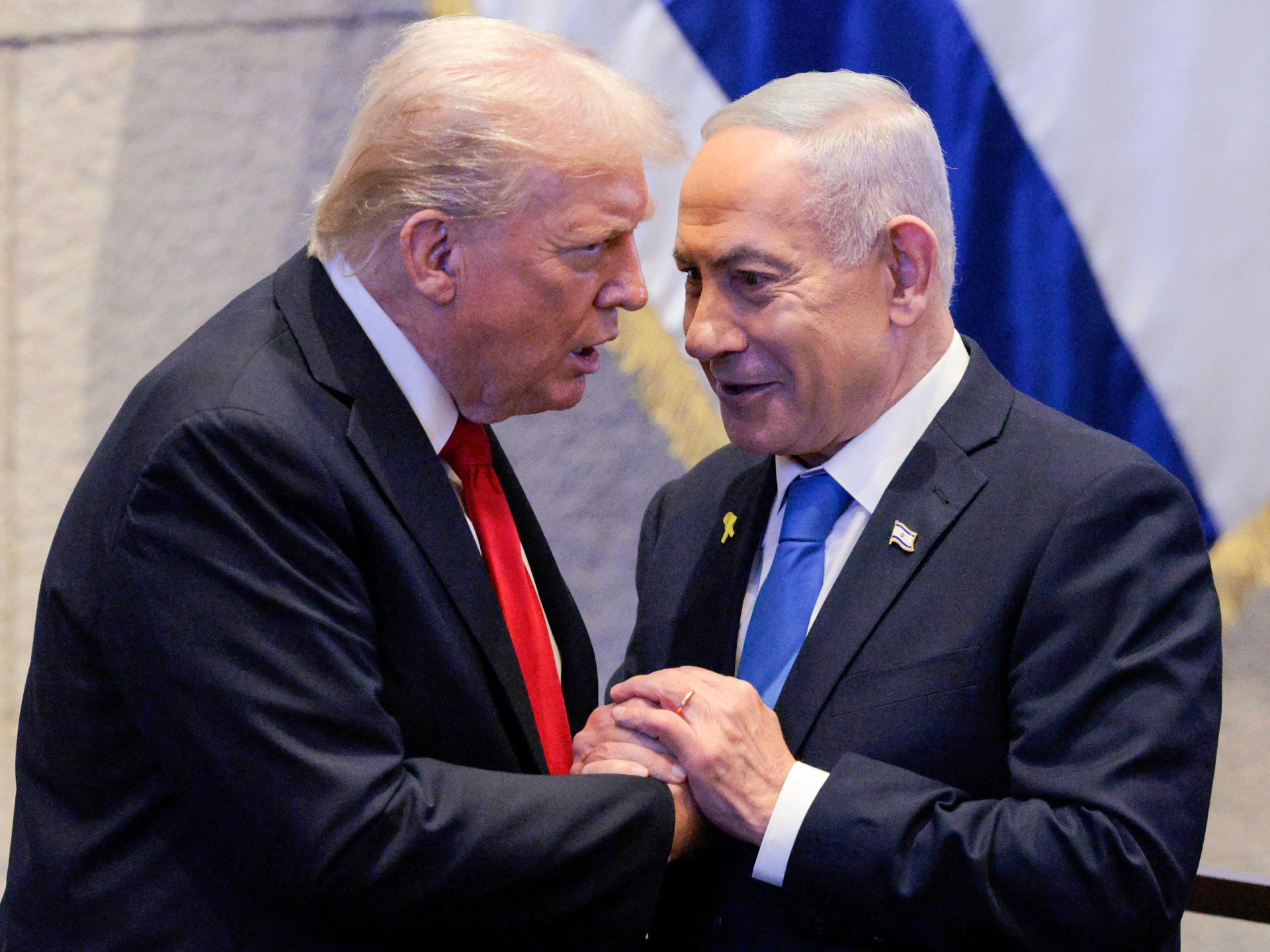

Few expected United States President Donald Trump to abandon Israel during his second term in office, considering how supportive he had been of the Middle Eastern country in his first term.
And yet, considering the still-mounting death toll from Israel’s genocidal war on Gaza, and the international condemnation that has accompanied it, his continued full-throated support for Israel has unnerved some in the president’s base.
- list 1 of 4US Congress releases Epstein estate photos featuring Trump, Clinton
- list 2 of 4UN General Assembly adopts resolution demanding Israel allow aid into Gaza
- list 3 of 4Israel is imploding
- list 4 of 4US sanctions more ICC judges, citing ruling on Israeli war crime probe
end of list
To them, the support is doubly offensive in the face of a still struggling economy, a mounting affordability crisis, spiralling healthcare costs and a US government shutdown, all while US aid to Israel has continued without pause.
That aid goes beyond the financial. It extends to blocking measures to criticise Israel at the UN, holding its leaders to account under international law, and even punishing those taking unilateral action against Israel, such as the International Criminal Court, which continues to be heavily sanctioned by the US.
So how extensive is US support for Israel, and just how much might that backing cost both Trump and his Republican Party?
How much aid has Trump given to Israel?
A lot.
Washington has been giving Israel $3.8bn per year to spend on US weapons under a 10-year commitment overseen by former US President Barack Obama in 2019.
In March, US Secretary of State Marco Rubio announced that Washington would be sending $4bn in emergency military assistance to Israel. He proudly said the Trump administration had approved $12bn in US military sales to Israel since taking office, framing it as a departure from the administration of Trump’s predecessor, Joe Biden, who himself was overwhelmingly pro-Israel.
![People carry caricature heads of U.S. President Donald Trump, left, and Israeli Prime Minister Benjamin Netanyahu as they march down 54th Street during a pro-Palestinian protest, on Friday, Sept. 26, 2025, in New York. [Angelina Katsanis/AP Photo]](https://www.aljazeera.com/wp-content/uploads/2025/09/AP25269545908878-1758900494.jpg?w=770&resize=770%2C515&quality=80)
According to the latest report by the Cost of War Project, published in October, the US has given Israel more than $21bn since its genocidal war on Gaza began.
Advertisement
How much has this cost Trump within his MAGA movement?
More than you might think.
Some of the most significant figures within the Make America Great Again (MAGA) movement have already rebelled over Trump’s unflinching support for Israel. But this is not entirely out of concern for the more than 70,000 people that Israel has killed in Gaza so far. Rather, many of their objections have focused on the cost of supporting Israel and the potential risks of doing so.
In June, the influential MAGA figure and Trump ally, former Fox News personality Tucker Carlson, openly broke with the president on the topic. Taking to social media, he wrote: “The real divide isn’t between people who support Israel and people who support Iran or the Palestinians. The real divide is between those who casually encourage violence, and those who seek to prevent it — between warmongers and peacemakers.”
Another of Trump’s inner circle, his former aide Steve Bannon, has also questioned the “special relationship”, describing Israeli Prime Minister Benjamin Netanyahu as having “betrayed” the US by launching strikes on Iran while knowing it did not have the tools needed for outright victory.
Later the same year, after Netanyahu had suggested that being anti-Israel was incompatible with being part of the MAGA movement, Bannon responded with what commentators described as a “scorched earth” approach, appearing to address the Israeli prime minister directly via social media. Bannon used colourful language to say that US citizens did not care about Netanyahu’s opinions towards MAGA, but instead cared about exposing the prime minister’s “pathological lies” so that the US stays out of “[Israel’s] next war”.
Has Trump’s support for Israel hurt his political base?
Up to a point.
While many Republican figures remain loyal, the most strident criticism – and one of the few on the US right to have accused Israel of genocide – has come from one of his previously most stalwart allies, Congresswoman Marjorie Taylor Greene.
In the midst of a number of ruptures over the cost of living and the release of files related to the convicted sex offender Jeffrey Epstein, Greene earned Trump’s fury after she took to social media to call out the “genocide, humanitarian crisis, and starvation happening in Gaza”.
Trump has responded to the congresswoman’s criticism by branding her Marjorie “Traitor” Greene.
Greene has since announced that she will be leaving Congress, but is still well respected by many in the MAGA movement, who see her as having stood up for an “America First” policy rather than an “Israel First” one.

How much might this be costing him electorally?
It is not certain.
Advertisement
A new poll released this week by YouGov and the Institute for Middle East Understanding (IMEU) Policy Project showed a plurality of Republicans surveyed favoured letting the 10-year aid agreement lapse once it had run its course. Feelings were even more marked among younger Republicans, with 53 percent of those aged between 18 and 44 favouring ripping up the agreement entirely.
“Even before the war in Gaza, there was less support for Israel and greater sympathy for Palestinians among younger Americans, including young evangelical Christians,” Dov Waxman, professor of Israel studies at the University of California, told Al Jazeera in October. “Israel’s behaviour during the war in Gaza has significantly accelerated the erosion of support for Israel among these key groups.”
But it is not just within Trump’s traditional base where his support for Israel is costing him. Polls also show it to be flagging in one of the most traditional pro-Israel branches of his base, evangelical Christians. In October, the Israeli government hired a newly formed PR company, Faith through Works, to, in its own words, “combat low American Evangelical Christian approval of the Nation of Israel”.
Earlier this month, more than 1,000 US Christian pastors and influencers travelled to Israel, becoming “the largest group of American Christian leaders to visit Israel since its founding”.
Significantly, the trip was organised by American author Mike Evans, a close evangelical ally of Trump and reportedly a longstanding Netanyahu confidant.
And yet, as Gaza recedes from US headlines, the importance of Israel within US discourse may recede with it.
The forthcoming US elections will likely be influenced by a myriad of issues, including Israel, but most probably focused on the economy and other domestic concerns.
And if they are confronted with electoral losses ahead of the 2028 presidential election, Republicans – both supporters and opponents of Israel – may decide to put the issue to one side as they focus on confronting the Democrats.
Related News

EU launches aid flights to Sudan’s Darfur as humanitarian crisis escalates
Israel and Hamas trade blame over delay of second phase of Gaza ceasefire
Trump prosecutor Jack Smith defends record before Republican lawmakers