US envoys meet Putin: What’s behind latest diplomacy on Russia-Ukraine war?
 06 September 2026
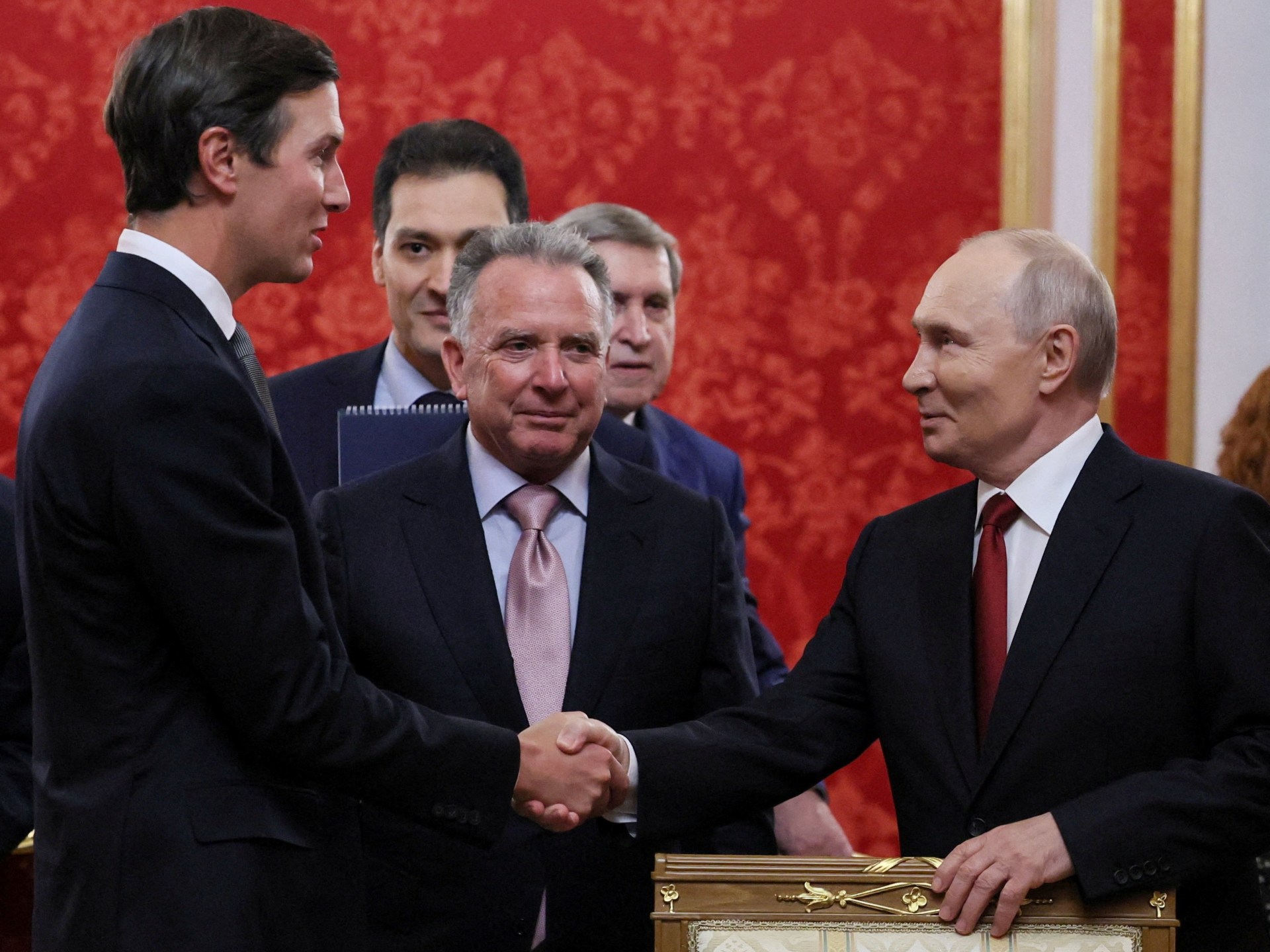

US envoys Steve Witkoff and Jared Kushner have held talks with President Vladmir Putin in Moscow, in what appears to be new efforts by the Trump administration to end the Russia-Ukraine war.
US President Donald Trump said on Saturday that the envoys were bringing “a proposal to end the war” – Europe’s deadliest conflict since World War II – and a senior Russian official said it was an “important peacemaking visit”.
- list 1 of 4Witkoff and Kushner will travel to ‘end’ Russia’s war in Ukraine: Trump
- list 2 of 4Trump sends envoys to Russia, Ukraine with new peace plan
- list 3 of 4At least 5 killed in Russian attacks on Ukraine as US envoys visit Moscow
- list 4 of 4US envoys arrive in Kyiv for Ukraine war talks after meeting Putin
end of list
Kushner, Trump’s son-in-law and Witkoff, the US special envoy, are expected to arrive in Kyiv on Sunday, reviving diplomacy when both countries have escalated attacks. Both Moscow and Kyiv announced a three-day ceasefire to coincide with the latest trip.
So what’s behind the latest initiative by the US envoys and will it help end the war?
What was the outcome of the meeting?
Kremlin aide Yuri Ushakov said the high-level talks were “highly useful” and lasted for more than three hours, according to Reuters.
Witkoff and Kushner “outlined a number of ideas regarding possible avenues for a settlement,” said Ushakov, without providing any further detail, but added that the talks had been “substantive, very frank and constructive”.
Videos show Putin meeting the US envoys in the famous Red Drawing Room at the Kremlin on Saturday and telling his guests that the situation they are exploring “is, of course, not an easy one”.
The question remains whether Russia is willing to compromise, said Al Jazeera correspondent Yulia Shapovalova from Moscow. “Moscow demands that Ukraine not join NATO and hand over four Ukrainian regions to Russia, including territories not controlled by Russian forces.”
Advertisement
In September 2022, Putin proclaimed the annexation of four partially occupied Ukrainian regions – Donetsk, Luhansk, Kherson and Zaporizhzhia. The move was not recognised by the international community, including the UN. Ukraine has refused to cede territory to Russia.
The Trump administration has ruled out a seat for Ukraine at NATO – which Russia has opposed. Trump had initially been critical of Ukrainian President Volodymyr Zelenskyy, but has since mended ties after berating the Ukrainian leader in the Oval Office in February last year.
In August, Trump met Putin in Alaska, but the summit failed to reach a deal to end the war.
Why are the US envoys in Moscow?
Witkoff and Kushner have been involved in a number of diplomatic talks, including the Iran war, the so-called ceasefire agreement between Hamas and Israel and the Ukraine-Russia war.
Witkoff was appointed as the special envoy to the Middle East and later assigned the task of helping end the Russia-Ukraine conflict. Kushner also played a major role in the 2020 Abraham Accords that saw a number of Muslim countries recognise Israel. The initiative has been criticised for prioritising Arab-Israeli normalisation without addressing the question of a Palestinian state.
The details of the latest Ukraine peace plan are unclear, but Trump reportedly said last week, “we have an idea for peace”, without providing any additional details.
US officials from the National Security Council, State Department and the Treasury were also part of the delegation. The presence of Treasury official Gene Lang, who oversees US sanctions policy, including on Russia, indicates that the ongoing financial, economic and trade sanctions on Russia might have been part of the discussions in Moscow.
The Trump administration has ramped up sanctions on Russia aimed at forcing it to end the war. The Iran war has, however, diverted Trump’s and global attention away from the Ukraine-Russia conflict.
The Iran war has also strained transatlantic ties as Trump has accused his European and NATO allies of not helping him in efforts to reopen the Strait of Hormuz, which Tehran has used as leverage in talks. He has also been critical of NATO allies for not sharing the burden of collective defence, particularly against Russian threats.
NATO members from Europe have since stepped up their spending and offered to provide security guarantees to Ukraine after a deal is signed with Russia.
The latest push comes amid deadly Russian missile and drone attacks on Ukraine, while Kyiv has stepped up drone attacks on Russian energy sites.
Advertisement
What is Witkoff and Kushner’s next stop?
They have arrived in Kyiv for their first visit to meet President Volodymyr Zelenskyy.
It was their second visit to the Kremlin this year and the eighth since the start of the war.
Experts say Ukrainians are sceptical of the US envoys.
“The view in Ukraine [is] that Witkoff, and to some extent Kushner, are most susceptible to accepting Russia’s narrative,” said Alexey Muraviev, a senior research fellow of defence and strategic studies at Edith Cowan University in Australia.
Witkoff told Putin that the US president had sent his best wishes and thanked him for the limited ceasefire during the delegation’s visit. The special US envoy was also recorded telling Putin that “we will have all these incredible stories and memories, and yours will be right at the top of it all”. The Russian president conveyed his gratitude to Trump and said Moscow would do its utmost to ensure the safety of the mediators.
The choice of words and tone won’t sit well with Ukrainians, explained Al Jazeera correspondent Audrey McAlpine from Ukraine’s capital, Kyiv.
While the visit there is seen as significant, the interaction between the envoys and Putin is an indication of “that familiarity between Witkoff and Putin”, she said.
Where the war stands now?
Russia and Ukraine announced a halt in attacks on each other’s capitals until Monday. The no-shoot policy is to ensure the envoys travel to the talks.
However, attacks have been reported in other cities in both the warring countries. At least seven people were killed in Russian attacks on Ukraine, while a Ukrainian drone attack killed one person in Russia’s Belgorod region.
In recent months, the two sides have intensified drone strikes, killing dozens. Ukraine’s production of low-cost, long-range drones has increased the number of attacks on industrial and logistical sites deep within Russia.
“There are growing concerns about the level of Ukraine’s resilience given the collateral damage that the Russian attacks have caused to Ukraine’s infrastructure ahead of the incoming winter,” Muraviev said, while pointing out that Putin is looking for a more long-term strategic deal.
Recent drone incidents reported in a number of European countries have raised suspicions that Russia is responsible, although no proof has been published. They included a failed drone explosion at Germany’s Leipzig airport and a fire at a drone factory in Poland.
Why is Trump pushing for a new deal now?
The US president has said that tens of thousands of people are dying on both sides every month due to the Ukraine-Russia war. During his re-election campaign in 2024, Trump said he would end the war within 24 hours, but that deadline has been revised several times.
He has hosted Putin in Alaska and held talks with Zelenskyy several times but has failed to find an agreement to end the war.
Recent steps by the Trump administration are interpreted as an attempt to revive relations between the US and Russia after months of stalled diplomacy.
Advertisement
CIA director John Ratcliffe visited Moscow last month to meet with Russian intelligence officials and the US invited Russia’s Finance Minister, Anton Siluanov, to a recent G20 meeting. His attendance was criticised by several European countries who refused a group photo with the Russian diplomat in protest.
Trump is expected to meet Putin next in November during the Asia-Pacific Economic Cooperation (APEC) summit in China, according to media reports. Russia’s Deputy Foreign Minister, Sergei Ryabkov, said on Sunday that Moscow has not ruled out a trilateral meeting between the Russian, Chinese and US presidents, the TASS state news agency reported.
Trump’s latest diplomatic push comes as the Iran war remains deadlocked and the Ukraine-Russia conflict has turned into a war of attrition. The war with Iran has become hugely unpopular domestically ahead of the crucial midterm elections in November. If Trump’s Republican party loses its majority in Congress, it would become extremely hard for the president to push his agenda.
A peace agreement in the longstanding war in the coming weeks could be a major boost for him ahead of election day.
Related News
Seoul court orders North Korea to pay $32.5m for blowing up office
Five years after Saied’s power grab, Tunisia’s old grievances resurface

China vs US: Who is winning the AI race, in four charts