

Turkish leaders have insisted that the new trilateral defence pact with Saudi Arabia and Pakistan is not directed at Iran.
Turkiye’s Foreign Minister Hakan Fidan said on Saturday that the pact does not identify Iran, or any other country, as a common threat.
- list 1 of 4Saudi Arabia, Pakistan, Turkiye defence pact challenges US role
- list 2 of 4Iran deliberates Hormuz arrangement amid uncertain prospects with US
- list 3 of 4Yemen’s government forces attack Houthis amid renewed shelling of Marib
- list 4 of 4What are the challenges facing the Mecca agreement?
end of list
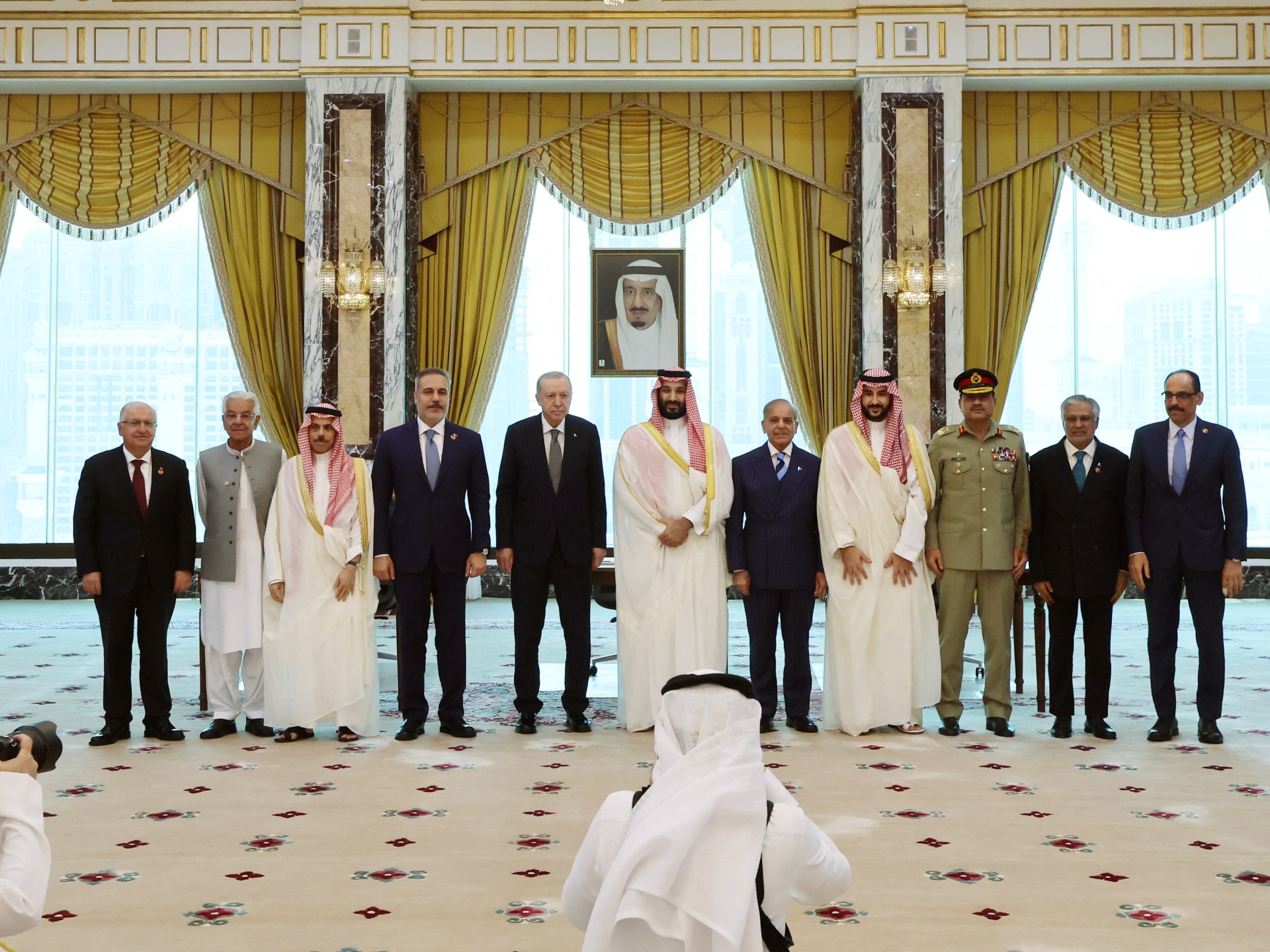
The Mecca Joint Defence Agreement was signed on Friday by Turkish President Recep Tayyip Erdogan, Saudi Crown Prince Mohammed bin Salman and Pakistani Prime Minister Shehbaz Sharif, stating that an armed attack on one of the three countries would be considered an attack on them all.
“There is no common threat that we have put in writing,” Fidan told Turkey’s state-run Anadolu agency, adding that countries that do not attack the signatories would not be considered targets.
An Article 5-style commitment
Fidan described the pact as “technically” similar to NATO’s Article 5 collective-defence clause, under which an attack on one member is treated as an attack on all.
But the response would depend on the circumstances.
A country under attack would have to request assistance and specify what kind of support it needed, Fidan said. That could range from intelligence and logistics to ammunition or the deployment of military units.
The alliance will also establish political and military committees, bringing together foreign and defence ministers and military chiefs, as well as a secretariat in Saudi Arabia.
Fidan said the three countries would work on joint training, intelligence sharing, logistics, threat assessments and military interoperability.

Defence-industry cooperation is also expected to be a notable part of the pact. Fidan said it was one of the main issues discussed by the three leaders in Mecca, including how the countries could benefit from each other’s military technologies.
Advertisement
The Turkish minister said preparations for the agreement had been under way for nearly two years and eight months, suggesting it was not drawn up simply in response to the current tensions involving Iran.
Iran pushes back
Despite Ankara’s assurances, some Iranian officials have questioned the agreement and warned Saudi Arabia against relying on its new partners for security.
Mahmoud Nabavian, a hardline member of Iran’s parliamentary National Security and Foreign Policy Commission, said Saudi leaders should understand that cooperation with Turkiye and Pakistan would not guarantee their security.
Another commission member, Ebrahim Rezaei, similarly dismissed the pact as a “paper agreement”.
Iranian Foreign Minister Abbas Araghchi did not directly mention the agreement in a message on X on Friday, but he called on regional states to rely on themselves and pursue what he described as “true brotherhood”.
At the same time, he stressed the strength and readiness of Iran’s armed forces.
Egypt could join next
Fidan portrayed the agreement as part of a broader effort to give regional countries greater responsibility for their own security.
“External hegemons coming into the region do not solve the problems; they make them more acute,” he told Anadolu.
He described Turkiye, Saudi Arabia and Pakistan as the “core countries” of the initiative and made clear that Ankara wants the arrangement to expand.
“Under our president’s vision, we should not remain limited to three countries,” Fidan said. “We should grow and, if necessary, bring all countries under this umbrella.”
Several countries have already expressed interest, according to Fidan, who said he expected Egypt, which he described as a “natural partner”, to join once outstanding technical issues were resolved.

For now, many of the practical details remain to be worked out, including how the three militaries would coordinate in a crisis.
But the planned committees, permanent secretariat and focus on interoperability and defence-industry cooperation suggest the pact is intended to develop beyond a simple mutual defence declaration.
Related News
UAE trade embargo could shut Iran’s key economic escape route: Here’s why
Fuel prices soar on back of Iran war, leaving Yemeni labourers with no work
Iran war live: Iran says it has a plan to respond to any US attacks