
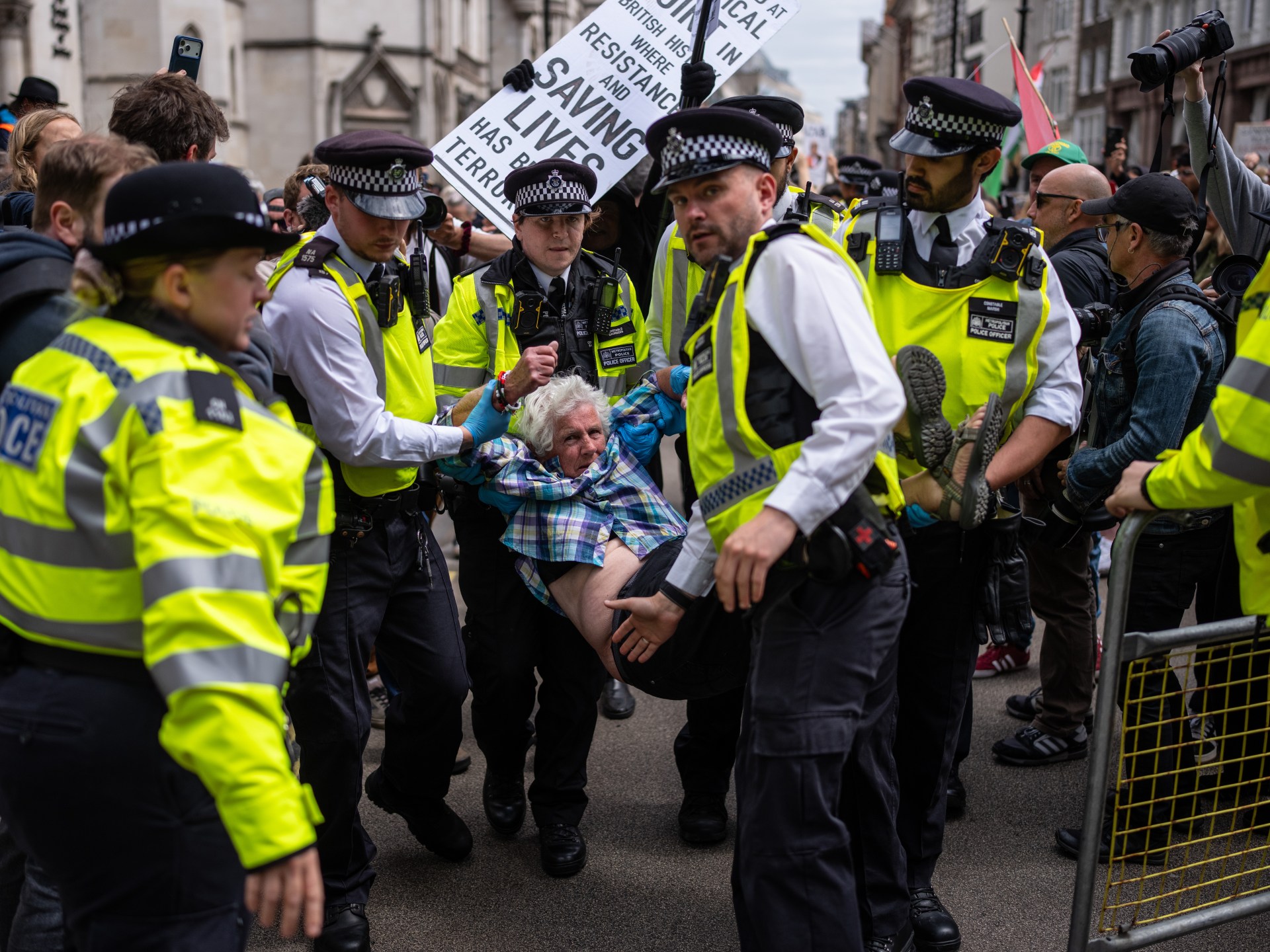

The United Kingdom’s Court of Appeal has upheld the government’s decision to proscribe the activist group Palestine Action as a “terrorist organisation”, marking the latest chapter in a growing debate about the right to protest in Britain.
Palestine Action, founded in 2020, describes itself as a “direct action” movement committed to disrupting companies and institutions it says are complicit in Israel’s genocidal war on Gaza. Its activists have targeted weapons manufacturers and military facilities in the UK mainly through acts of vandalism and property destruction.
- list 1 of 4What a UK court’s backing of the Palestine Action ‘terror’ ban means
- list 2 of 4UK Court upholds ban on Palestine Action as ‘terrorist’ group
- list 3 of 4Israel uses ‘battlefield evidence’ to prosecute Palestinians abroad
- list 4 of 4Palestine weekly wrap: World sanctions settlers, Israel funds settlements
end of list
Supporters say the group belongs to a long British tradition of civil disobedience while critics accuse it of engaging in tactics that cross the line into “terrorism”. The dispute raises a broader question: How has Britain historically treated direct-action movements, and what, if anything, has changed?
We look at the UK’s rich history of activist movements that have used similar tactics.
1910s-1920s: The suffragettes
Direct action has long played a role in Britain’s democratic history. The Women’s Social and Political Union, founded by Emmeline Pankhurst in 1903, emerged after years as a movement campaigning for women’s suffrage.
Its members, known as suffragettes, heckled politicians, disrupted public meetings, chained themselves to railings, smashed windows and carried out arson and even bombing campaigns that targeted property. Suffragettes were frequently imprisoned for offences that included criminal damage, obstruction and arson, and many endured repeated jail terms.
Advertisement
Katharine Gatty, for example, was imprisoned for three weeks in 1911 and six months in 1912 for smashing windows. Another suffragette, Jane Short, was sentenced to three months in prison after smashing the windows of a post office. She openly admitted the offence, saying it was intended to draw attention to the campaign for women’s suffrage and refused to promise she would not repeat her actions. Short became the first suffragette to be placed in the First Division, a category reserved for political prisoners or “terrorists”.
Others launched hunger strikes while in jail, prompting the government to force-feed them, which was called for under the 1913 “Cat and Mouse Act”.
The death of Emily Wilding Davison after she stepped onto a track during the 1913 Epsom Derby and was hit by a horse became one of the defining moments of the movement.
Despite fierce hostility from much of the media and political establishment at the time, suffragettes are now widely celebrated in Britain as pioneers of democratic reform. Women gained partial voting rights in 1918 and equal voting rights with men a decade later.

1950s onwards: Mass protests and civil disobedience
The post-World War II period saw some of Britain’s largest protest movements emerge around the issues of nuclear weapons, taxation and war.
The Campaign for Nuclear Disarmament, founded in 1957, mobilised hundreds of thousands of people against Britain’s nuclear arsenal and later nuclear energy. The movement largely stuck to lawful protests, but despite decades of demonstrations, Britain retains both nuclear weapons and a civil nuclear industry.
The anti-poll tax movement produced a different outcome. Opposition to Prime Minister Margaret Thatcher’s Community Charge culminated in the 1990 Poll Tax Riots in central London, where clashes injured more than 100 people and hundreds more were arrested. Within a year, the tax was abolished and replaced.
In 2003, one million to two million people marched peacefully through London against the invasion of Iraq in what remains the largest political demonstration in British history. The war nevertheless went ahead.
2018 onwards: The climate movement and changes to the law
The rise of climate movements such as Extinction Rebellion, Insulate Britain and Just Stop Oil is seen as a turning point in the British authorities’ approach to protests, experts said.
Founded in 2018, Extinction Rebellion popularised a strategy of nonviolent civil disobedience aimed at forcing climate change onto the political agenda. Protesters blocked roads, often gluing themselves to the ground, and deliberately sought arrest to generate publicity and awareness about climate change.
Advertisement
Successive governments have responded with increasingly restrictive legislation. The Police, Crime, Sentencing and Courts Act 2022 transformed the common-law offence of public nuisance into a statutory offence carrying a maximum sentence of 10 years. The Public Order Act 2023 introduced a range of new protest-related offences and expanded police powers.
According to a recent report by researchers at Queen Mary University of London, the result has been a fundamental reshaping of Britain’s protest landscape. Activists have faced longer prison sentences, spent longer on remand and encountered growing restrictions on the arguments they are allowed to present before juries in their defence.
“In our research, we found 286 cases of protesters sent to jail for civil disobedience actions in Britain,” David White, a professor of climate justice at Queen Mary University of London, told Al Jazeera.
“The total time spent on remand or sentenced by the courts was more than 136 years. The average was 28 months, and one in five were jailed for a period exceeding a year.”
According to White, this is a dramatic departure from previous practice. “Where imprisonment for acts of direct action or civil disobedience was once rare, custodial sentences are now being imposed with rising length and frequency,” he said, describing the response of the criminal justice system as “extremely repressive”.
Legal experts said defendants have increasingly been prevented from explaining the political or moral motivations behind their actions. “Contempt of court has been freely used as a mechanism to circumvent criminal process,” White said. “Large numbers have been held in contempt of court and even jailed simply for breaching a civil order. Many more have been ordered by the court not to mention climate change or genocide.”
The criticism comes amid a series of high-profile cases involving climate activists, including protesters jailed for four years for simply planning to block a motorway, while defendants have been prevented from advancing a “reasonable excuse” defence or presenting climate evidence to juries.
UN Special Rapporteur Mary Lawlor has also criticised Western governments, including the UK, for criminalising environmental activists while professing support for climate action.

The 2020 Black Lives Matter protests brought another high-profile test of how Britain responds to direct action.
During demonstrations in Bristol after the murder of African American George Floyd by police in the United States, protesters graffitied and pulled down a statue of slave trader Edward Colston and threw it into the harbour. Four people charged with criminal damage were later acquitted by a jury.
The verdict was hailed by supporters as recognition that direct action can sometimes reflect broader public sentiment while also highlighting continuing tensions between what prosecutors describe as criminal damage and the right to protest.

2020: Palestine Action
That debate has now escalated to new heights after the UK government proscribed Palestine Action as a “terrorist organisation”, placing it in the same legal category as armed groups that include al-Qaeda and ISIL (ISIS). United Nations experts warned that the move risks creating a chilling effect on political protests. Palestine Action cofounder Huda Ammori, who challenged the decision at the High Court, said on Monday that she plans to take the group’s appeal against proscription to the Supreme Court.
Advertisement
Proscription makes it illegal to protest in support of a group. Since last year, about 3,000 people have been arrested for supporting Palestine Action.
Palestine Action says it uses disruptive tactics against what it describes as the corporate infrastructure supporting Israel’s military. Its actions have included occupying property, disrupting factory operations and alleged high-profile acts of property damage targeting defence companies.
The controversy intensified further last week when four Palestine Action activists called the “Filton Four” were sentenced after causing 1.2 million pounds ($1.6m) of damage at a site operated by the Israeli defence company Elbit Systems in Filton near Bristol.
Jurors at their trial for criminal damage earlier this year were not told that they could be sentenced on the basis that their actions were linked to “terrorism” – something the court decided they were on Monday – meaning their sentences would be longer and they could be labelled as “terrorists” for life.
Anas Mustapha, head of public advocacy at CAGE International, said: “This ruling tells us exactly what these powers are for. They are not safeguards against violence. They are authoritarian tools for crushing dissent.”
Thomas Bell, acting UK director at Human Rights Watch, said: “This disastrous decision further cements the UK’s place among countries that are backsliding on human rights by classifying acts of protest as terrorism.”
Legal experts said the case reflects a broader trend in which “antiterrorism” powers are increasingly being used in protest-related cases. “The Filton Four case undermines any credibility left in British criminal process,” White said.
“The jury found all four guilty of relatively minor charges, no doubt expecting that the court would decide they had already spent far too much time on remand and would be freed. The sentences were absolutely astounding and unheard of. This case is just one of many that shows how political the courts have become.”
“This is a very dangerous moment indeed for British democracy.”
Related News

Trump says in ‘final throes’ of peace deal but at least 8 killed in Tyre
Trump touts Iran deal and Ukraine ambition as he arrives at G7

Democrat and Republican go head-to-head in California governor race