
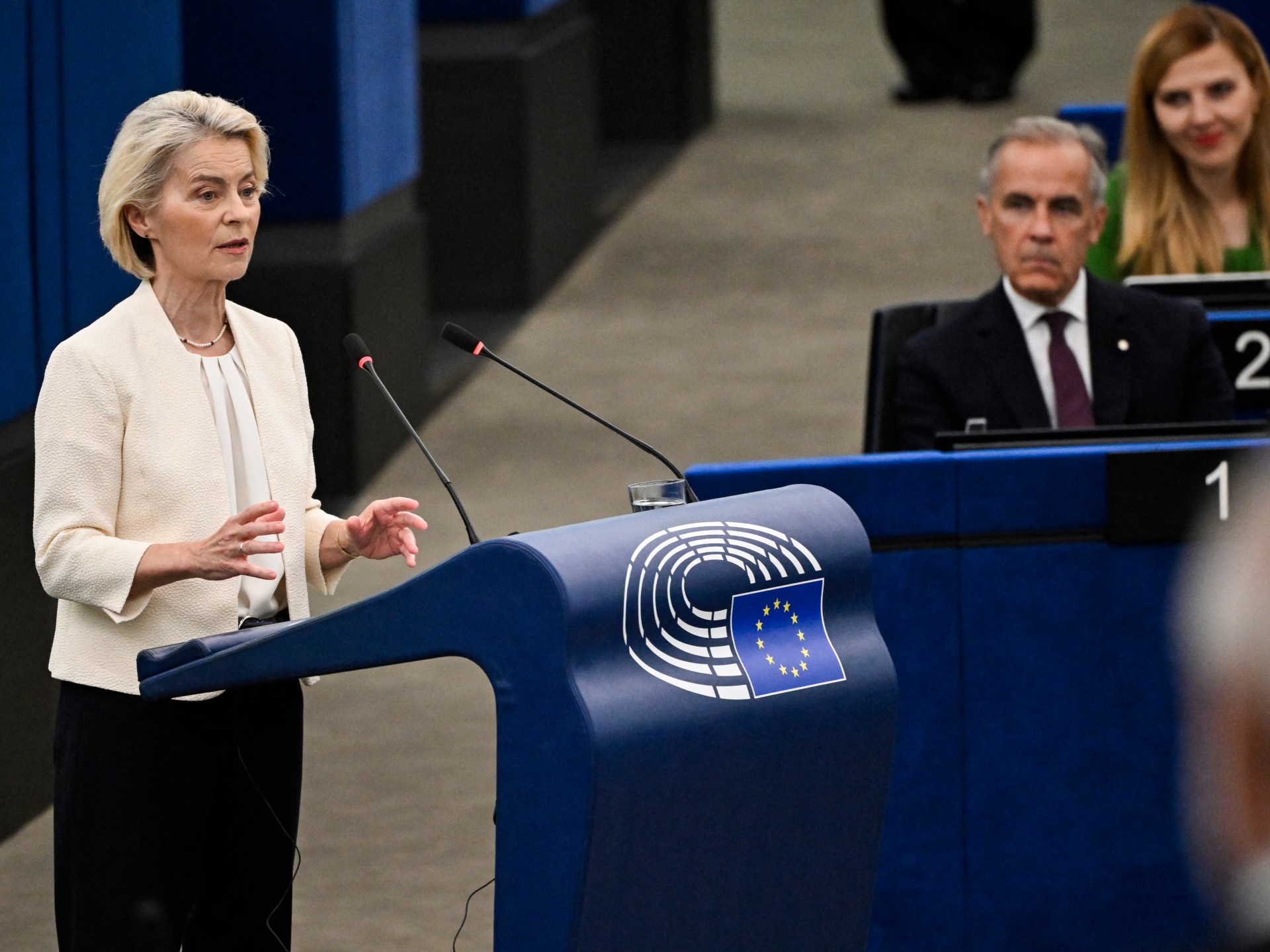

European Commission President Ursula von der Leyen has raised the prospect of Canada becoming the 27-nation European Union’s first “associate member”, a striking overture as both seek to pivot away from a hostile United States under President Donald Trump.
Von der Leyen’s statement on Wednesday came after Prime Minister Mark Carney said earlier this week that Canada was seeking a “unique alliance” with the EU, but not membership.
- list 1 of 3Europe, Canada condemn Israeli plans for new West Bank settlement
- list 2 of 3Five key takeaways from the NATO summit in Ankara
- list 3 of 3‘A global rupture’: Carney calls for Canada-EU unity before G7 summit
end of list
Von der Leyen told the European Parliament in Strasbourg that, as democracies are facing a “fracture in the international rules-based system”, Brussels and Ottawa needed to pull closer together.
“I would like to work with you on opening the door for Canada to be the first associate member of the EU,” von der Leyen told Carney, who was attending her annual keynote speech.
The first foreign head of government to attend the annual “State of the European Union” address, his visit comes in advance of an EU-Canada summit in Montreal next month. Carney will deliver his own address to the European Parliament on Thursday.
Von der Leyen said it was time to move from cooperation based on a trading relationship to a broader “alliance for the future” and “bring the relationship with Canada to the highest level possible”.
She said that the EU and Canada would work together on sectors ranging from manufacturing to AI, critical minerals and energy.
“This is a partnership not against anyone else, but for our common strength,” she added.
EU treaties do not envision the possibility of becoming an “associate member”. But the idea was first proposed by German Chancellor Friedrich Merz this year regarding Ukraine.
Advertisement
Under the plan, which met a cold reception in Kyiv as it pushes for full membership status, Ukraine would have been allowed to attend the bloc’s summits and have a representative in the European Commission.
It would have also benefitted from parts of the EU budget, but without full voting rights.
Buffeted by US tariffs and competition from China, Brussels and Ottawa already enjoy considerable cooperation.
A free-trade agreement (CETA) that abolished almost all tariffs has been credited with boosting trade in goods and services by more than 80 percent since 2016.
Furthermore, Canada became the first non-EU country to join a flagship defence loan programme this year.
“We believe that power does not belong to the strongest, the richest or the loudest – but to all of us. That democracies have the freedom to choose with whom to work,” von der Leyen said. “So, we are joining forces voluntarily.”
Related News

Eiffel Tower closed in row over women removed for Hindu group
In El Salvador’s mass trials, lawyers struggle to defend hundreds
Can China play peacemaker as Iran’s foreign minister heads to Beijing?