

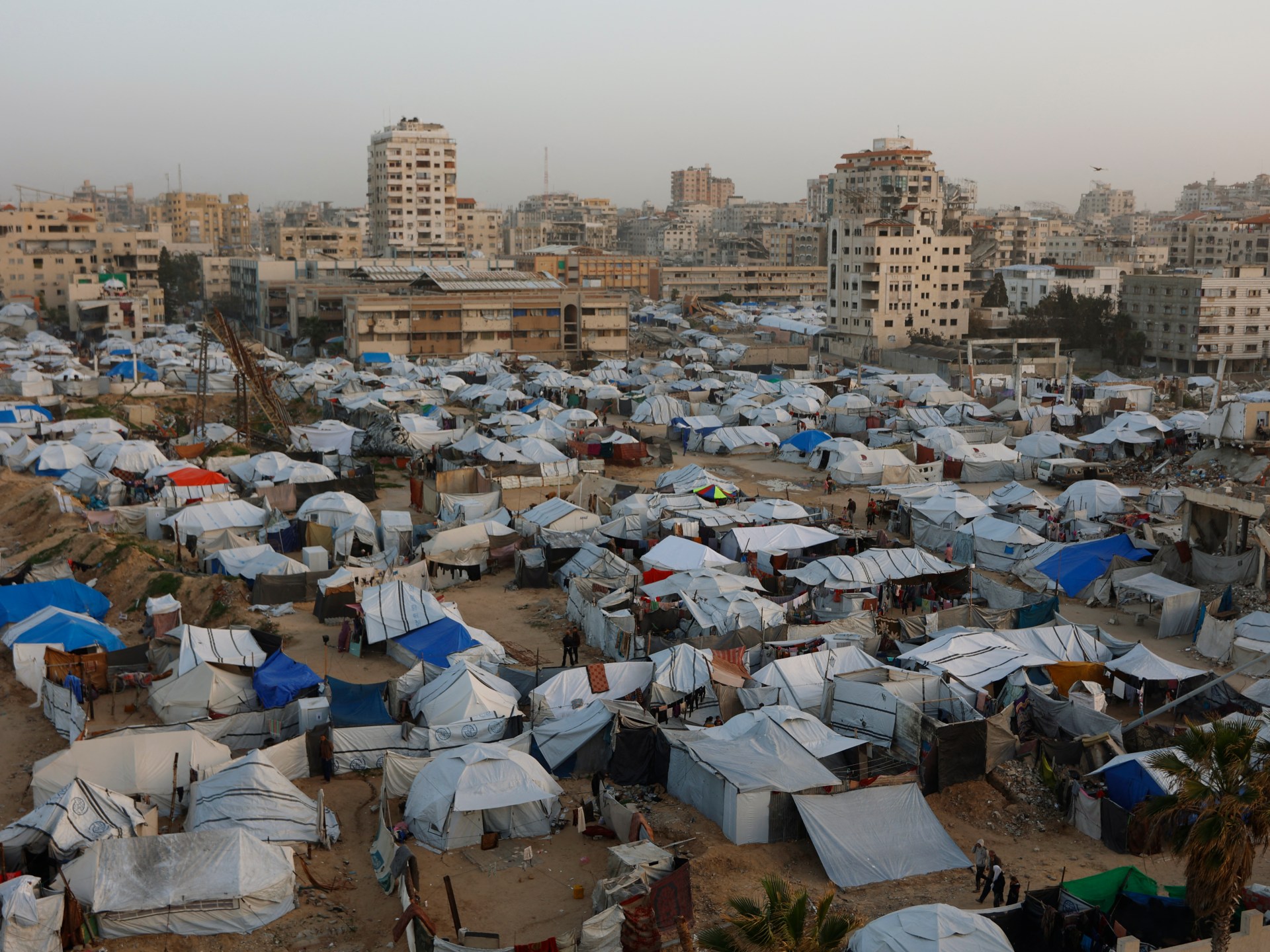

Details of a plan submitted by Board of Peace Director General Nickolay Mladenov for the disarmament of Hamas and other Palestinian groups in Gaza have been seen by Al Jazeera.
The plan would see disarmament – one of the components of the October ceasefire to end Israel’s genocidal war on Gaza – implemented gradually over an eight-month, multiphase process.
- list 1 of 3As a Palestinian, I stand in solidarity with the Iranian people. Here’s why
- list 2 of 3Israel hinders repair of damaged water infra deepening Gaza’s health crisis
- list 3 of 3‘He will call me Mama’: The Gaza ‘grandmother’ raising an orphaned baby
end of list
The process would see disarmament in exchange for Israel fulfilling its own obligations, including allowing reconstruction materials into Gaza to begin the work of rebuilding the enclave after Israel’s devastation of the territory since October 2023. Israel would also allow an increase in humanitarian aid entering Gaza, and the plan envisions the transfer of the administration of the Palestinian territory to a national committee.
Mladenov referred to the plan in general terms in a speech to the United Nations Security Council on Wednesday. There he said the plan had been “presented to relevant armed groups” that were urged to accept the framework “without delay”.
“Decommissioning [arms] proceeds in parallel with staged withdrawal,” Mladenov said.
The disarmament of groups in Gaza has been a controversial topic, particularly as Israel has continued to attack the enclave during the ceasefire, killing hundreds of Palestinians. Israel has also not stopped restricting aid into Gaza, driving up prices, even as many in the territory remain displaced and unable to afford basic items.
Hamas has repeatedly refused to give up its arms as long as Israel’s occupation of Gaza continues. Israeli forces maintain a presence in Gaza in areas beyond a “yellow line”, giving it a de facto buffer zone that Palestinians cannot approach without risking being shot. Hamas has also said disarmament is an internal Palestinian matter that should be discussed between factions rather than imposed from the outside.
Advertisement
Hamas and Israel have so far not officially reacted to the details of the Mladenov plan. But Palestinian experts have previously told Al Jazeera that the plan in effect means the “political surrender” of Hamas.
The Board of Peace, created by United States President Donald Trump in the wake of the ceasefire his government brokered, has assumed oversight of Gaza’s administration.
Step-by-step process
The Mladenov plan operates on a step-by-step formula, with transitions between phases only taking place once both sides have fulfilled their obligations.
The first phase, spanning the first two weeks of the deal, would see a complete cessation of military operations by Israel and Hamas as well as the implementation of humanitarian protocols that Israel committed to under the ceasefire. Representatives of the Palestinian national committee – a technocratic body established after the ceasefire with the aim of administering Gaza – would also be allowed into Gaza during this phase to assume all security and administrative responsibilities.
The second phase of the proposal, which would take place between day 16 and day 60, represents the central element of the plan with the beginning of the disarmament process. Hamas and other Palestinian factions would cooperate to remove heavy weapons initially from areas controlled by Israel and then, before 90 days, from areas still controlled by Hamas.
Hamas would also destroy its tunnel network before day 90 of the plan.
For its part, Israel would be required to allow temporary prefabricated residential units to be constructed in locations approved by the Palestinian national committee.
Once all sides have met their obligations in the first three months of the plan, they would move on to the next phase, in which Israeli forces would gradually withdraw to the perimeters of Gaza after a monitoring committee determines that Palestinian factions in Gaza have been disarmed.
Security forces answerable to the Palestinian national committee would be tasked with gathering weapons. That task should be completed by day 251, and if it is, then Israel would withdraw from Gaza with the exception of an undefined security perimeter “until Gaza is secured … from the potential for a return of any terrorist threat”.
Full reconstruction would also be permitted at this stage as well as the lifting of restrictions on the entry of “dual-use materials”, such as concrete, steel, fertilisers and fuel, which Israel has severely restricted, arguing that they can be used for military purposes even as humanitarian groups emphasise their importance to civilian life.
Scepticism
The plan, if implemented, would mark a final end to the war and to Hamas’s almost two-decade-long rule of Gaza.
Advertisement
But stumbling blocks remain, including whether Israel is truly prepared to withdraw from Gaza, fulfil its commitments and not attempt to spoil any deal, as it has in the past.
Hamas and other Palestinian factions are deeply sceptical of Israel’s adherence to any deal and to the idea of giving up their weapons, seeing them as a vital part of Palestinian national resistance.
Hamas would also give up all control of Gaza as part of what the plan envisions as “one authority, one law, and one weapon” in the territory under the Palestinian national committee.
Mladenov referenced that principle at the UN, adding that “the people of Gaza want reconstruction, and reconstruction requires the decommissioning of weapons.”
Related News
EU leaders slam Hungary’s Orban for blocking Ukraine aid package
Casualties as Israeli settlers set fire to homes and cars in West Bank
UN experts urge Israel to free Gaza doctor amid reports of ‘severe torture’