

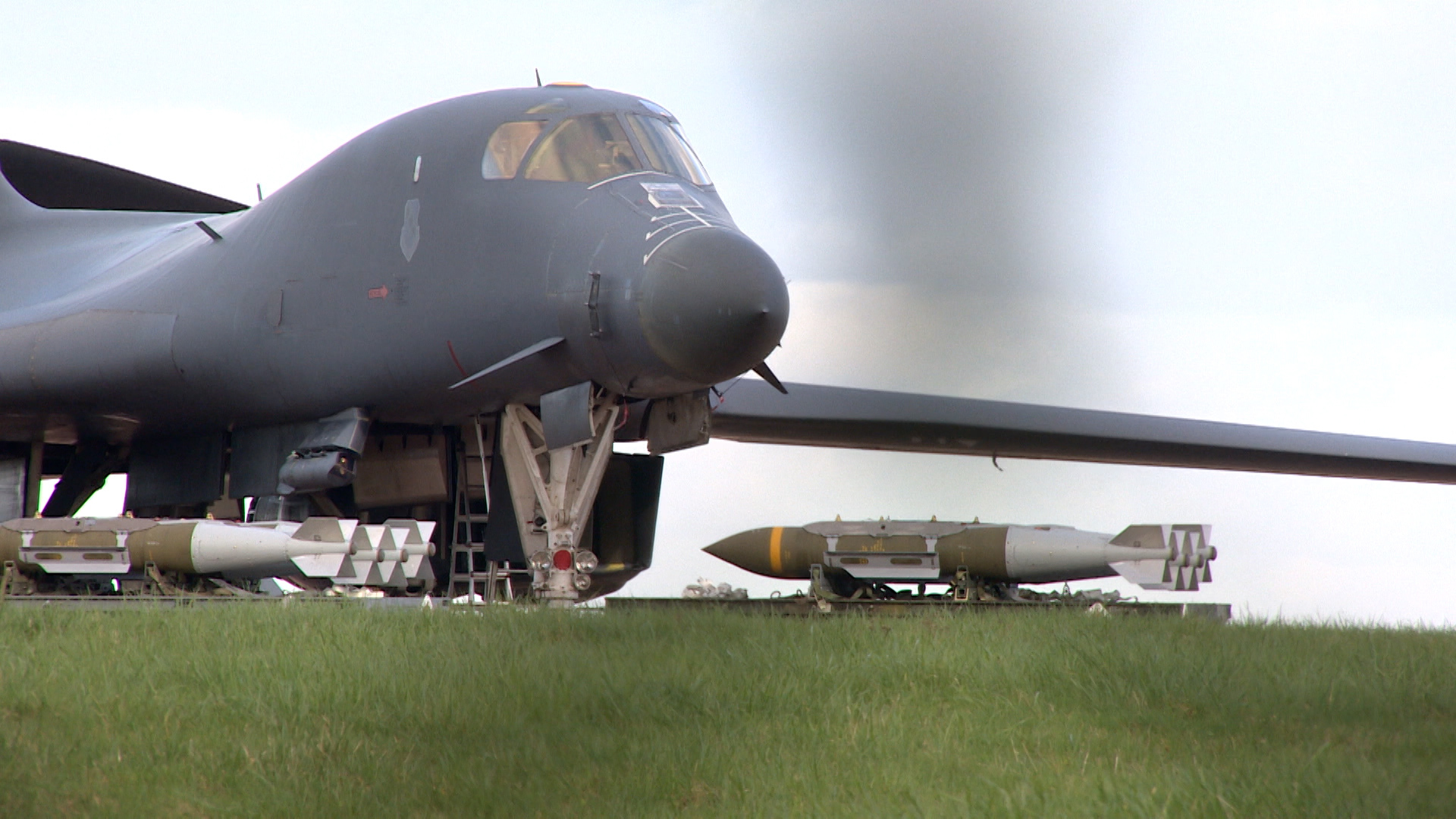

Three United States B-1B Lancer bombers have touched down at RAF Fairford in the United Kingdom after what is believed to be the first American strike mission against Iran launched from a British base, during the US-Israeli war on Iran.
Al Jazeera’s team witnessed the aircraft returning to the base as ground crews moved new stocks of bunker-busting bombs, fitted with JDAM (Joint Direct Attack Munition) guidance kits, across the runway.
- list 1 of 4Residents of this Beirut neighbourhood felt safe. Then Israel attacked it.
- list 2 of 4Iran says it targets Israeli bases, accuses Israel of targeting hospitals
- list 3 of 4Air attack hits house in suburbs of Tel Aviv
- list 4 of 4Who wins and loses in the global energy crisis?
end of list
Since the US and Israel first attacked Iran on February 28, the UK military has joined operations to intercept retaliatory Iranian drones and missile strikes across the Middle East, and has deployed additional assets to the eastern Mediterranean.
During the outbreak of the war, UK Prime Minister Keir Starmer said he had refused the US permission to use UK bases for attacks on Iran.
But on March 1, Starmer changed tack, stating that Westminster had approved a US request to use British bases for the “defensive purpose” of destroying Iranian missiles “at source” after a drone struck a British military base on Cyprus.
Yet, the latest operations at RAF Fairford signal a shift in the munitions used in the US bombing campaign and highlight the increasingly active role of British facilities in US strategic bombing operations.

The B-1B Lancer is a long-range strategic bomber capable of carrying large conventional payloads.
The bunker-busting bombs being prepared at RAF Fairford were fitted with JDAM kits, guidance systems that convert unguided bombs – such as the 500lb Mk-82, 1,000lb Mk-83 and 2,000lb Mk-84 – into precision-guided weapons by adding a GPS and inertial-navigation tail unit with control fins.
Advertisement
The kits can also be attached to penetrator bombs such as the BLU-109, which Israel has used in its war on Gaza, allowing aircraft to strike hardened or underground targets.
Once fitted, the bomb can be programmed with target coordinates and guided, though it typically must be released closer to the target than long-range standoff missiles.
Members of the House of Commons Defence Select Committee have been briefed on the use of British bases. Government officials have repeatedly talked of a “defensive” approach.
On Monday, the UK Secretary of State for Defence John Healey said British forces had “conducted defensive military operations from day one” of the war on Iran.
Meanwhile, polls indicate that the majority of the public opposes the war.
In a poll conducted by YouGov and published on Monday, only 10 percent of the British public surveyed “strongly supported” military action that the US has taken against Iran, with 37 percent stating that they “strongly oppose” it.
In another YouGov poll released on Wednesday, 61 percent of the public stated that they think the reasons for the US attacks on Iran remain “unclear”.
Related News

Near-blind Rohingya refugee dies after US agents left him far from home

China set to release new five-year plan at National People’s Congress

‘Russian oil will be sought’: What are Moscow’s gains from the war in Iran?