

Voters in Bangladesh will head to the polls on Thursday for the country’s first parliamentary elections since former Prime Minister Sheikh Hasina was ousted following her brutal crackdown on widespread student-led protests in 2024, which resulted in the deaths of an estimated 1,400 people.
Election campaigning ended on Tuesday morning.
Here is how voting works in Bangladesh.
Polls will open at 7:30am (01:30 GMT) on February 12 and close at 4:30pm (10:30 GMT).
Votes will be cast across 42,761 polling centres in 64 districts for 300 parliamentary constituencies, according to the Election Commission of Bangladesh (ECB).
How does voting work in Bangladesh?
There are 127,711,793 registered voters, aged 18 and above as of October 31, 2025, including those registered to vote via postal ballot within and outside the country. This is the first time postal voting has been facilitated, benefitting about 15 million overseas workers whose remittances form a vital part of the Bangladeshi economy.
Bangladesh has a “unicameral” legislature – a single legislative chamber which makes laws – the Jatiyo Shangsad or the House of the Nation, with 350 constituencies. Each constituency has a single-member seat.
Voting through the first-past-the-post (FPTP) electoral system is used to elect 300 members, while the remaining 50 seats are reserved for women and are allocated to parties proportionally after the election results. So, for example, if a party wins 60 seats, it receives 10 reserved seats to be allocated to female politicians.
Advertisement
Bangladesh operates a plurality voting system under which voters make one choice from a list of candidates and, after the votes are counted, the candidate with the most votes wins the seat.
This means that if a party wins a large number of seats by only small margins, this will be reflected through an imbalance between overall vote share and overall seats won.
Theoretically, one party could win 51 percent of the vote in every seat, while another could win 49 percent in every seat. The first party would receive 100 percent of the seats, however.
The party which wins 151 seats forms a government without the need for a coalition with other parties, regardless of how well other parties perform. The party with the second-highest number of seats forms the official opposition.

What’s at stake?
This is the first election since January 2024, when Hasina returned to office for a fifth term. That vote, boycotted by the main opposition Bangladesh Nationalist Party (BNP) amid a crackdown on opposition figures, was widely described by international observers and rights groups as not free or fair.
In July 2024, students in Bangladesh began protesting against a conventional job quota system, which reserved a significant share of prized government jobs for descendants of Bangladesh’s freedom fighters of 1971, now widely regarded as the political elite.
Hasina ordered a brutal crackdown as the protests escalated. Nearly 1,400 people were killed, and more than 20,000 were wounded, according to the country’s International Crimes Tribunal (ICT).
Hasina was eventually ousted, and she fled to India, where she remains in exile. Nobel laureate Muhammad Yunus took over as the country’s interim leader in August 2024.
Last year, Al Jazeera’s Investigative Unit obtained recorded evidence that the former Bangladeshi leader had ordered police to use “lethal weapons” against the protesters.
In November, she was convicted, in absentia, of crimes against humanity and sentenced to death by the ICT in Dhaka. India has so far not agreed to send her back to Bangladesh to face justice.
After Hasina went into exile, her Awami League party was also banned from all political activities.
Besides the vote for parliamentary seats, Bangladesh will hold a referendum on the July National Charter 2025, which was drafted by the caretaker government following the student protests and outlines a roadmap for constitutional amendments, legal changes and the enactment of new laws.
This election will serve as a litmus test for change in the country, experts say.
Advertisement
“Regardless of its outcome, this election will carry profound implications for the political trajectory of Bangladesh,” Khandakar Tahmid Rejwan, a lecturer in global studies and governance at the Independent University, Bangladesh, told Al Jazeera.
“The result of the referendum will serve as a critical indicator of whether the political spirit of July remains resilient or is gradually dissipating.”
Rejwan added that whoever wins the election will also have to grapple with the “Awami League question”, referring to Hasina’s party, which has been barred from politics.
“Under these circumstances, determining the future of the [Awami League], how long a substantial segment of the electorate aligned with the party can remain politically excluded, and under what conditions the party might be rehabilitated and reintegrated into democratic politics, will constitute a central challenge for the next government.”
The biggest groups vying for parliamentary seats are the two main coalitions.
Bangladesh Nationalist Party
The centre-right BNP is leading a coalition of 10 parties.
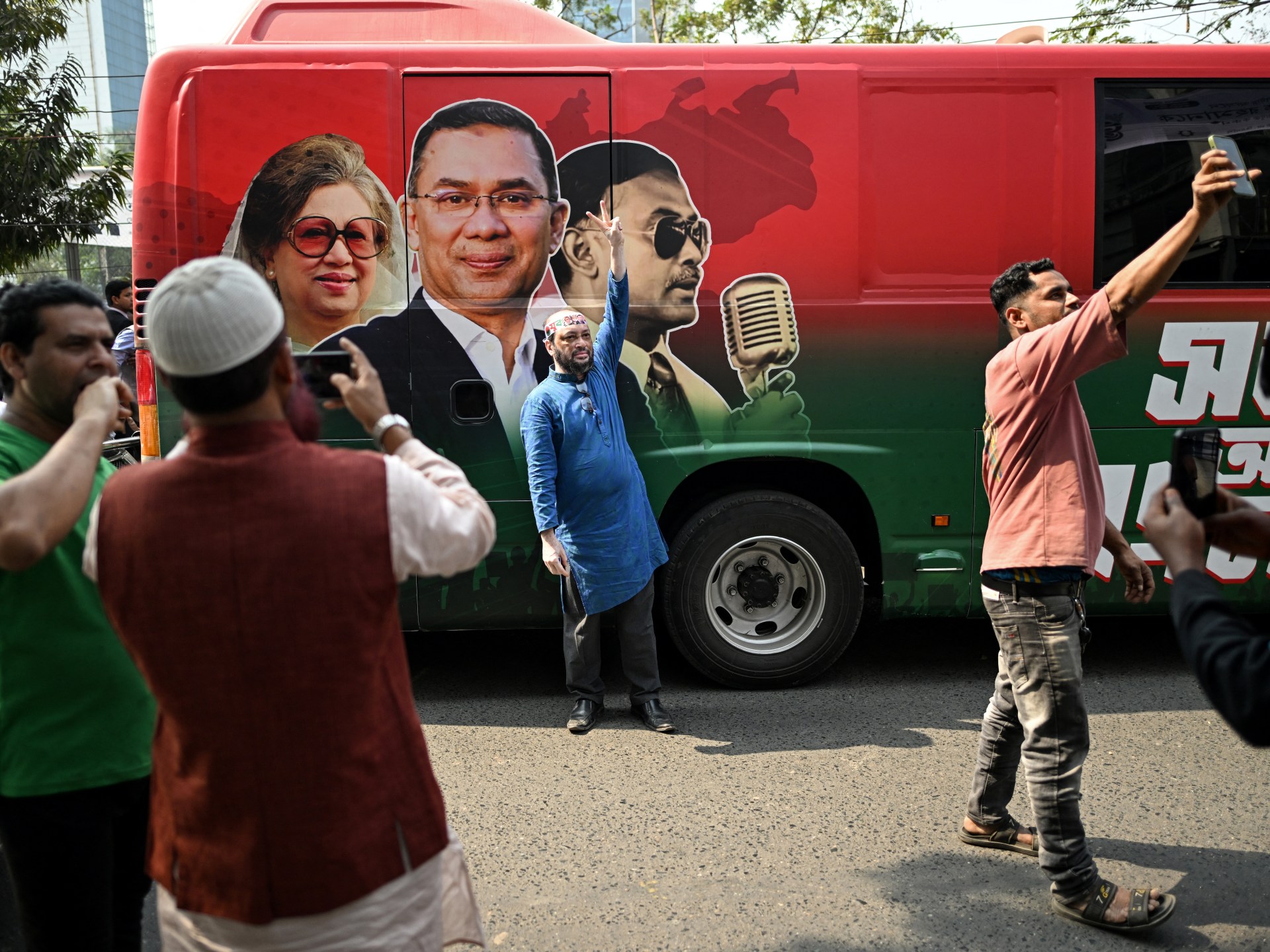
It is led by Tarique Rahman, the son of the late former Prime Minister Khaleda Zia. In December, Rahman, 60, returned to Bangladesh after nearly 17 years of exile in London. He had escaped the country in 2008 amid what he deemed a politically motivated persecution.
The BNP was founded by Rahman’s father, Ziaur Rahman, a prominent military figure in the country’s independence war against Pakistan in 1971, in 1978.
The party states that it was built on the principles of Bangladeshi nationalism. According to the BNP website, this is an “ideology that recognises the right of Bangladeshis from all walks of life, irrespective of their ethnicity, gender or race”.
The BNP has traditionally swapped positions as governing and opposition party with the Awami League since independence.
After Ziaur Rahman’s assassination in 1981, his wife Khaleda Zia led the BNP, serving twice as prime minister, from 1991 to 1996 and from 2001 to 2006.
During this time, the Islamist Jamaat-e-Islami (JIB) was a key ally of the BNP against the Awami League.
After Hasina returned to power in 2009, the BNP came under intense pressure; Khaleda was placed under house arrest following a conviction in 2018 on corruption charges, but was acquitted and freed after Hasina was ousted in 2024.
Since Hasina’s departure, the BNP has re-emerged as a leading political force.
Jamaat-e-Islami
The JIB, commonly known as Jamaat, spearheads an 11-party alliance, including the National Citizen Party (NCP), a group formed by students who led the protests against Hasina in 2024. The party is led by 67-year-old Shafiqur Rahman.
Jamaat was founded in 1941 by Abul Ala Maududi when India was still under British colonial rule.
In 1971, Jamaat opposed Bangladesh’s independence from Pakistan and was banned after the liberation. However, the BNP government lifted the ban in 1979.
Jamaat burgeoned into a significant political force over the next two decades, backing BNP-led coalitions in 1991 and 2001.
Advertisement
While Hasina was in power from 2009 to 2024, five senior JIB figures were executed, and others jailed for 1971 war crimes, and the party was barred from elections in 2013.
In June 2025, the Supreme Court restored its registration, allowing it to contest again. Jamaat is no longer allied with the BNP and is, instead, facing off against it as its biggest rival in the upcoming election.
In a bid to win support from non-Muslim voters, Jamaat is fielding one Hindu candidate, Krishna Nandi, from Khulna for the first time in its history.
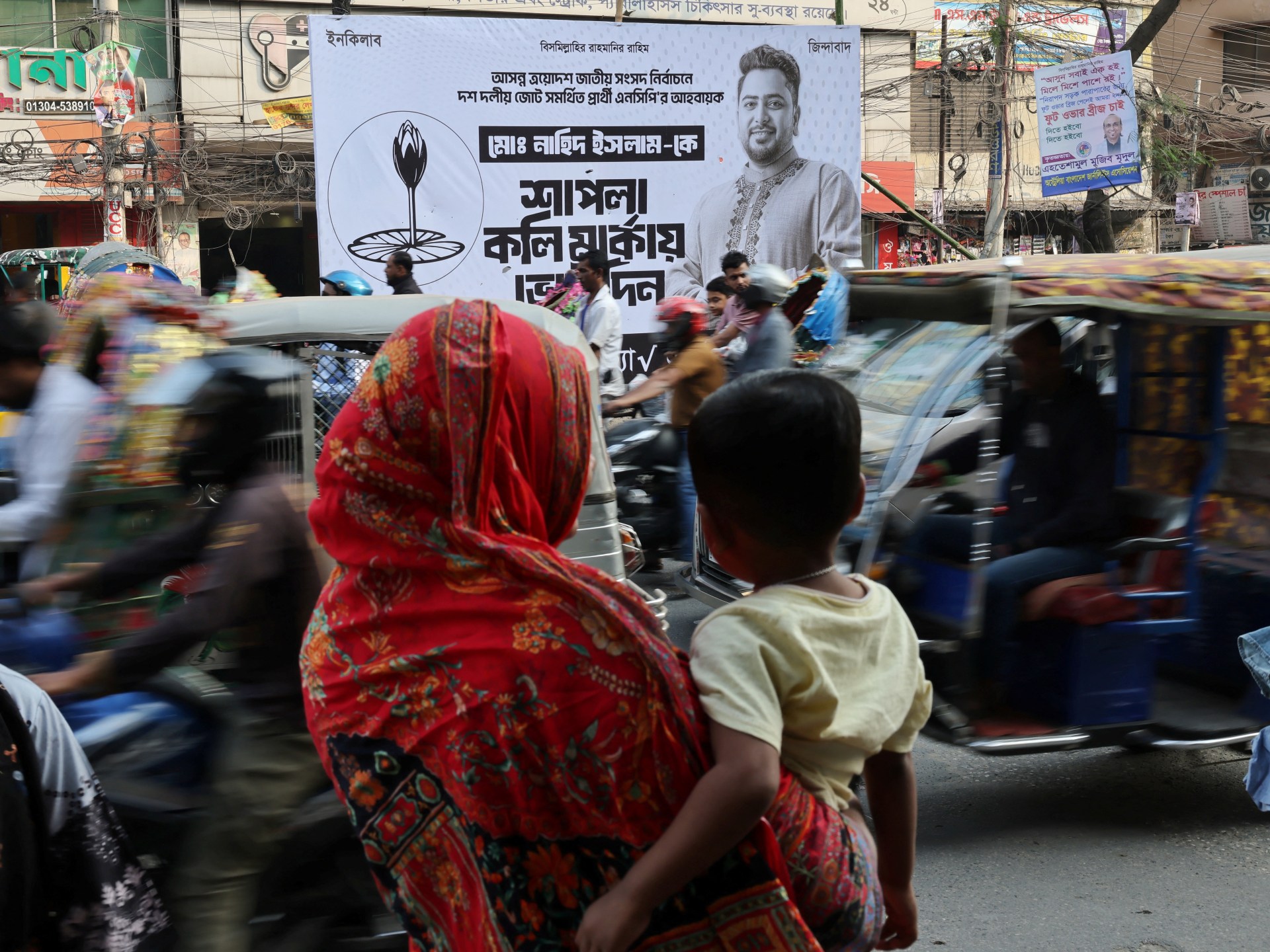
JIB ally NCP was formed in February 2025 by students who led the mass protests in July 2024. It is led by 27-year-old Nahid Islam.
Independent University’s Rejwan said the election will serve as a test of how strong the Jamaat really is, and will determine Bangladesh’s path on the global stage.
“A victory by the BNP would likely signal a move towards detente with India amid existing diplomatic strains, alongside a more balanced and diversified engagement with external partners that avoids rigid alignments or geopolitical binaries,” Rejwan said.
“In contrast, a JIB-led government may pursue a markedly different approach. It could seek to counter India’s apprehensions by cultivating closer ties with Pakistan and Turkiye, as well as with either China or the United States, or both.”
Non-allied parties
A JIB-alliance breakaway party, the Islami Andolan Bangladesh, and the Jatiya Party, a longtime ally of Hasina’s Awami League, are contesting the elections independently.

What do opinion polls suggest so far?
A survey by the United States-based International Republican Institute, published in December 2025, put the BNP’s support at 33 percent.
The survey placed Jamaat closely behind the BNP, with 29 percent.
When will the results be known?
In previous elections, unofficial results have typically begun to emerge early the following morning.
ECB officials have told local media, however, that the vote count may take longer this time as it will involve both the white parliamentary voting ballot and the pink ballots for the referendum on the July National Charter.
There is also a higher number of parties and candidates this time.

“After nearly 17 years, the electorate anticipates the opportunity to participate in a genuinely competitive and meaningful electoral process in which individual votes carry real weight,” Rejwan said.
Since Hasina rose to power in 2009, the fairness of each election in Bangladesh has been questioned by opposition parties.
Additionally, the election is significant because “young voters constitute a substantial proportion of the electorate, many of whom will be casting their votes for the first time”.
He said, “This generation was also at the forefront of the popular movement that challenged and ultimately deposed the autocratic rule of Sheikh Hasina.”
The rapid rise of Islamist parties in both domestic politics and the public sphere, as well as the absence of the Awami League, one of Bangladesh’s largest and most influential political parties, from the electoral contest, are also highly significant, he said.
“This altered political configuration has transformed traditional alliances into arenas of competition. Former allies, such as the BNP and the JIB, now find themselves as rivals despite their earlier cooperation in opposing the Hasina regime.”
“Taken together, the longstanding public demand for a free and fair election, the unprecedented possibility of constitutional and structural transformation of the state, the decisive presence of a large Gen-Z electorate, and the growing popularity of Islamist parties such as the JIB render this election one of the most consequential in Bangladesh’s political history,” Rejwan concluded.
Advertisement
Related News
Russia-Ukraine war: List of key events, day 1,442

Trump hosts Honduras’s new president Asfura at Mar-a-Lago in US
WHO says fatal case of Nipah virus confirmed in Bangladesh