


Madrid, Spain – After losing his left arm in a farming accident, Joel Caceda struggles to work delivering packages.
His tough job is typical of many that migrants are forced to take when they arrive in Spain without any legal papers.
- list 1 of 4Trump suspends immigrant visas for 75 countries: Who’s affected?
- list 2 of 4One-year-old twin girls missing after migrant crossing to Italy: NGO
- list 3 of 4Protests in Paris over death of migrant worker in police custody
- list 4 of 4From a refugee family to Nobel Laureate: Omar Yaghi’s story
end of list
So, the 30-year-old Peruvian welcomed the news that Spain plans to regularise about 500,000 undocumented migrants, in a break with harsh policies on immigration elsewhere in Europe, in countries like Denmark, Germany and Austria, and in the United States.
“This is good for me and many others. It will mean the chance to become legal after six years working here without any official papers,” he told Al Jazeera from his home in Barcelona.
“It will give me the chance to get a flat with my partner and her daughter and live a better life.”
His story is typical of tens of thousands of migrants who work in what is known as the “black economy” in Spain, where they fight bureaucracy for years to win legal status.

Spanish Migration Minister Elma Saiz told a news conference on Tuesday that the beneficiaries would be able to work “in any sector, in any part of the country” and pointed to “the positive impact” of migration.
“We are talking about estimations, probably more or less the figures may be around half a million people,” she added, saying the government was “recognising” and giving dignity to people already in Spain.
Advertisement
Socialist Prime Minister Pedro Sanchez has said Spain needs migration to fill workforce gaps and counteract an ageing population that puts a strain on pensions and the welfare state.
Laetitia Van der Vennet, of the Platform for Undocumented Immigrants, an NGO, said the Spanish policy was a welcome contrast to the anti-migrant wave in Europe and the US.
“At a time when a hostile environment against migrants is spreading on both sides of the Atlantic, this move shows both humanity and common sense,” she said.
Ousman Umar knows only too well the struggle of countless migrants who head to Spain hoping to forge a new life in Europe.
The son of a witch doctor from Ghana, he spent five years trying to reach the “promised land” of Europe after leaving his remote village in the west African country.
At one stage, he was abandoned by smugglers in the Sahara and thought he would die. He only survived by drinking his urine.
After making it to Spain, he lived on the streets before he was adopted by a family. He attended one of the top business schools in Europe and founded NASCO Feeding Minds, an NGO which gives children in Ghana the chance to choose their own future by providing training and computers.
“This is not only going to be good for migrants but the whole society. It will mean that these people can start working legally, pay taxes and social security,” Umar told Al Jazeera.
“This will mean that all these people pay into the pension system in a country where the birthrate is low and there is a growing number of older people.”
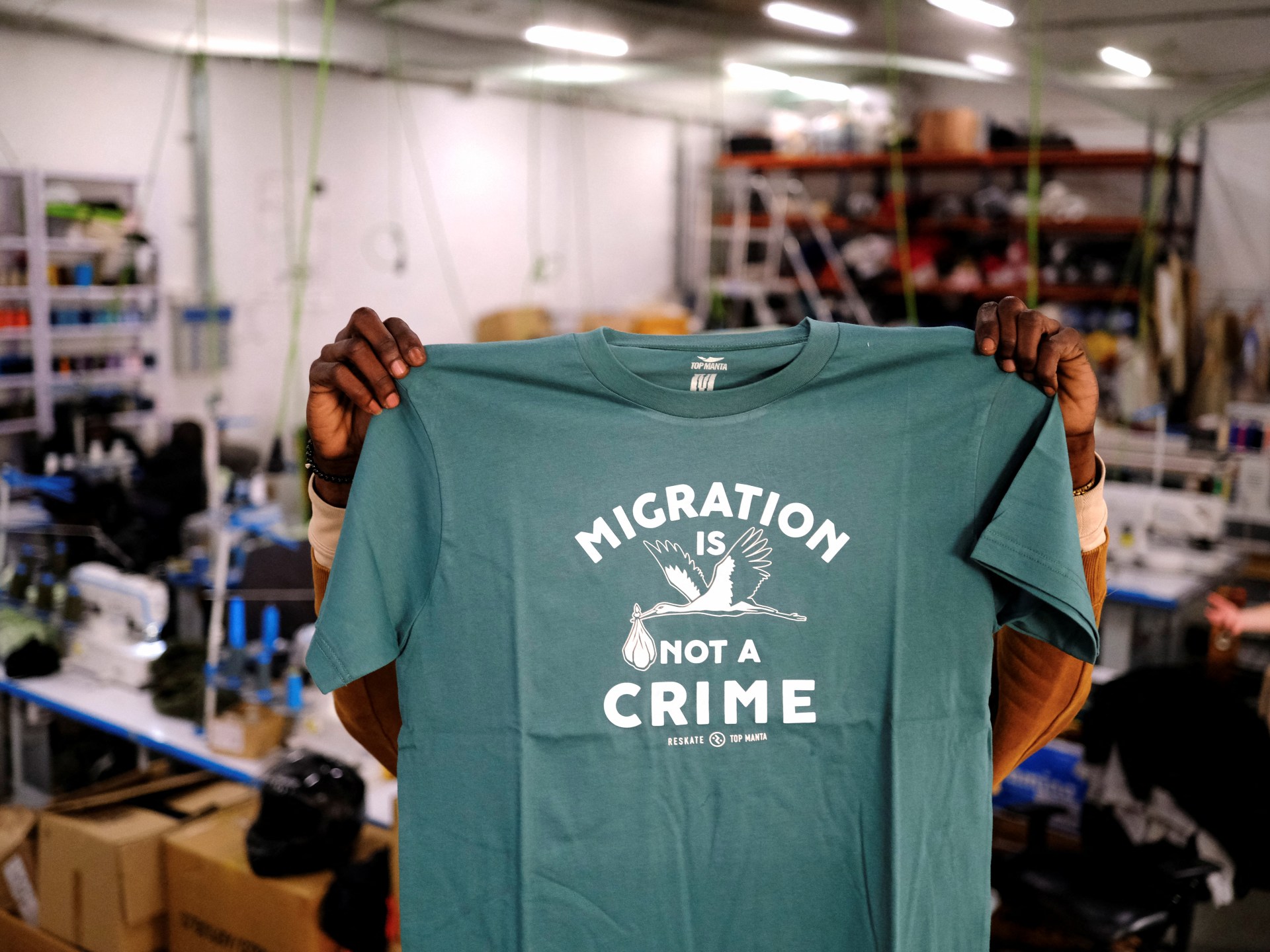
Lamine Sar, who arrived in Spain from Senegal 18 years ago, works with the Top Manta fashion label, which celebrates the work many migrants are forced to do, selling fake football shirts or handbags on sheets – known as mantas – in the streets.
“This is a huge step forward, not just for migrants in Spain but for everyone. It will mean these people contribute to society instead of being used in a kind of slavery in the black economy,” he told Al Jazeera.
The measure will apply to those living in Spain for at least five months and who had applied for international protection before December 31, 2025.
The regularisation will also include children of the applicants who already live in Spain. Applications start in April and run until June.
Spain’s government passed a decree that will not need to be passed in parliament, where the Socialist-led coalition lacks a majority and might have met with staunch opposition from the opposition conservative People’s Party and the far-right Vox party.
Advertisement
“The invasion kills. The arrival of half a million migrants will be a call to another half million migrants and put under strain on our health system, social security and security,” wrote Santiago Abascal, leader of Vox, in a message posted online.
Irregular migration to Spain fell by more than 40 percent last year, mainly because of deals struck between the Spanish government and those in Morocco and West Africa to increase security and cooperation.
Related News

Iran: The protests, the blackout and the narrative war
US-backed Palestinian committee shares mission statement on Gaza governance
‘Not optimistic’: In Ukraine, scepticism surrounds peace talks