

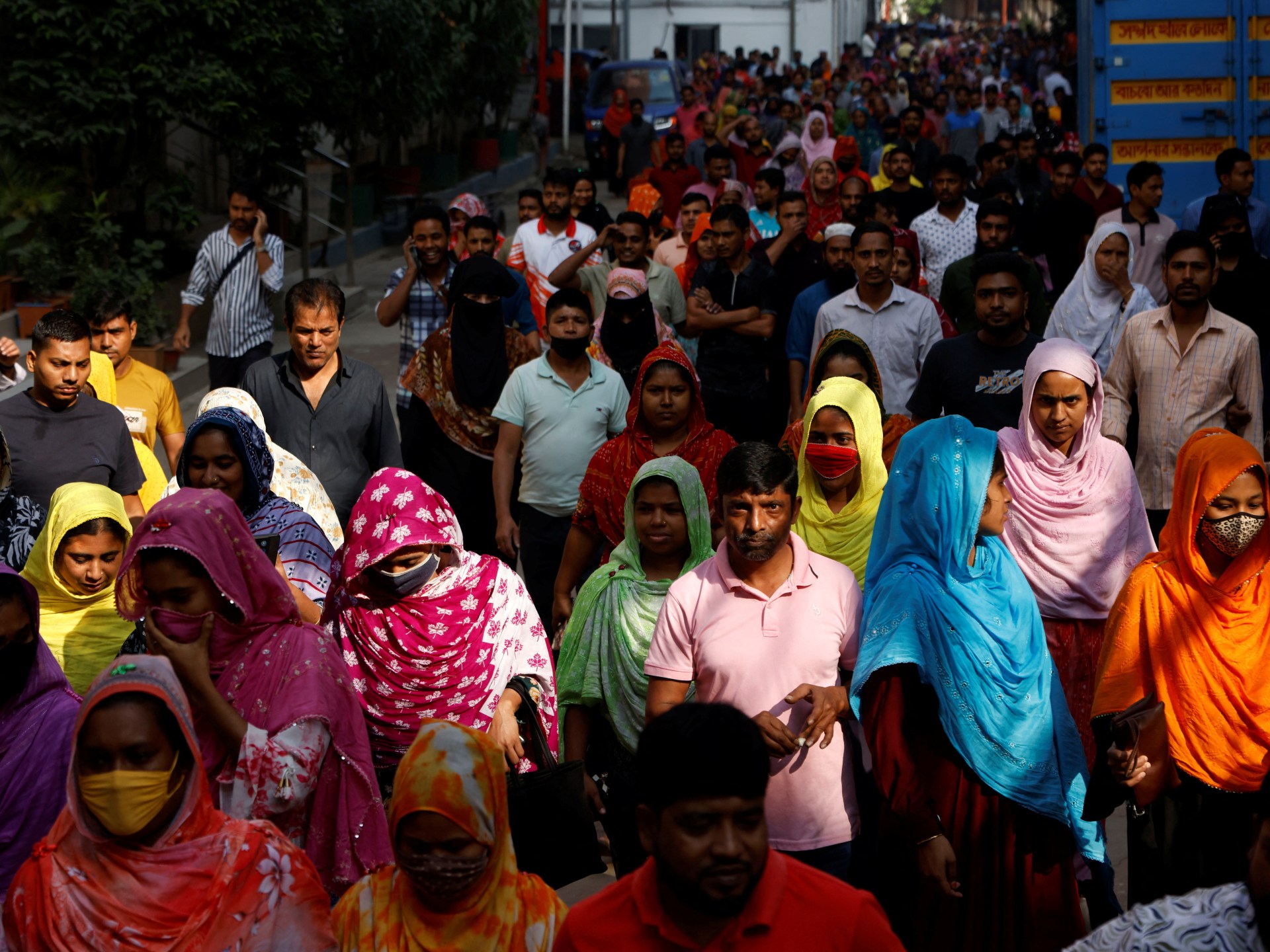

The protests have cost Bangladesh hundreds of millions, but it is unclear whether workers will accept the offer.
Workers in Bangladesh’s garment sector have been offered a 36 percent pay rise after months of protests that are estimated to have cost the country’s economy hundreds of millions of dollars.
The chairman of Bangladesh’s government-appointed garment industry wage board said on Wednesday that the “majority” of the board had agreed to increase the sector’s minimum wage from 12,500 taka ($100) to 17,500 taka ($136) monthly.
Recommended Stories
list of 3 items
- list 1 of 3‘Going hungry’: Garment workers in Bangladesh say wages barely cover needs
- list 2 of 3Bangladesh police clash with garment workers amid protests over wages
- list 3 of 3Protesting Bangladesh garment workers reject pay offer
end of list
Bangladesh’s central bank calls the garment sector the “country’s export engine”. It earns roughly $38bn a year, employs four million people, and accounts for four-fifths of the country’s exports. Many of the industry’s workers are women in rural areas.
The 17,500 taka offered is below the 30,000 taka ($240) that protesters had asked for, and it’s not currently clear whether they will accept the amount offered.
“Although we are not completely satisfied, the outcome is not entirely bad either,” Babul Akhter, the labour representative on a wage board set up to resolve the crisis, told reporters. Akhter urged workers to return to their factories.
“Previously, workers used to get a wage revision every five years, but this time they are getting a revised wage after three years.”
The wage hike will take effect in December, with workers receiving the new salaries in January.
An economic success
The Bangladesh Garment Manufacturers and Exporters Association (BGMEA) said on Sunday that protests had cost the industry an estimated $428m in losses, while orders worth $254m had moved to other countries.
Advertisement
Bangladesh is the world’s second-largest garment exporter, behind China. Home to 170 million people, the garment industry has proved an economic success story that has driven development in the South Asian country.
That has, at times, come at a cost: in 2013, the Rana Plaza factory collapse killed 1,134 people and injured thousands, exposing poor safety standards and working conditions for the millions of workers in the industry.
Numerous other incidents, including fires, have resulted in deaths – sometimes killing dozens.
Related News
Mosque set on fire in Israel, politicians blame Netanyahu’s ‘incitement’

El Salvador’s Bukele expected to formalise bid for third presidential term
Democratic Party flips US Senate in 2026 midterm elections