

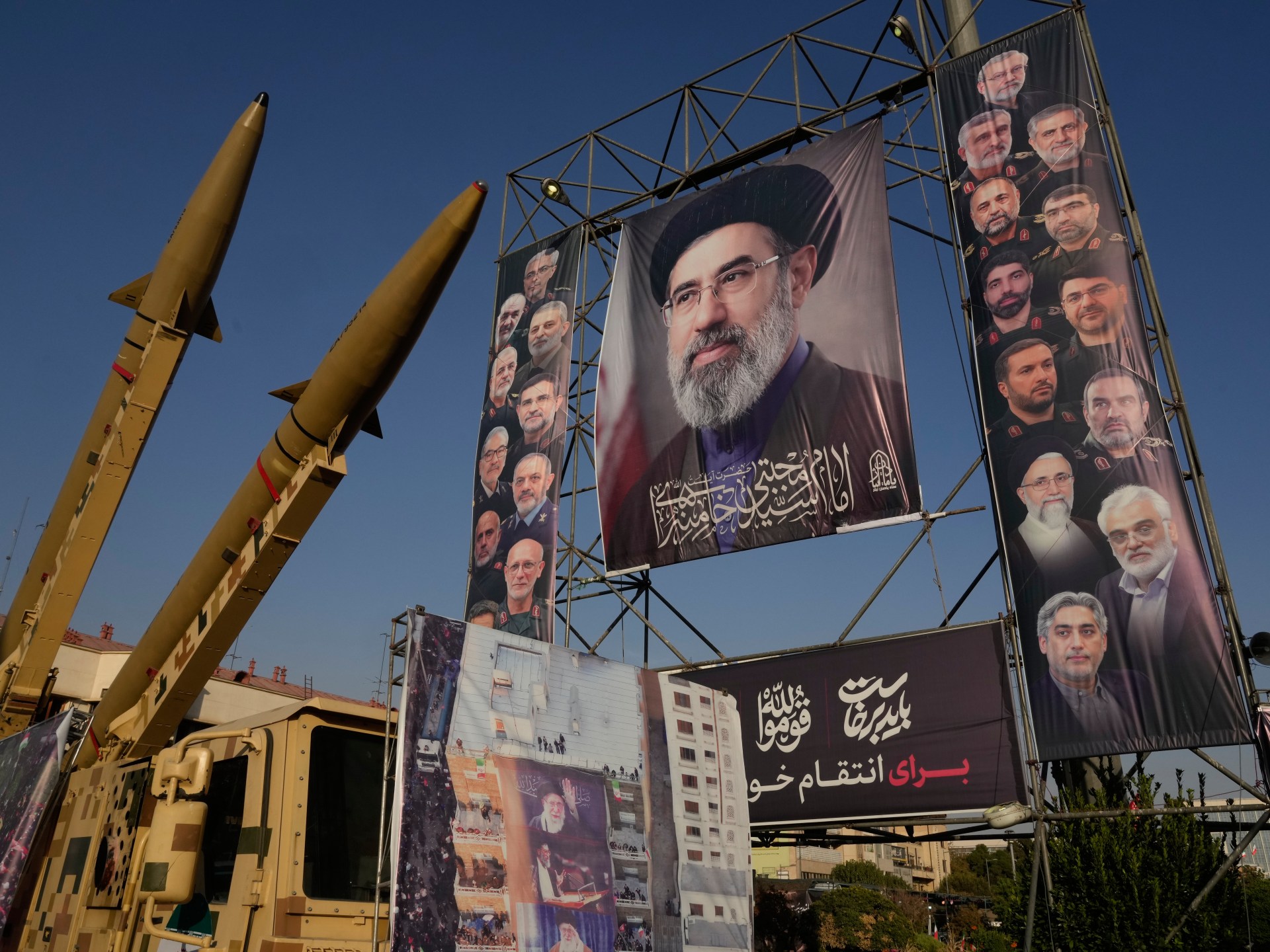

Iran’s Foreign Minister Abbas Araghchi has said the country’s stockpile of enriched uranium will be used according to its needs, “however they are defined”, as he spoke about possible changes to Iran’s longstanding nuclear doctrine.
Araghchi’s comments during an interview with Iranian media on Saturday have increased speculation that Iran may be moving away from its policy of limiting its nuclear programme to civilian purposes amid its conflict with the United States.
Recommended Stories
list of 3 items
- list 1 of 3Is Iran plotting a ‘dirty bomb’ attack in the US? What we know
- list 2 of 3US Navy chief says Iran war has put ‘strain’ on maritime forces
- list 3 of 3Trump claims Iran is developing bioweapons: Is there any evidence?
end of list
The future of Iran’s nuclear programme has become a major sticking point in efforts to end the war, with Washington insisting that it must have guarantees that Iran will never develop a nuclear weapon before it will agree to a full ceasefire.
So, is Iran’s nuclear policy changing, and what could that mean for the conflict?
What is Iran’s official nuclear policy?
Iran has consistently maintained that its nuclear programme is for peaceful purposes only, such as for electricity generation, medical research and agriculture.
This policy has been underlined by a decades-old religious decree, or fatwa, issued by the late Ayatollah Ali Khamenei, banning the development of nuclear weapons.
However, Iran has also insisted it has the right to enrich uranium for these purposes under the Treaty on the Non-Proliferation of Nuclear Weapons (NPT), which it joined in 1970. It has called this right “non-negotiable”.
What have Araghchi and other officials said?
In an interview with Iran’s state-run IRNA news agency on Saturday, Araghchi reiterated that Iran’s stockpile of enriched material would remain inside the country.
Advertisement
The International Atomic Energy Agency (IAEA) estimated in 2025 – before Israel launched strikes on Iran in June that year – that Iran had about 440 kilogrammes (970 pounds) of uranium enriched to about 60 percent. This is short of the 90 percent required for making nuclear weapons, but is the level at which it becomes much quicker to reach 90 percent. It is also far beyond the roughly 3 percent needed for power generation.
This material, Araghchi said during his interview, would “be used according to our needs however those needs are defined”.
Araghchi also made reference to an ongoing debate among lawmakers and officials in Iran about altering its nuclear doctrine, and said people on both sides of that debate have “strong arguments”.
“This is a major strategic debate, and there is nothing wrong with examining it seriously because it directly concerns national interests and security,” Araghchi said, adding that those in favour of reform argue Iran’s current approach of no nuclear weapons has “failed to protect” the country’s nuclear facilities, which have come under attack from US and Israeli forces both last year and this year.
However, Araghchi acknowledged that any official change to the policy would have “far-reaching consequences”.
“For now, our doctrine has not changed, and our official position remains the same,” he said.
Other Iranian officials have also spoken about a potential review of the country’s nuclear doctrine. Earlier this month, security chief Mohsen Rezaei said “there is a discussion on whether we want to continue to follow the previous nuclear doctrine in the event of a new war breaking out”, though he also stressed that Tehran has not yet made any change.
On November 12, Iran’s Assembly of Experts, the body that appoints the supreme leader, said reviewing “the country’s defence doctrine and establishing the necessary deterrence have become unavoidable necessities”.
Ali Fathollah-Nejad, a German-Iranian political scientist who directs the Center for Middle East and Global Order (CMEG), told Al Jazeera the move by the Assembly of Experts “appears to mark the first time a governing institution has endorsed this position”.

Why do the US and Israel think Iran is developing nuclear weapons?
Besides being a signatory to the NPT in 1970, Iran also initially complied with a nuclear agreement it struck with the US and other global powers in 2015 – the Joint Comprehensive Plan of Action (JCPOA), which required it to limit uranium enrichment to very low levels and undergo inspections.
Advertisement
But after Washington pulled out of the deal in 2018 under the first administration of US President Donald Trump, Tehran eventually went back to intensifying its nuclear programme and abandoned restrictions imposed by the deal.
In June 2025, the IAEA’s board of governors declared Iran was no longer complying with its commitment to international nuclear safeguards. Tehran rejected that report and accused the IAEA of giving a pretext for US and Israeli attacks targeting Iranian nuclear facilities, including Fordow, Natanz and Isfahan, just days later during the 12-day war.
In March of this year, IAEA chief Rafael Grossi said at least 200kg (440lbs) of Iran’s enriched material was believed to have survived the US-Israeli attacks and was likely buried underground in or near the Isfahan nuclear facility site.
Grossi has since said the agency cannot verify the amount or location of Iran’s enriched material due to a lack of access.
The IAEA has called Iran’s enrichment level “a matter of serious concern”, while the US has pointed to it as evidence that Iran is pursuing nuclear weapons despite its official policy.
“If you don’t want a nuclear weapon, then why do you need 60 percent enriched fuel?” US Vice President JD Vance said in an interview with the Reuters news agency last month. “And if you want to show commitment to not building a nuclear weapon, don’t build highly enriched fuel. That’s a very basic threshold issue.”
President Trump has repeatedly stated that Iran must never be allowed to develop a nuclear weapon.
Officials in Israel, which is widely believed to have its own undeclared nuclear weapons, have also long accused Iran of pursuing nuclear weapons.
“The Iranian regime, which seeks to destroy Israel, is once again working to revive its nuclear programme,” said Israel’s now-caretaker Prime Minister Benjamin Netanyahu in an address last week. “We must remove this existential threat once and for all.”
Will Iran officially reverse its no-nuclear-weapons policy?
That remains to be seen, but it is “within the realm of possibility”, Rouzbeh Parsi, an Iran analyst and affiliated researcher at Lund University’s Department of History and Human Rights Studies, told Al Jazeera.
He said the US-Israeli war launched against Iran in February this year “has significantly changed all the calculations in Tehran”, with more open discussion about whether to renew the late ayatollah’s ban on nuclear weapons now taking place.
“What used to be a fringe opinion, leaving the NPT and potentially going for a nuclear weapon, is now something that’s within the realm of possibility – even though all the major players are still warning against it,” said Parsi. “It’s not a decision but an indication that deterrence is being rethought in light of the war.”
Simon Mabon, a professor of international politics at Lancaster University, told Al Jazeera that a “broadly rational defensive reason” for potentially shifting Iran’s nuclear policy is emerging within the country, though adding that such a shift would be legally and ethically problematic.
Advertisement
“If you look at the sort of traditional nuclear logic, it says that nuclear weapons play a very strong defensive role in deterring the actions of another state,” Mabon told Al Jazeera. “That would be very sound logic for the Iranians in light of what’s happened.”
“This, of course, is something that’s deeply problematic,” said Mabon. “It goes against the terms of the NPT, it goes against the spirit of the NPT, so it would necessitate withdrawal from that.”
CMEG director Fathollah-Nejad said that there are serious divisions within Iran’s government over the direction of its nuclear programme.
Hardline lawmakers and religious leaders view Iran’s nuclear and missile assets as “indispensable” to “regime security and deterrence”, while a separate camp that includes former Foreign Minister Mohammad Javad Zarif argues against the development of nuclear arms, saying it would “almost inevitably” trigger further attacks by the US and Israel, said Fathollah-Nejad.
For now, he added, Iran “plays with the ambiguity” of its nuclear policy.
What does this mean for US-Iran negotiations?
Fathollah-Nejad said a shift in Iran’s nuclear doctrine would directly counter the US’s “single most important goal” in the conflict: to secure nuclear concessions from Tehran.
The US has insisted Iran must make nuclear commitments at the outset of any negotiations, while Iran wants its own seven stated conditions met, including lifting the blockade, restoring access to its frozen assets and ending hostilities on all fronts, before even beginning discussions about its nuclear programme.
Mabon said a change in Iran’s nuclear policy “would have a dramatic impact on how the Americans and the Israelis read the next phase of this conflict”, with the Israelis likely believing it necessitates a “return to violence”.
“That’s where some of the other dangers start to come in,” Mabon added. “The shift in Iran’s doctrine, even if it’s meant intentionally as a defensive shift, can easily be read in offensive terms.”
“I think it’s a very, very dangerous moment,” he said.
Related News
US blames system upgrade for longest nationwide FAA ground stop since 9/11
Activists accuse Israeli settlers of assault in occupied West Bank
Russian bombing of Ukrainian aid centre kills 24 people: Zelenskyy