

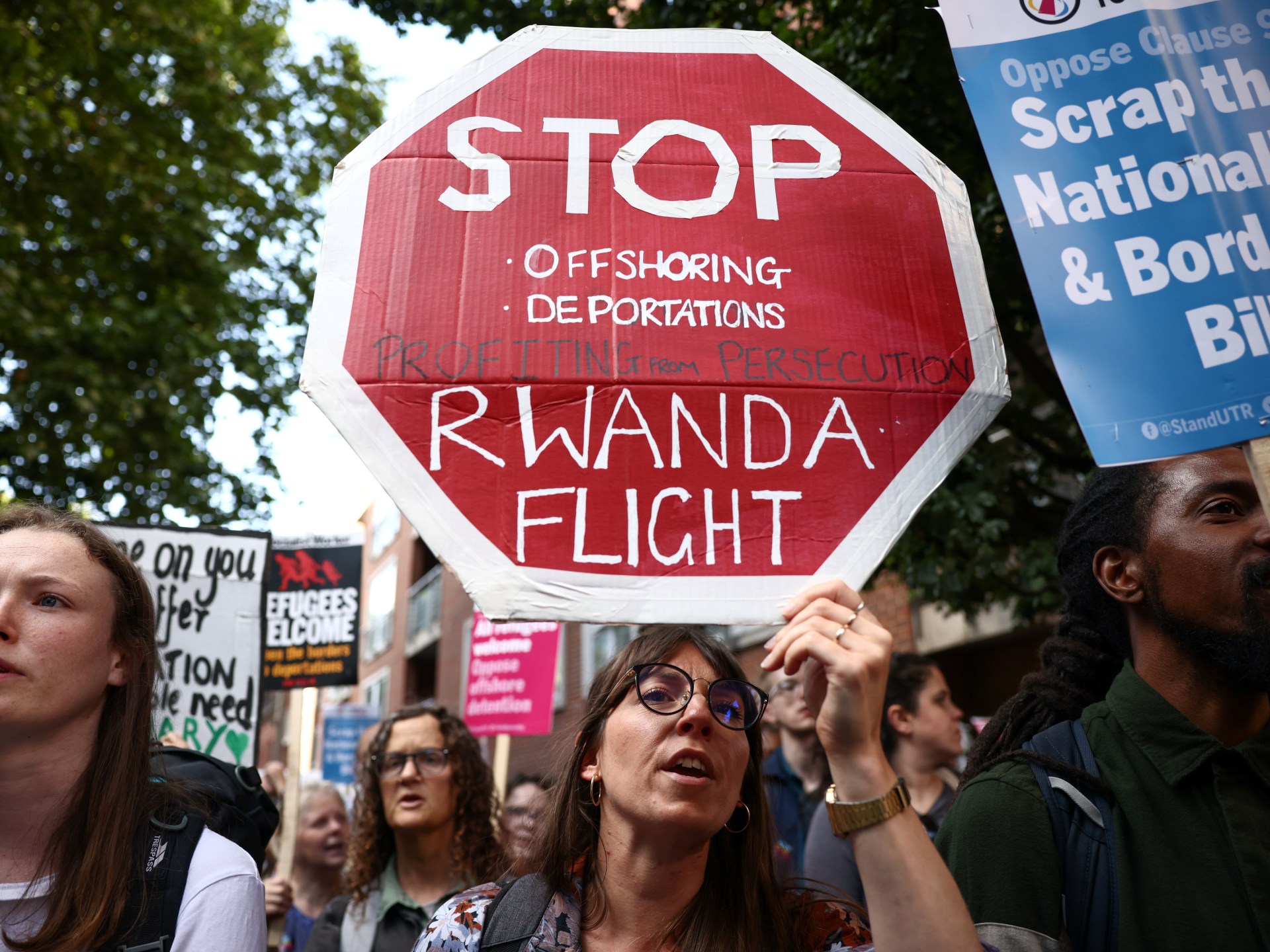

London, United Kingdom – The seven asylum seekers were on the runway, their plane bound for Rwanda from a military airport in southern England.
It was mid-June 2022.
- list 1 of 3Exiled critic of Rwandan president found beheaded in Uganda
- list 2 of 3Five EU countries announce plan to send rejected asylum seekers to Rwanda
- list 3 of 3Why are five EU countries reviving plans to deport migrants to Rwanda?
end of list
They were being sent thousands of kilometres away to a country they had never visited and with little idea of what awaited them.
But after much legal wrangling, a ruling from the European Court of Human Rights (ECHR) stopped their deportation minutes before the flight was due to take off.
British immigration lawyer Alasdair Mackenzie, who was involved in the case, said the people being deported – among them Iranians, Iraqis, an Albanian and a Vietnamese citizen – were terrified.
“A lot of them were in an absolutely desperate state,” he told Al Jazeera. “They felt terrified as they were going to a place they didn’t know, being shunted around like packages. Rwanda is a very repressive country. There were concerns that asylum seekers would not be able to speak up or protest about their conditions.”
Four years later, European governments are preparing to revive the idea.
Germany, Denmark, Greece, Austria and the Netherlands announced plans on Monday to establish a deportation centre in Rwanda for people whose asylum claims have been rejected. The proposal is part of a wider European push to increase removals by transferring rejected asylum seekers to “return hubs” in countries with which they have no previous connection.
Rwanda has pledged independent monitoring and the involvement of the Office of the United Nations High Commissioner for Human Rights. It has also pushed back against concerns from rights groups. On Tuesday, after 47 organisations decried the proposal and warned that Rwanda does not respect international human rights standards, Interior Minister Vincent Biruta said: “Human rights in Rwanda are respected and granted to everyone and specifically to refugees who choose to come to our country.”
Advertisement
Rwandan investigative journalist Samuel Baker Byansi, who now lives in an undisclosed location in Europe, said of the new plans: “This partnership buys their silence.”
In 2022, Byansi was investigating Rwanda’s suspected military activities in the neighbouring Democratic Republic of the Congo (DRC) with his colleague John Williams Ntwali. He said he received warnings that they both could be arrested or killed.
“I received a tip from credible sources that me and my colleagues would be subject of arrest or elimination. I had a way to leave the country, so I did. John died months later,” he told Al Jazeera.
Ntwali officially died in a reported road accident, but Byansi and human rights monitors have questioned the circumstances surrounding his death.
Byansi fears the migration deal will give the Rwandan government another way to deflect international scrutiny.
President Paul “Kagame puts Western governments in a position where they cannot hold him accountable.”
Kagame, Rwanda’s leader since 2000, has been praised for overseeing the country’s economic transformation after the 1994 genocide. But his government faces persistent accusations of repression.
The UN and other organisations have repeatedly accused Rwanda of supporting the armed group M23 in its war in the eastern DRC. In October, the United States announced sanctions against Rwanda’s Ministry of Defence over its “destabilising activities”.
In October, a prominent critic of the Rwandan government was found decapitated outside the Ugandan capital, Kampala.
Amnesty warns of ‘real danger’
Amnesty International argued that transferring asylum seekers and migrants to a country with such a record risks leaving them with little protection or ability to challenge their treatment.
“Sending people to a country they have never been to is irresponsible, and there is a real danger that the Rwanda deal will, with its limited chance for scrutiny, become a cruel black hole for human rights,” the rights group said.
Some are concerned about the potential to monitor the treatment of people after they are deported.
Tineke Strik, a Dutch member of the European Parliament, visited Rwanda in September to inspect facilities in Kigali that could be used to house Europe’s rejected asylum seekers.
Rwandan officials presented the proposal as a mutually beneficial arrangement, telling her the people who arrive could remain in the country and eventually receive residency or citizenship.
“The authorities were pitching the scheme as a win-win,” Strik told Al Jazeera. “… But it was not possible for us to verify their claims as there are no [domestic] NGOs expressing criticism.”
Advertisement
Strik also tried to establish the whereabouts and wellbeing of people recently deported to Rwanda by United States President Donald Trump’s administration but was unable to obtain details.
“It made me convinced how impossible it will be for European governments to check on what is happening over there.”
Rwanda has previously been used as a destination for deported asylum seekers. From 2013 to 2018, Israel sent thousands of Eritrean and Sudanese citizens to the country. Many reportedly subsequently left Rwanda or were deported elsewhere.
The United Kingdom’s proposed arrangement with Kigali in 2022 accumulated estimated costs of $940m but resulted in just four voluntary transfers before the Supreme Court ruled it unlawful. The Labour government abandoned it in 2024, the same year the party won a general election and returned to power.
The European proposals would apply to people whose asylum claims have been rejected, rather than potentially all unauthorised arrivals.
But lawyers involved in the earlier British scheme remain concerned about the consequences of sending people to a country where they may struggle to challenge their treatment.
In 2018, Rwandan police fired on several Congolese refugees protesting against food cuts in the country’s west. Twelve died in an incident that has added to concerns about the protection available to vulnerable refugees and migrants already living there.
Kigali has nevertheless defended its role as a potential destination for deported asylum seekers and migrants.
Rwanda hosts large numbers of refugees, predominantly from neighbouring DRC and Burundi. Interior Minister Biruta described Rwanda’s policies as “progressive” because they allow people to work and launch businesses.
Dissent from Spain’s Sanchez to a Dutch politician: Deal ‘will not work’
The proposals have also exposed divisions within Europe over how far governments should go to deter irregular migration.
While Austrian Interior Minister Gerhard Karner defended the initiative as “an important contribution to further curbing illegal migration, dismantling the business model of smugglers and relieving the burden on our population”, Spanish Prime Minister Pedro Sanchez said the scheme has no “future or humanity”. French President Emmanuel Macron questioned the idea in June. “I’m not sure that these are the fundamental principles on which our Europe was built, and I don’t believe it’s effective either,” he said.
Asylum applications in the European Union lodged in the first half of 2026 fell by 17 percent compared with the same period a year earlier, reaching their lowest level since 2021.
“Europe could invest much more in establishing a smoother cooperation with countries of origin,” Strik said. Return hubs are expensive, apply to few people, carry a high reputational risk “and will not work”, she said.
Further details of the Rwanda scheme are expected in early 2027, and an initial pilot project at this point is expected to involve about 100 people.
Aside from the human rights concerns, Mackenzie, the immigration lawyer, questioned the theory that return hubs would act as a deterrent.
Advertisement
“People don’t set off and cover thousands of miles across land and sea with the expectation that they are going to be sent back. To the extent that they are aware of these policies, they are prepared to take the risk because the economic or political conditions in their home countries are so dire.”
Related News
Grenade exercise sparked deadly fire at Canada military base, army says
Deadly RSF drone attacks reveal deep divisions between Sudan and Ethiopia

Paraguay raids ex-president’s home: Why a bank crash brought down Pena