
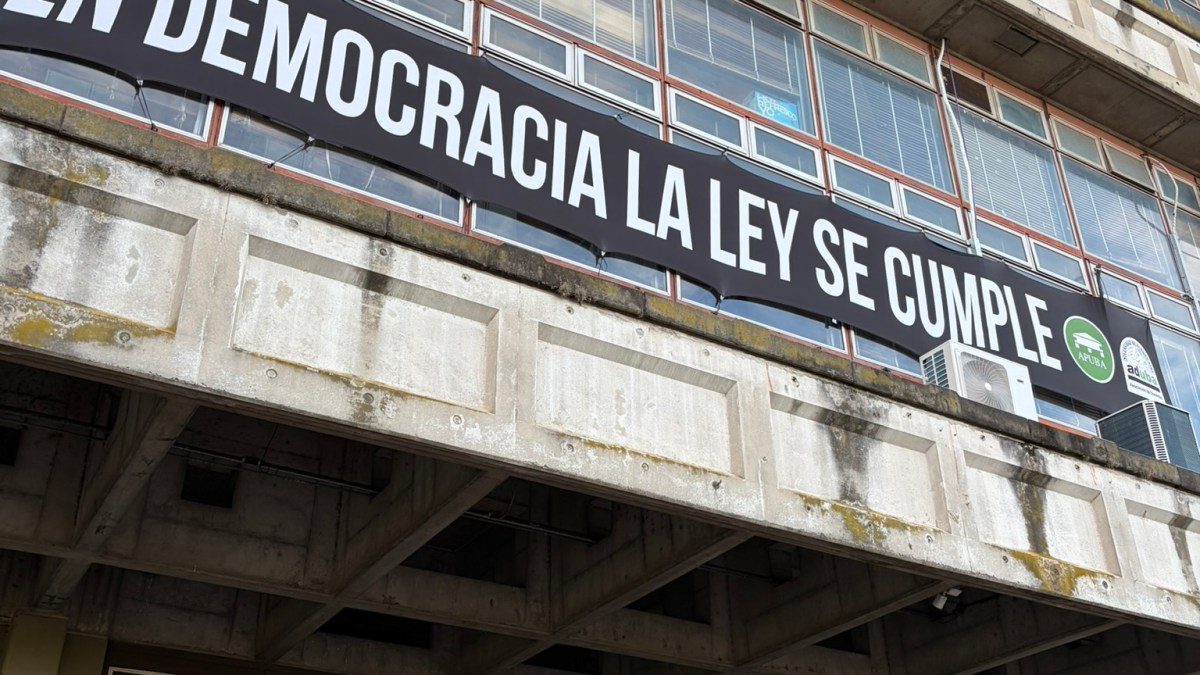

“This cannot go on!” students shout during an assembly in the middle of the central hall of the University of Buenos Aires Exact and Natural Sciences building.
It is part of Argentina’s prestigious public university system.
- list 1 of 3Milei says UN ‘looking the other way’ on Falkland Islands dispute
- list 2 of 3Argentina’s poverty rises to 32 percent under Milei with more pain forecast
- list 3 of 3Argentina’s Milei threatens legal action over Falklands oil project
end of list
The faculty’s central hall is covered with dozens of banners protesting President Javier Milei’s spending cuts. Students have called an assembly to announce the occupation of the university, a traditional form of protest in Argentina meant to raise public awareness and pressure the government.
They say they will take over the building for a day. Many students and professors here are concerned about the impact of Milei’s austerity policies on public universities and say the future of free higher education is at risk.

“Our best professors are leaving en masse. With salaries that cannot cover their basic needs, they are leaving for private universities,” Emiliano Gato, a physics student who is part of the group, told Al Jazeera.
“I dream of doing research and teaching at the public University of Buenos Aires. It’s a prestigious school. But now, with this austerity plan, I don’t know what will happen.”
Public universities in Argentina have become a major battleground of Milei’s austerity plan. Students and professors are protesting the lack of funding and the erosion of salaries, which they say is a major threat to the country’s public education.
Milei is implementing one of the harshest austerity plans in Argentina’s history.
Advertisement
Since taking office in 2023, he has laid off thousands of state employees, shut down ministries, reduced subsidies and cut government-funded programmes. The measures were meant to fight high inflation, which was a major problem in Argentina. Almost three years later, inflation has fallen to around 2 percent a month. Milei says his plan is going well.
“Argentina is growing at a remarkable pace. We have now recorded 27 consecutive months of sustained growth, and today the country is expanding at four times its historical rate. This growth is being felt across almost every sector of the economy,” said Milei during a recent visit to Washington.
But not everyone agrees. His plan is also having a profound impact on public education, welfare plans for people with disabilities, pensioners and others who depend on state support. The opposition has tried to block many of Milei’s reforms.
Last year, Congress overturned presidential vetoes and approved two laws, one increasing funding for public universities and another declaring a disability emergency. But Milei’s government has refused to implement them, arguing that Congress failed to identify how they would be financed.
A federal judge has now begun fining the government 100,000 pesos (around $70) a day for failing to implement parts of the financing law, which requires Milei’s government to restore university salaries and student scholarships lost to inflation, regularly update budgets and provide funding for research, hospitals and infrastructure.
And that’s why thousands of people took to the streets on Thursday to demand that the government implement it. All around Buenos Aires, long columns of people blocked the centre of the city as they called for a general strike. Although the protest was meant to be peaceful, it soon turned violent. Police fired tear gas and rubber bullets as protesters threw rocks.
The plaza in front of Congress resembled a battleground. At least 25 people were detained, and several others were injured, including members of the security forces.
Maria Teresa de Jesus is a professor in the University of Buenos Aires chemistry department. She says she makes around $700 a month and it has become difficult to make ends meet. “I have come to this protest as a last resort. I am professor. I love teaching, doing research. I shouldn’t be here,” she told Al Jazeera. “Public education is crucial in this country, to make education accessible to all. And the government is ignoring it.”
Many in Argentina continue to support Milei’s economic plan. They are hoping the government’s plan to exploit the country’s vast natural resources will pay off and translate into more jobs, higher wages and improved living standards.
Advertisement
But many others have stopped believing and are prepared to raise the stakes. They accuse Milei’s government of protecting the interests of a privileged few while asking the rest of the country to bear the cost of his economic plan.
Related News
Israel’s former security chief sues Netanyahu for October 7 defamation
‘Partial satisfaction’: Sri Lankans hail 2019 bombings ruling with a caveat
Rubio defends Trump’s White House ban on CNN, MS NOW and Politico