

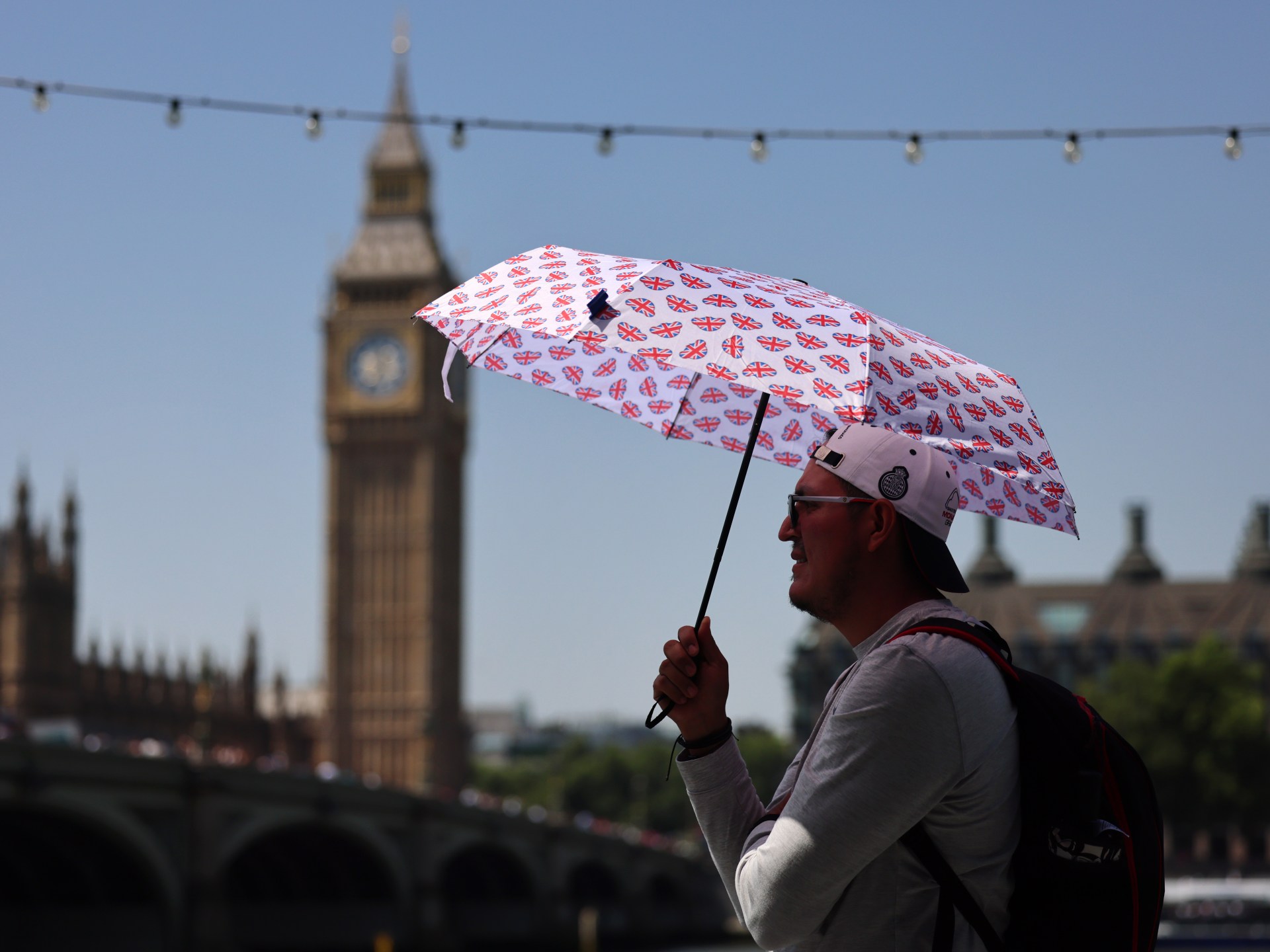

Last month was provisionally the warmest June in England since records began, as well as the second-warmest for the United Kingdom, according to figures published by the country’s Met Office.
Rare extreme heat warnings were issued for several days last month, with “exceptionally warm overnight temperatures”, the weather agency said on Wednesday.
- list 1 of 4‘London cooking’: Why can’t the UK cope with the heat; when will it adapt?
- list 2 of 4World’s oceans experience hottest June ever, scientists say more heat ahead
- list 3 of 4Heatwave scorches east Europe as Slovakia, Czechia see record temperatures
- list 4 of 4More than 1,300 deaths in Europe amid heatwave: What can countries do?
end of list
England registered an average temperature of 17.1C (62.78 degrees Fahrenheit) last month – the highest since records began in 1884.
“The exceptional warmth was driven by an intense and record-breaking heatwave at the end of the month,” the Met Office said in a statement.
The previous record of 16.9C (62.4F) was set in June 2025, nearly 3C (5.4F) above the long-term average. It means England’s top three warmest Junes since data began in 1884 have all occurred this decade, with the third being in 2023.
A punishing heatwave affected many parts of the country during the last week of the month, with temperatures topping 30C (86F) at some places in the UK for seven days in a row from June 21-27.
A peak of 37.7C (99.86F) was provisionally reached at Lingwood in Norfolk on June 26 – the highest maximum temperature ever recorded for the month.
This was more than 2C higher (3.6F) than the previous June record of 35.6C (96.08F), set in 1957 at Camden Square in London and equalled in 1976 at Mayflower Park in Southampton.
Last month also saw a provisional new June record for the highest overnight minimum, with temperatures at Cardiff Bute Park dropping no lower than 23.5C (74.3F) on June 25.
Advertisement
More than 1,000 schools and nurseries were closed during the heatwave, and there was disruption to public transport with overhead wires and signalling strained because of the heat.
Critics felt the country was ill-prepared to deal with the sweltering heat. Climate experts have urged the UK government to adapt its infrastructure to warming summers, with a surge in demand for fans and air conditioners, which remain rare in British homes.
The heatwave has also affected many countries in Europe, including France, Germany, Slovakia, Serbia, Croatia, Italy, Austria and western Ukraine, with more than 1,000 deaths linked to the scorching heat reported in France alone.
A group of scientists blamed climate change for the dangerous weather blazing across Europe. In a report by the World Weather Attribution, experts warned that the phasing out of fossil fuels is essential to reverse the extreme weather trend.
Related News

Two civilians killed in Houthi strike on Marib, says Yemen’s government

J&J offers $5.5bn settlement in lawsuits claiming talc link to cancer

France and Spain brace for heatwave that could worsen raging wildfires