History’s biggest census: Why India’s new population count is controversial
 01 April 2026
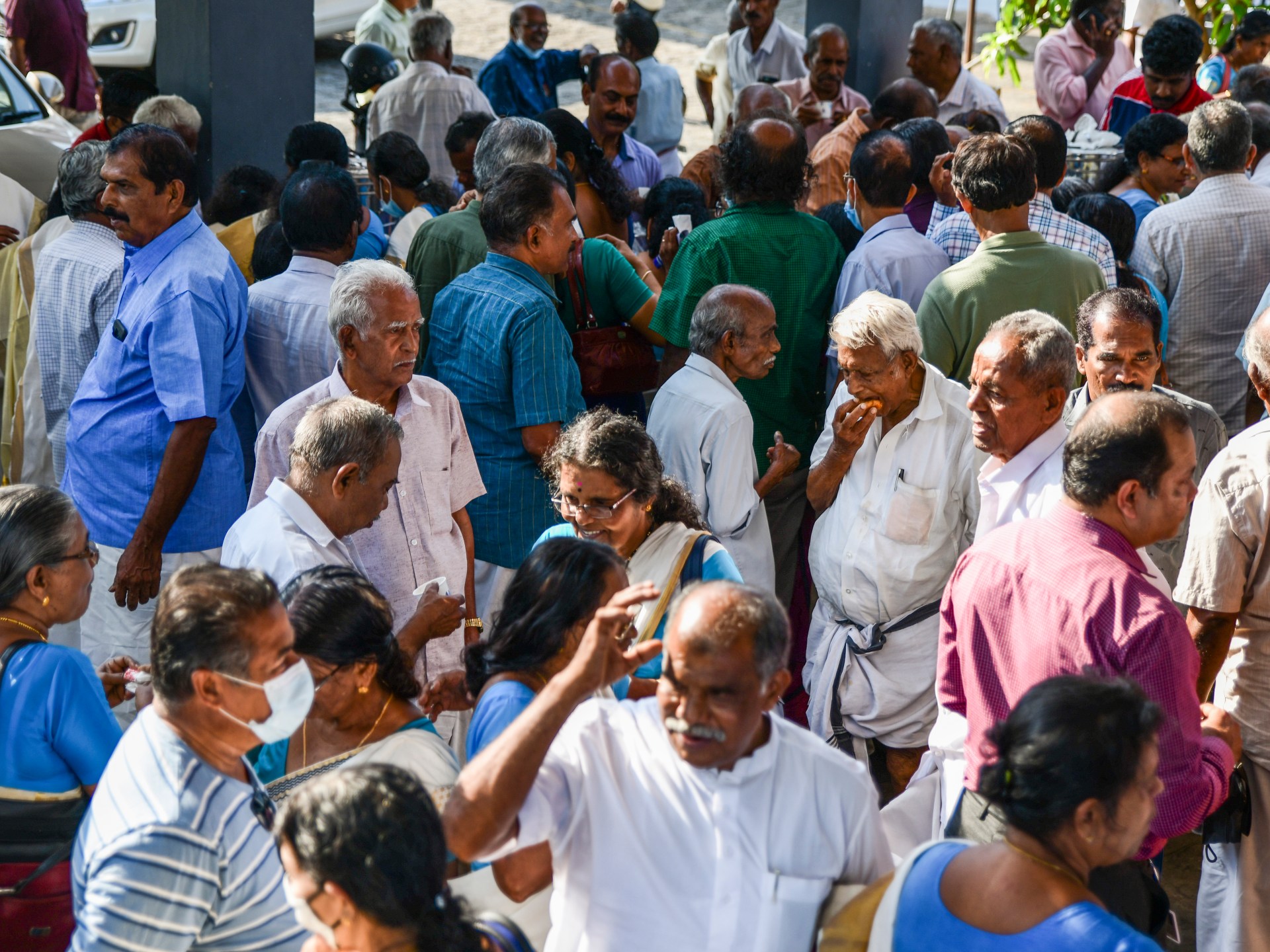

India has begun counting its population in the world’s largest census, which will include caste enumeration for the first time in nearly a century.
This year’s census is a $1.24bn exercise during which more than three million Indian officials will spend a year surveying about 1.4 billion Indians about their household composition, living conditions and access to basic amenities.
- list 1 of 3IPL: 15‑year‑old Sooryavanshi tears apart Chennai with 15‑ball fifty
- list 2 of 3‘Gerrymandering’ in India’s Assam cuts Muslim representation before vote
- list 3 of 3India begins world’s largest population census
end of list
The last census was conducted in 2011. Another one was due in 2021, but it was delayed due to the COVID-19 pandemic, leaving India’s data on such things as its demographics, housing conditions and welfare amenities outdated.
How will the gargantuan task of counting more than a billion people spread out across a vast country be carried out, and why is the latest census being watched particularly closely?
Here’s what we know:
How will India’s census take place?
According to the Press Information Bureau, India’s first modern census was conducted from 1865 to 1872 during the British colonial period, but it did not happen simultaneously across all regions of the country. It was only in 1881 that India conducted its first coordinated census.
After independence in 1947, India conducted its first census in 1951.
The census this year, which is the eighth since independence, will take place across the country’s 28 states and eight union territories (federally run territories), which include more than 7,000 towns and 640,000 villages.
For the first time, the census will be conducted digitally. Its 30 million enumerators will use digital tools like mobile applications on smartphones to collect and submit data by asking people 33 questions. Individuals will also have the option to self-enumerate through an online portal and then receive a unique digital ID, which can be submitted to the officials collecting data.
Advertisement
The census will take place in two phases.
At a news conference in India’s capital, New Delhi, on Tuesday, Registrar General and Census Commissioner Mritunjay Kumar Narayan said the first phase of the census begins on Wednesday and will continue until September.
During this phase, known as the House Listing and Housing Census, people will be asked “How many people live in your house?” “Do you own the house?” and questions linked to the household’s access to basic amenities like fuel, water, electricity, internet and transport.
The second phase, known as the population enumeration phase, will take place in February and will focus on gathering socioeconomic details and information on education, migration and fertility. Caste enumeration will take place in this phase.
The census is scheduled to conclude next year on March 31.
Why is a census important?
Dipa Sinha, a development economist who works on social policy, said that along with counting the number of people in the country, a census shows demographic trends.
“It also tells us the distribution between rural and urban areas. It gives broad demographic structure,” she told Al Jazeera, adding that details of people’s occupations and religions are also collected in census surveys.
She said such information helps governments plan policies and citizens to claim their rights. Census data also form the basis for allocations under antipoverty programmes, she noted.
Sinha added that India’s latest census is drawing particular attention because the government is planning a delimitation exercise, which is basically redrawing the boundaries of electoral constituencies based on population.
Politicians in southern India, where population growth has been stalling, have raised concerns that if delimitation is done purely based on population size, then northern India, where most of India’s population is located, will get outsized political representation. The bulk of representation in the Indian Parliament already comes from the north, which has been a source of north-south tensions.
“So given that the population has grown at very different places in different parts of the country, the information from this census could become highly politically relevant,” Sinha said.
In addition, “the government has passed a women’s reservation bill last year, which says that once the new census is in place and the delimitation is done, the country would have one-third reservation for women in the parliament. So all of this makes the census something that has an impact,” she added.
Advertisement
How has India’s census evolved?
When India’s census was carried out under British rule, questions mainly focused on registering household data, such as the number, age and gender of residents, their caste and religion. How proficient a person was in the English language was also part of the data collected in the census then.
Postcolonial India’s census has evolved to include questions not only about individuals’ identities but also to assess their socioeconomic status and living conditions.
In 1971, according to the Press Information Bureau, the census also tracked internal migration by collecting data on people’s last place of residence, which provided crucial insights into India’s population movement patterns.
Details on employment, disability and fertility status were standard questions in the 2011 census.
This year, questions on couples’ relationship status have also been included. Couples in a live-in relationship will be counted as married “if they consider their relationship as a stable union”, according to the census portal.
Government officials blamed the five-year delay in the census initially on the COVID-19 pandemic and later on administrative issues.
Experts said the delay has left significant data gaps. Ashwini Deshpande, an economist at Ashoka University, argued the census matters beyond what it directly measures.
“Since it is a full enumeration of the entire population, all large-scale surveys – which, by design, capture only a subset of households – rely on the census as their sampling frame,” she told Al Jazeera.
She explained that a sampling frame is essentially the master list from which survey samples are drawn and, if that list is outdated, surveys risk being unrepresentative in ways that are difficult to detect or correct.
“With India’s last census now well over a decade old, every major survey conducted in this period is working off a frame that no longer reflects the population it is meant to represent. That is not a minor technical inconvenience. It introduces systematic errors into the data that policymakers, researchers and planners depend on,” she said.
Sinha noted that the delay in conducting the census has also meant there is a lack of information on India’s demographics at a time of rapid economic and political changes.
Why is this year’s census controversial?
Besides being delayed, this year’s census has been marred by controversy over the resistance by Prime Minister Narendra Modi’s government to include questions on caste.
Comprehensive caste data have not been collected since 1931, and India completely stopped the caste census in 1951 to prevent what the government at the time said was “social divisions”.
Limited information continued to be collected about Scheduled Castes (SCs) and Scheduled Tribes (STs), the caste groups located on the lowest rung of the caste hierarchy. This was recorded through the National Sample Survey. The SCs, or Dalits, are communities often excluded from the larger society under the traditional caste hierarchy while STs are tribal communities.
Advertisement
Some states have also carried out a caste census to gather information about poverty rates, education levels and employment of marginalised communities to enable policy-making.
Modi’s Bharatiya Janata Party (BJP) has historically opposed caste enumeration in the census, saying it believed it would create further divisions in society. In an interview with News 18 India in 2024, Modi said people demanding a caste census thought like “urban Naxals”. Naxals are mostly members of far-left and tribal groups that have waged armed rebellion against exploitation of their resources and militarisation.
However, in May, the government announced caste enumeration would be included in the census after pressure from campaigners and caste groups.
The process will take place in the second phase of the census and will involve asking every individual their caste rather than simply recording whether someone belongs to an SC or ST as previous censuses have done.
“This would be the first systematic, population-wide count of jati [caste] since 1931, which makes it a genuinely historic – and deeply contested – exercise,” Deshpande, the Ashoka University economist, said.
She noted that the debate for including caste enumeration is split along a familiar fault line.
“Those in favour argue that without granular caste data, we are essentially flying blind. We cannot assess how resources, opportunities and deprivations are actually distributed across the caste hierarchy, nor can we design or evaluate policies with any precision. If caste continues to shape life outcomes – and the evidence strongly suggests it does – then not counting it is a political choice masquerading as neutrality,” she said.
“Those opposed argue the reverse, that enumerating jati will harden identities, entrench divisions and give caste an official permanence it might otherwise gradually lose,” she noted, adding that the opposing camp’s concern is that the state, by cataloguing every subcaste, lends caste a kind of bureaucratic legitimacy that “deepens rather than dissolves social cleavages”.
“What makes this particularly fraught is that the debate is not just academic. It has direct implications for reservations policy, political representation and the ongoing legal battles over OBC subcategorisation,” she added, referring to Other Backward Classes, the bureaucratic categorisation of Hindus from unprivileged castes.
“The census, in other words, is not merely a measurement exercise. It is a political one.”
Why is including caste important in the census?
India’s caste system, which came into existence thousands of years ago, divided society into privileged and unprivileged castes, whose privileges and rights are based on one’s birth. A person born in an unprivileged caste can never rise to become a member of a privileged caste. For thousands of years, unprivileged people were seen as impure and were called “untouchables”.
In the 1950s, the Indian Constitution banned discrimination based on caste and announced reservation quotas in jobs and education for people from traditionally disadvantaged communities.
But analysts said discrimination has continued, making it important to carry out caste enumeration in the census.
“The number of disadvantaged groups in the country are plenty and diverse, and each of their problems are different,” Sukhadeo Thorat, an emeritus professor at Jawaharlal Nehru University in New Delhi, told Al Jazeera.
“They suffer from social discrimination and exclusion. Some of them are denied property rights, business ownership and education for several years. The people belonging to Indigenous tribes, they suffer from physical and social isolation and prejudice. Religious minority groups like Christians and Muslims are also facing problems of discrimination and undermining of their religious rights,” Thorat said.
Advertisement
“So in order to develop and identify every group’s specific problem and address it, you need data, and that can only come through a caste census,” he added.
Independent researcher Yashwant Zagade added that a caste census will also determine how privilege works in India.
“The government has institutionally made marginalised communities in India invisible. We have no knowledge of the kind of privileges they get to enjoy compared to people from upper castes or no information of what their social status is. This is why it is important to carry out a separate caste enumeration,” he told Al Jazeera.
While the government has revealed the 33 questions that people will be asked in the first phase of the census, it remains unclear what sort of questions they will be asked as part of the caste enumeration process in February.
Thorat, who was the first Dalit to head the body that governs universities in India, said that based on the caste censuses carried out by states like Telangana and Bihar, the questions would largely be confined to an individual’s socioeconomic status, education and wealth.
However, he stressed that questions focusing on discrimination, such as whether people experience untouchability, should be included.
“In order to understand to what level this practice of untouchability and caste discrimination is carried out today, the census should include this question of discrimination in a detailed manner,” he said.
He added that instead of asking each social group a standard set of questions, specific questions should be framed for each group to understand their individual problems.
There are worries about how the census will be used due to the BJP government’s pledge to implement a National Register of Citizens (NRC), which would contain the names of Indian citizens and is meant to identify and deport undocumented immigrants.
It has been implemented so far only in the northeastern state of Assam, where nearly two million people, including Hindus and Muslims, were left off the citizenship list published in August 2019. The BJP has declared its intent to implement the NRC nationwide.
Modi’s government has also implemented the Citizenship Amendment Act (CAA) in 2024, which fast-tracks citizenship for non-Muslims. Rights groups say making faith as a basis for citizenship is against the spirit of India’s secular constitution.
“The census would be something that would be linked to citizenship, which has not happened in the past,” Sinha, the development economist, said, adding that people impacted by the CAA would now be particularly concerned about how the census might be used to determine their citizenship.
Critics have accused the right-wing government of weaponising the CAA and NRC to target Muslims and said hundreds of Muslims were unlawfully deported to Bangladesh last year. “India’s ruling BJP is fuelling discrimination by arbitrarily expelling Bengali Muslims from the country, including Indian citizens,” Elaine Pearson, Asia director at Human Rights Watch, said in July.
Several BJP leaders have called Muslims, who are 14 percent of India’s population, a threat to India and falsely claimed that Muslims will overtake India’s Hindu population in the next decade.
There are also concerns about how data from the census will be used.
“There has been an issue on data credibility in the last decade,” Sinha said, “and that has also a lot to do with two things. One is that there has been a lack of transparency, so oftentimes, data is not shared or some data is trashed out because they suddenly declare that the quality is not good without giving enough justification.”
“Secondly, there have been frequent changes in methodology and sampling,” she said.
She called for the census to be conducted through an act of parliament with full transparency and defined methodologies.
“When the census is governed by an act of the parliament, one hopes that that will not be distorted in any way because there are checks and balances in general,” Sinha added.
Related News
Iran launches waves of missiles towards Israel
Trump attempts to distance US from Israeli strikes on key Iranian gasfield
What’s Israel’s death penalty law that only applies to Palestinians?