
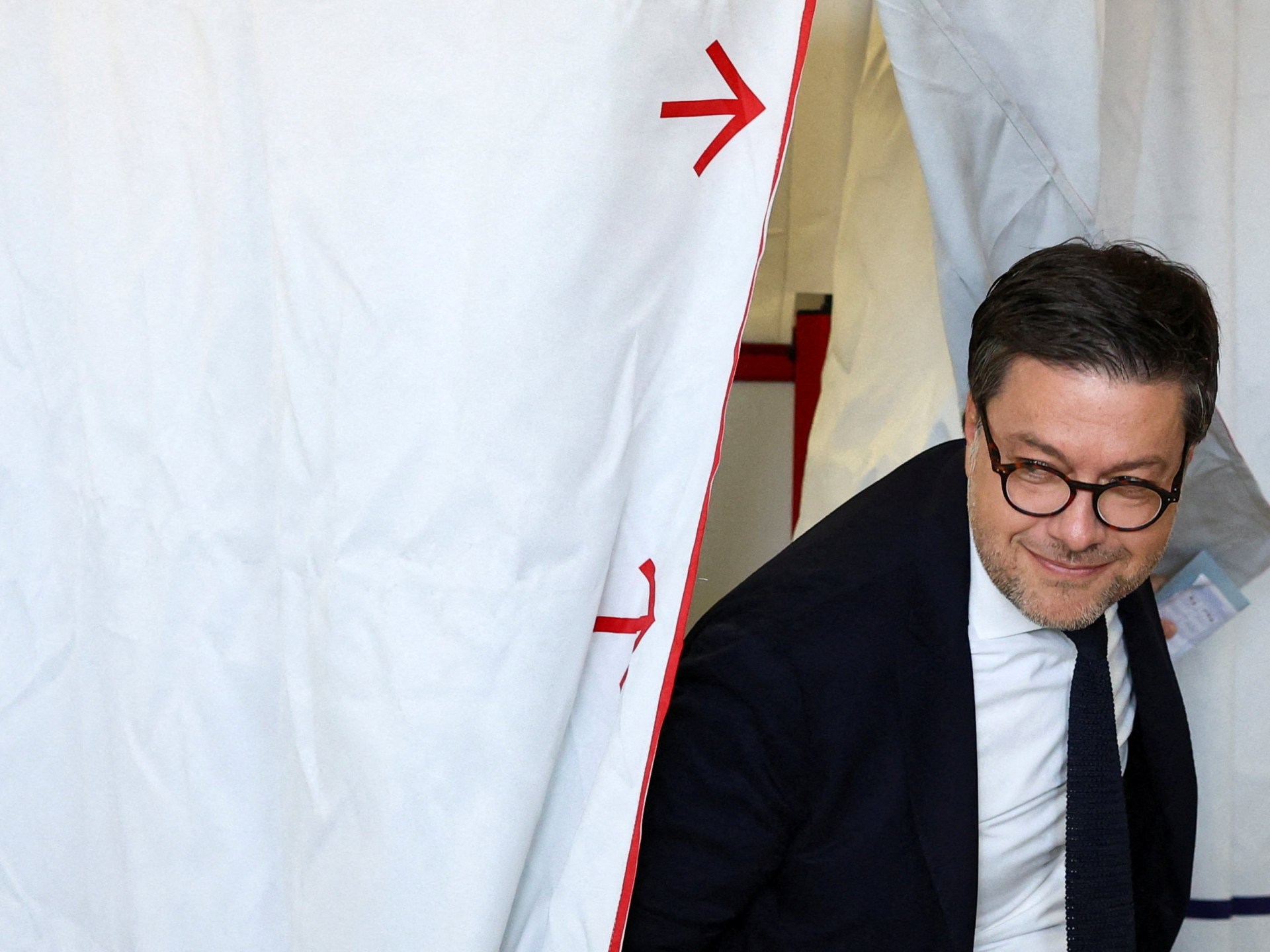

Paris, France – France heads to the polls on Sunday for local elections to usher in mayors and city council members, in a final round of voting.
The municipal elections, which come a year before France’s presidential vote, offer a glimpse of the country’s political landscape.
- list 1 of 4France arrests nine over far-right activist’s killing
- list 2 of 4France to increase nuclear warheads, lend nuclear aircraft to Europe allies
- list 3 of 4Europe’s hard right fractures over US-Israel war on Iran
- list 4 of 4Macron prepares France for ‘an age of nuclear weapons’ as Iran war rages
end of list
The first round on Sunday showed France’s far-right party, the National Rally, performing slightly less well than predicted. But it still made gains in key southern cities, including Nice, Toulon and Marseille.
“The results are worse than expected for the National Rally, and the far right in general, because their goal was to establish a foothold and win medium-sized cities, to scale up, but that doesn’t seem to be happening,” Jean-Francois Poupelin, a journalist at Marsactu in Marseille, told Al Jazeera.
“On the other hand, they’ve already increased the number of municipalities they will run, compared to 2020.”
In the last mayoral race, the far right held a majority in 17 municipalities. Sunday’s results indicate victories in 24 municipalities. Far-right parties are also leading in 60 other municipalities.
Nice and Toulon are the two largest cities that look poised to elect far-right mayors.
‘We might be in for a few unpleasant surprises’
In Marseille, incumbent mayor Benoit Payan is locked in a run-off with far-right National Rally candidate Franck Allisio.
“We might be in for a few unpleasant surprises,” Poupelin said. “We might see major cities like Nice and Toulon swing the other way. Since [left-wing party France Unbowed] LFI recently withdrew in Marseille, we’re hoping the city won’t swing right.”
Advertisement
Abstention is another big headline.
Voter turnout in the first round was 57 percent, the second-lowest in the history of France’s Fifth Republic, after the 2020 election, which was affected by the COVID-19 pandemic, according to data from the Ministry of the Interior.
In Marseille, “voter turnout was low, especially in working-class neighbourhoods … where [left-wing party France Unbowed] LFI expected to do much better”, said Poupelin. “Abstention will be a key issue in both the second round of the municipal elections and the presidential election, because voter abstention generally works in the National Rally’s favour.”
Baptiste Colin, a 31-year-old theatre production assistant in Marseille, told Al Jazeera, “A lot of people around me didn’t vote. There’s a lack of interest.”
“Many didn’t understand these elections because there were new rules. For example, in Marseille, we had to vote for the arrondissement mayor and then for the city mayor. Second, with the National Rally’s strong showing in the polls, people felt like they already knew the results.”
For Colin, the close mayoral race is concerning.
“I’m obviously a bit alarmed, especially in Marseille, by the rise of the National Rally, because these are real, significant gains,” Colin said. “The far right is effectively becoming the new right.
“Marseille is a classic example of this, where the centre-right, which used to be strong, is now collapsing, handing all its votes over to the National Rally.”

The traditional right is disintegrating across much of France, said Rim-Sarah Alouane, legal scholar and an associate researcher in public law at the University Toulouse Capitole.
“My main concern is the normalisation of the far right with the traditional right,” Alouane told Al Jazeera. “We are witnessing an evolving relationship between the traditional right-wing party and the far right. In several municipalities, the results suggest a growing permeability between these two political spaces.
Although voters have different considerations for municipal elections and presidential votes, the results so far speak to larger trends in France’s political landscape.
“The 2026 municipal elections, we can widely interpret as an early test before the next presidential cycle. The first round of results shows a political system in transition, fragmented and territorially polarised. No single political force appears capable of dominating the national arena,” Alouane said.
Advertisement
“The first round of the elections does not simply reflect local dynamics. It reveals deep transformation within the French party system itself, and clearly offers some sort of early indication of the political reconfiguration that may shape national politics in the year to come.”
Although the far right did not achieve the massive gains that some feared, Alouane said gradual victories should still raise alarm bells.
“The far right is slowly but very surely gaining more and more voters. Whether they are voting out of conviction or to vote against someone, they are now part of the landscape,” she said. “It’s not an atomic victory, but that’s how they progress. They don’t do it all at once. It’s step by step, and their strategy is working quite well.”
When the far right does cement a hold in a municipality, they tend to stay in power for years.
“Once they’re in power, they stick around – at least in the south, but it’s similar in the north. It’s very difficult to dislodge them because their policies are very focussed,” Poupelin said.

The far right usually governs with a focus on tax cuts, public safety and reducing subsidies for “communitarian” organisations, according to Poupelin, who analysed the administrative accounts of 10 municipalities in southeastern France to see how funding for local organisations is distributed when the far right is in power.
Organisations focused on working-class neighbourhoods, vulnerable populations, and immigrants are often targeted, he said.
“Social services tend to shrink significantly, and in some cases disappear, in those cities,” Poupelin said. “In Frejus, for example, community centres have gradually closed.”
When social centres for young people disappear, it negatively affects the whole neighbourhood.
“These were kids who no longer had any places to meet up or to play, so they stayed outside, which inevitably led to misbehaviour and other issues. So, we see a lost generation in those neighbourhoods,” Poupelin said.
As Colin votes again on Sunday, he retains some optimism despite the close race in Marseille.
“There’s still a glimmer of hope that it’s not a total loss. There are still some gains on the left,” Colin said.
For once, he hopes it will rain in the southern city and draw more people away from the sea and to the polls.
“The weather wasn’t great last weekend, which actually encouraged people to go vote instead of going to the beach,” Colin said. “I hope it doesn’t turn out to be nice on Sunday either, so people do the same.”
Related News
Israel denies women in Gaza ‘conditions to live’: Amnesty
How targeting of desalination plants could disrupt water supply in the Gulf
Afghanistan says children among four killed in latest attacks by Pakistan