

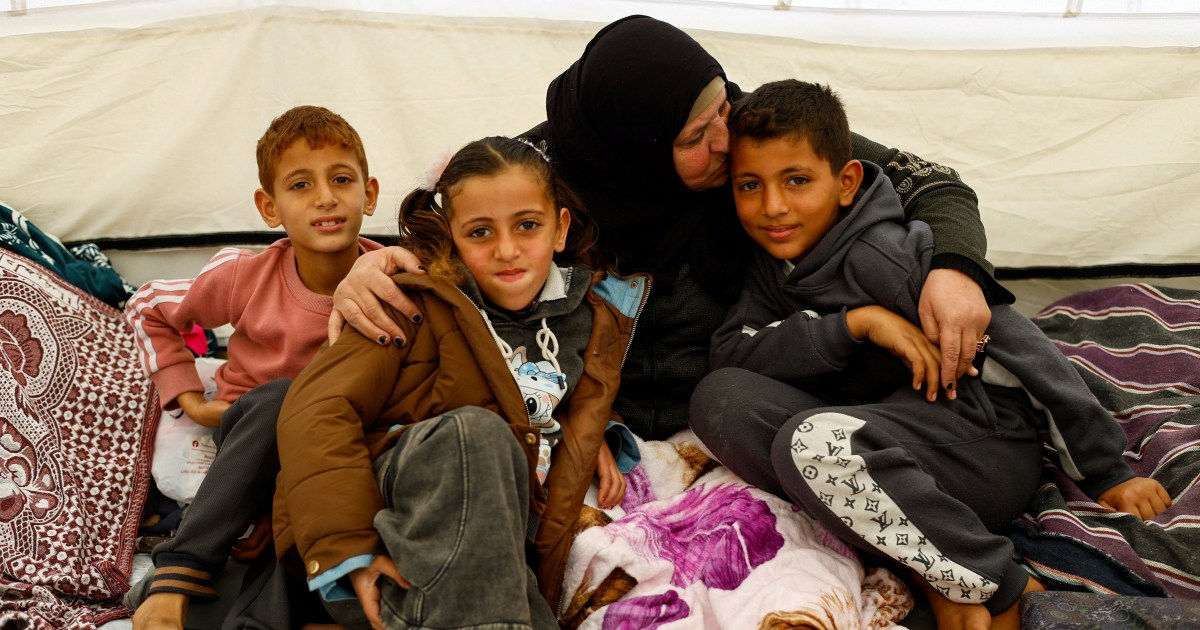

Palestinian women have described a “journey of horror” as they passed through the Rafah border crossing on their way home to Gaza from Egypt, with the few allowed to enter the war-torn territory being separated from their children, handcuffed, blindfolded, and interrogated “under threat” for hours.
For the 12 Palestinian women and children allowed to enter Gaza through the Rafah crossing on Monday, the journey back home was “long and exhausting, marked by waiting, fear and uncertainty”, Al Jazeera’s Ibrahim Al Khalili said, reporting from Khan Younis in southern Gaza.
- list 1 of 4UN chief urges Gaza aid as Israel blocks most medical evacuees at Rafah
- list 2 of 4UN welcomes reopening of Gaza’s Rafah border with Egypt
- list 3 of 4Relief for patients leaving Gaza as Rafah opens, but thousands still wait
- list 4 of 4Israel reopens Rafah crossing but continues bombing Palestinians
end of list
The small group of returnees was subjected to harsh security procedures by Israeli forces who hold the power at the Rafah crossing to determine “when and if” people will be allowed to return to their homes in the Palestinian territory, Al Khalili said.
“They took everything from us. Food, drinks, everything. Allowing us to keep only one bag,” said one of the returnees, speaking to Al Jazeera about her ordeal at the hands of the Israeli military on Monday.
“The Israeli army called my mother first and took her. Then they called me, and took me,” the woman said.
“They blindfolded me and covered my eyes. They interrogated me in the first tent, asking why I wanted to enter Gaza. I told them I wanted to see my children and return to my country. They tried to pressure me psychologically, wanted to separate me from my children and force me into exile,” she said.
“After questioning me there, they took me to a second tent and asked political questions, which had nothing to do with [the journey]… They told me I could be detained if I didn’t answer. After three hours of interrogation under threat, we finally went on the bus. The UN received us; then we headed to Nasser Hospital. Thank God we were reunited with our loved ones,” she added.
Another member of the group, Huda Abu Abed, 56, told the Reuters news agency that passing through the Rafah border “was a journey of horror, humiliation and oppression”.
Advertisement
Accounts of being blindfolded, handcuffed and interrogated for hours by Israeli forces were given to reporters by three women, Reuters said.
Some 50 Palestinians had been expected to enter the enclave on Monday, but by nightfall, only 12 – three women and nine children – had been allowed through the reopened crossing by Israeli authorities, Reuters said, citing Palestinian and Egyptian sources.
Worse still, of the 50 people waiting to leave Gaza on Monday, mostly for critical medical treatment, only five patients with seven relatives escorting them managed to clear the Israeli inspections and cross into Egypt.
On Tuesday, just 16 more Palestinian patients were allowed to cross into Egypt via Rafah, Al Jazeera’s Hind Khoudary said, reporting from Khan Younis.
The numbers being allowed to cross at Rafah are far below the 50 Palestinians who Israeli officials said would be allowed to travel in each direction via the crossing every day, Khoudary said.
“There is no explanation as to why crossings are being delayed at Rafah,” Khoudary said. “The process is taking an extremely long time.”
“There are about 20,000 people waiting [in Gaza] for urgent medical attention abroad,” she added.
Related News
US, Iran exchange threats of broadscale war in latest sabre rattling
ASEAN does not recognise Myanmar’s elections ‘as of now’: Philippine FM
US envoys meet Netanyahu as Israel continues to bomb Gaza