
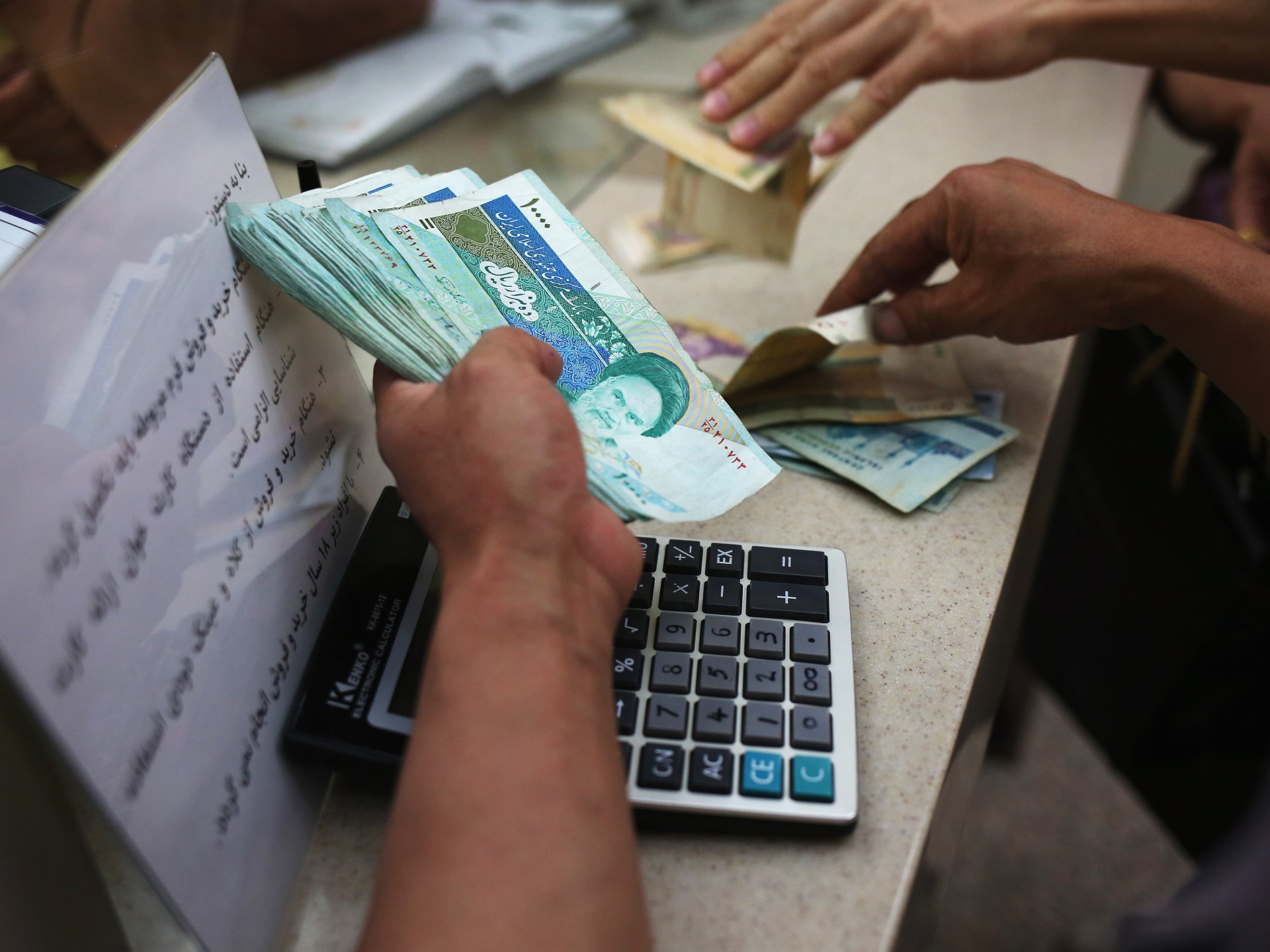

Iran’s currency has dropped to a record 1,500,000 rials to the US dollar, according to several Iranian currency tracking websites, weeks after protests sparked by the rial’s dwindling value rocked the country.
Exchange shops on Tuesday offered the record-low rial-to-dollar rate in Tehran, deepening the economic hardship for large swaths of the Iranian populace suffering from decades of extensive economic mismanagement and international sanctions.
- list 1 of 3Envoys from US meet Netanyahu as Israel continues to bomb Gaza
- list 2 of 3US military moves Navy, Air Force assets to the Middle East: What to know
- list 3 of 3Rubio speaks to Iraqi PM al-Sudani amid tensions with Iran
end of list
Iran’s newly appointed Central Bank Governor Abdolnaser Hemmati said that “the foreign exchange market is following its natural course.”
This latest dip comes nearly a month after shopkeepers in Tehran’s Grand Bazaar shut their stores in protest against the falling value of the rial, hyperinflation and a government decision to end certain food and fuel subsidies.
The demonstrations that began in the capital on December 28 quickly spread across the country, with protesters demanding political change. They were met by a violent crackdown by Iranian security forces, the scale of which is only starting to become clear as the country faced more than two weeks of internet blackout – the most comprehensive in its history.
Iran’s government said at least 3,117 people were killed in the unrest, saying 2,427 were civilians and security forces, and labelled the rest “terrorists.”
The US-based Human Rights Activists News Agency, which verifies each death with a network of activists in Iran, put the death toll at 5,777 protesters, 214 government-affiliated forces, 86 children and 49 civilians who were not participating in the demonstrations.
Advertisement
Iranian state media accused forces abroad of escalating the protests as Tehran remains unable to address the country’s ailing economy, squeezed by international sanctions over its nuclear programme.
Economic instability has also been fuelled by spiralling tensions with the US and Israel. US President Donald Trump on Tuesday said the situation with Iran was “in flux” after he ordered what he described as a “big armada” to the region.
On Monday, the USS Abraham Lincoln, and the guided missile destroyers accompanying it, entered the US Central Command’s “area of responsibility”, marking a significant escalation in the US military posture near Iran.
Two Iranian-aligned armed groups in the Middle East have signalled their willingness to launch new attacks, likely trying to back Iran after Trump threatened military action over the killing of protesters. Gulf Arab states said they want to stay out of any attack, despite hosting US military personnel.
At the same time, Trump stressed diplomacy remains an option. “They want to make a deal. I know so. They called on numerous occasions. They want to talk.”
Top Iranian military figures have reiterated the country’s readiness to engage in another war with Israel and the US in case of an attack similar to June’s 12-day conflict, while the Ministry of Foreign Affairs has promised a “comprehensive and regret-inducing response”.
Related News
Palestinian students strike as Israel bans access to West Bank teachers

Greenland hit by power outage, strong winds in wake of US tensions easing
Iran accuses foreign intelligence behind protest movement