
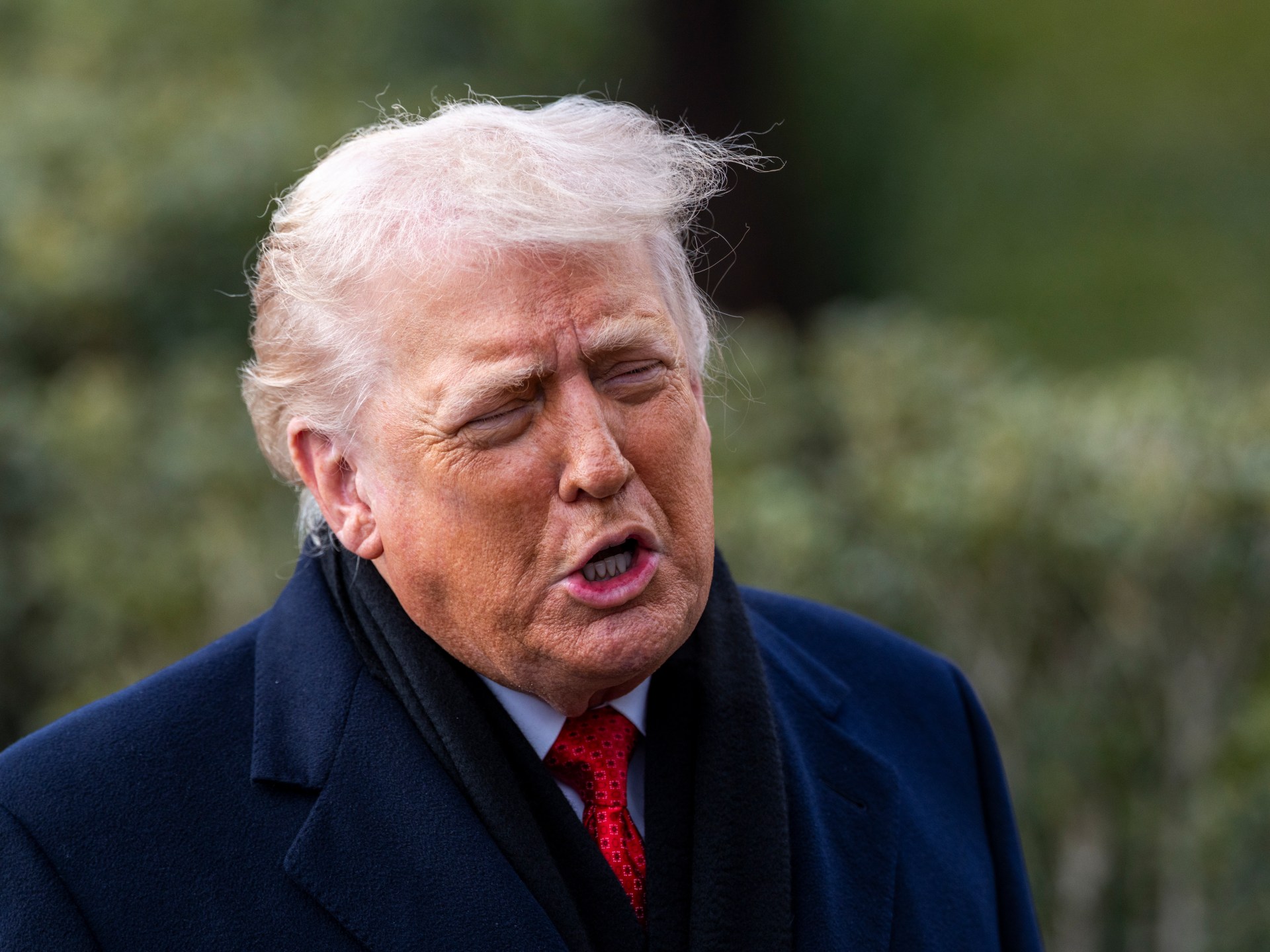

United States President Donald Trump has begun to invite world leaders and other prominent figures to be part of his so-called “board of peace“, reportedly outlining a wider vision for a long-term body that responds to global conflicts beyond Gaza.
Trump had initially unveiled the board as part of phase two of a ceasefire agreement between Israel and Hamas to end Israel’s genocidal war on Gaza, envisioning that the body would oversee “governance capacity-building, regional relations, reconstruction, investment attraction, large-scale funding, and capital mobilisation” in the enclave.
- list 1 of 3‘Easy way or hard’: Trump issues new demand for Hamas demilitarisation
- list 2 of 3Scepticism and hope: Gaza reacts to Trump’s ‘Board of Peace’
- list 3 of 3Trump names Tony Blair, Jared Kushner to Gaza ‘Board of Peace’
end of list
But letters written by Trump, which were posted to social media on Saturday by two leaders invited to be part of the board – Argentinian President Javier Milei and Paraguay’s leader, Santiago Pena – pointed to wider ambitions. A so-called “charter” that accompanied the letter also pointed to loftier goals, according to several reports.
In Trump’s letter to Milei, the US president said the board would seek to “solidify Peace in the Middle East”, adding that it would “embark on a bold new approach to resolving Global Conflict” at the same time.
The Financial Times, meanwhile, quoted the accompanying “charter” as saying that “the Board of Peace is an international organisation that seeks to promote stability, restore dependable and lawful governance, and secure enduring peace in areas affected or threatened by conflict”.
“Durable peace requires pragmatic judgment, common sense solutions, and the courage to depart from approaches and institutions that have too often failed,” said the charter, which did not directly reference Gaza, according to the newspaper.
Advertisement
Two diplomatic sources also told the Reuters news agency that the invitations included a “charter” that outlined a wider mandate for the body.
“It’s a ‘Trump United Nations’ that ignores the fundamentals of the UN charter,” one diplomat aware of the letter told the news agency,
A senior US official, meanwhile, told The Associated Press news agency that an expanded role for the board of peace remains “aspirational”.
The official added that Trump and his advisers believe such a role is possible, particularly as Washington and other UN members have repeatedly expressed frustration with the international organisation.
However, the official said the board of peace was not intended to replace the UN.
To be sure, the Trump administration has so far publicly said that the board of peace will initially focus on Gaza.
On Friday, Trump announced that Tony Blair, the United Kingdom’s former prime minister, would be among the board’s founding executive members, alongside Trump’s son-in-law, Jared Kushner, US Secretary of State Marco Rubio and the US special envoy to the Middle East, Steve Witkoff.
Also initially announced were Marc Rowan, the CEO of Apollo Global Management, World Bank Group President Ajay Banga, and Robert Gabriel, a US deputy national security adviser.
Many of those figures were also named to a separate “Gaza executive board”, which is set to oversee a technocratic committee of Palestinians expected to handle day-to-day governance in Gaza in lieu of Hamas.
The 11-member executive board includes Blair, Kushner and Witkoff, as well as Turkish Minister of Foreign Affairs Hakan Fidan, Qatari diplomat Ali Al Thawadi, UN Middle East peace coordinator Sigrid Kaag, United Arab Emirates Minister of State for International Cooperation Reem Al-Hashimy, and Israeli-Cypriot billionaire Yakir Gabay.
Beyond Argentina’s Milei and Pena, Turkiye and Egypt have confirmed their respective leaders, Recep Tayyip Erdogan and Abdel Fattah el-Sisi, have been invited to join the wider board of peace. A European Union official said that European Commission President Ursula von der Leyen had also been invited to represent the EU.
Four sources told Reuters that the leaders of France, Germany, Australia and Canada were also invited to sit on the board, although there was no official confirmation.
The White House said it would announce more members in the coming weeks.
Still, the initial announcement of board members sparked outrage among many in the Middle East for not including any Palestinians, but instead elevating staunch supporters of Israel.
Advertisement
Israeli Prime Minister Benjamin Netanyahu, meanwhile, raised opposition to the Gaza executive board on Saturday, saying its composition “was not coordinated with Israel and runs contrary to its policy”.
A statement from Netanyahu’s office did not specify what exactly it opposed about the board’s makeup.
Related News

How volatile is the situation in Iran?
Israeli strikes kill two in Lebanon, UN forces report drone attack
Uganda faces mounting calls to end internet blackout before elections